Source: Wikimedia Commons
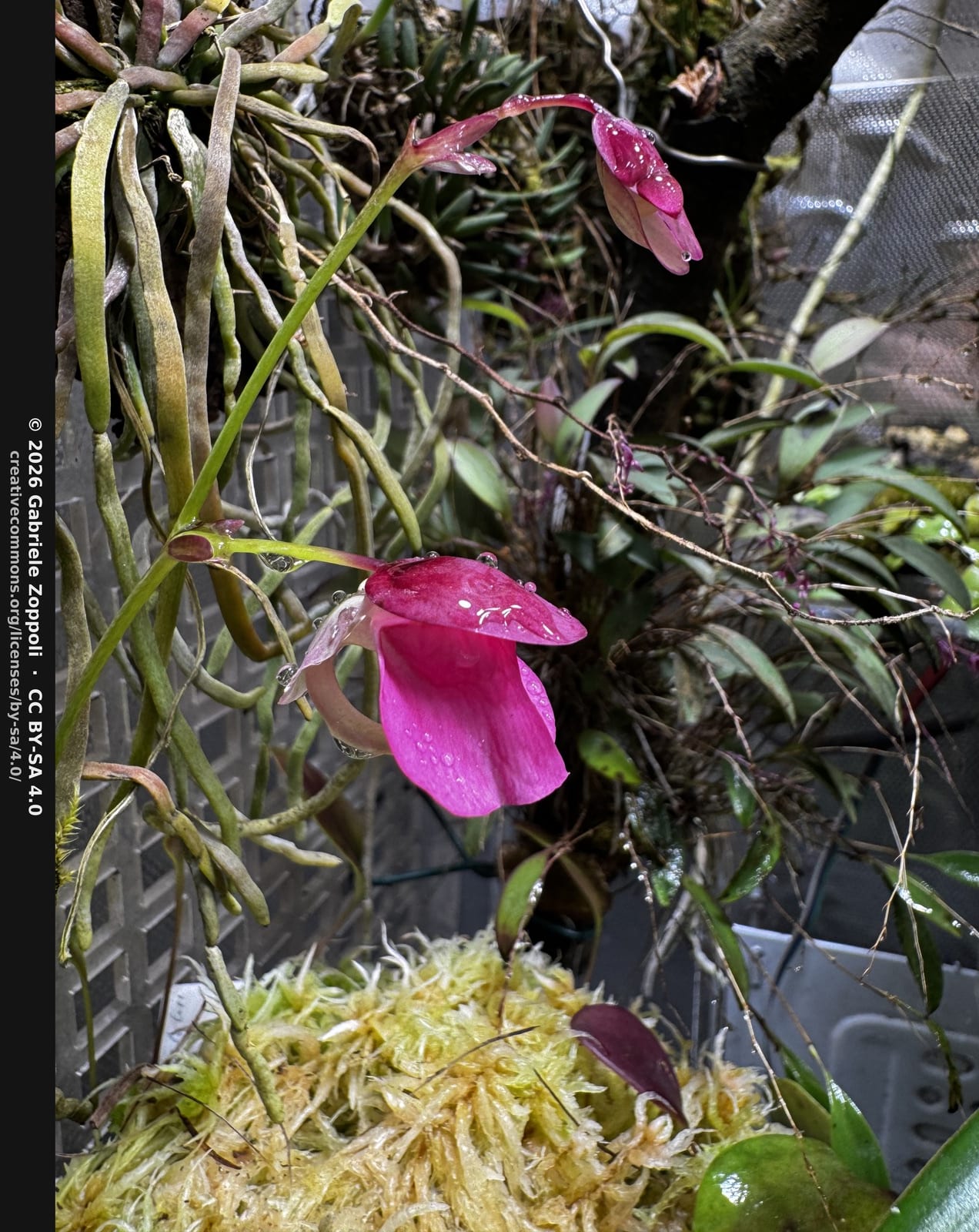
Utricularia quelchii
AdvancedUtricularia quelchii
A small bladderwort growing on mossy rocks and trees on the Guiana Highlands. It is one of the few red-flowered species in the genus, and sometimes grows in water held in the leaf axils of Brocchinia.
About
Utricularia quelchii is a small perennial bladderwort endemic to the Guiana Highlands of Guyana and Venezuela, with one collection from Brazil, described by N. E. Brown in 1901. It grows on wet, mossy rocks, banks in swamps and low tree trunks and branches, and sometimes in water held in the leaf axils of the bromeliad Brocchinia. It is most typical around 2,000 m, recorded from 1,400 to 2,800 m, with the highest collections from Roraima. It can grow terrestrially or as an epiphyte and belongs to section Orchidioides, whose species form tubers. Alongside U. campbelliana and U. menziesii, it is one of the few red-flowered bladderworts. A hybrid with U. praetermissa, 'Jitka', has also been raised. Species of this section are sometimes called orchid-flowered bladderworts; their flowers are spectacular, but many are picky in cultivation. In Japan it appears in small numbers at online auctions. It comes from cool, humid cloud-forest conditions, so coping with Japanese summer heat is the key.
Source: Wikipedia (CC BY-SA 4.0)
Temperature & humidity for the Utricularia quelchii
The ideal temperature for the Utricularia quelchii is 16〜27℃.
Basic Info
Origin
Guiana Highlands (Guyana and Venezuela, about 1,400-2,800 m)
Lifespan
Perennial (forms tubers)
Size
Small (little published size data)
Temperature
16〜27℃
Humidity
60〜90%
Watering & Fertilizer
Very little fertilizer (catches tiny organisms in bladder traps)
Growing Tips
Temperature & Overwintering
A cool cloud-forest plant; do not let it overheat. About 16-27°C is recommended for the epiphytic species, and summer heat is the main challenge.
Light & Placement
Grow in a bright, humid place; a cool, humid greenhouse or large terrarium suits it, and it can be grown in a hanging pot like an orchid.
Watering
Water from above and do not leave the pot standing in water. Use rain water or other water low in dissolved minerals.
Soil & Repotting
Use a light, free-draining mix, for example equal parts long-fibred sphagnum, perlite and pumice; if live sphagnum grows well for you, it can be used instead.
Fertilizer
Keep fertilizer to a minimum; a very small amount added to the water is enough.
Propagation
Propagate from stem cuttings; including a small tuber speeds recovery. It spreads into neighbouring pots easily, so keep pots apart.
Utricularia quelchii FAQ
QWhat is the growing difficulty level for Utricularia quelchii?
Advanced. A variety suitable for advanced growers. Requires advanced cultivation techniques and specialized equipment, with careful environmental adjustments needed.
QWhat is the ideal temperature for Utricularia quelchii?
The ideal temperature for Utricularia quelchii is 16〜27℃. Avoid sudden temperature changes and maintain a stable environment.
QHow should I water and fertilize Utricularia quelchii?
Utricularia quelchii: watering & fertilizer — Very little fertilizer (catches tiny organisms in bladder traps). Aim for appropriate frequency and amount.
QWhat is the typical price for Utricularia quelchii?
The price of Utricularia quelchii varies significantly by variety, characteristics, size, and lineage. Please check GrowerDirect's price guide for the latest market information.
Last updated: September 23, 2026
References & Sources
Edited & verified by: GrowerDirect Editorial Team
The classifications, regulations, and growing data on this page are created and verified based on the primary information database below.
Primary sources
- Wikipedia
- Ministry of the Environment, Japan: list of Invasive Alien Species (Utricularia requires a species-name certificate on import)
- ICPS Growing Guide: epiphytic Utricularia
- The Carnivorous Plant FAQ (B. Rice): epiphytic & emergent Utricularia
- The Carnivorous Plant FAQ (B. Rice): Utricularia section Orchidioides
- GBIF
Taxonomy & Authority
Accepted name: Utricularia quelchii N.E.Br.
Authority databases: GBIF · GBIF Utricularia quelchii N.E.Br.
Nomenclature follows global taxonomic authority databases.
Regulations & Conservation Status
Not listed under CITES. Because the genus Utricularia includes designated Invasive Alien Species in Japan, any Utricularia imported into Japan must be accompanied by a species-name certificate. No paperwork is needed to buy or grow plants already in domestic trade.
Regulations may change. Always verify the latest information with the relevant authorities.
Related Species
Find listings for this species
Related Articles
How to Grow Utricularia: Cultivation Methods by Aquatic and Terrestrial Types
We explain how to grow Utricularia by aquatic and terrestrial types. We provide detailed information on the mechanism of traps (bladders), recommended varieties, soil and watering management methods, and tips for getting plants to bloom.
Why Carnivorous Plant Traps Fail and How to Fix Them | Optimizing Humidity, Nutrition, and Prey-Capture Systems
Investigate why carnivorous plant traps fail to capture insects. From humidity management to nutrient balance, gland secretion function, and dormancy, a detailed scientific approach to restoring trap function.
A Guide to Giving Carnivorous Plants as Gifts | How to Choose Unique Presents and Tips for Long-Term Enjoyment
A guide to selecting carnivorous plants as gifts. Covers how to choose varieties based on the recipient's type, and important care tips to communicate before gifting, such as water quality and dormancy periods.
Developing Nepenthes Pitcher Traps Completely: Cultivation Secrets Through Environmental Management and Physiological Approaches
The carnivorous leaves of Nepenthes represent the masterpiece of an insect-trapping mechanism evolved over 200 million years. This article explains how to mature the carnivorous leaves completely and develop healthy plants with actual predatory function through humidity, light, and nutrient management.
Can't find the plant you're looking for?
Post your wishes for free and growers with matching plants will contact you with introductions.