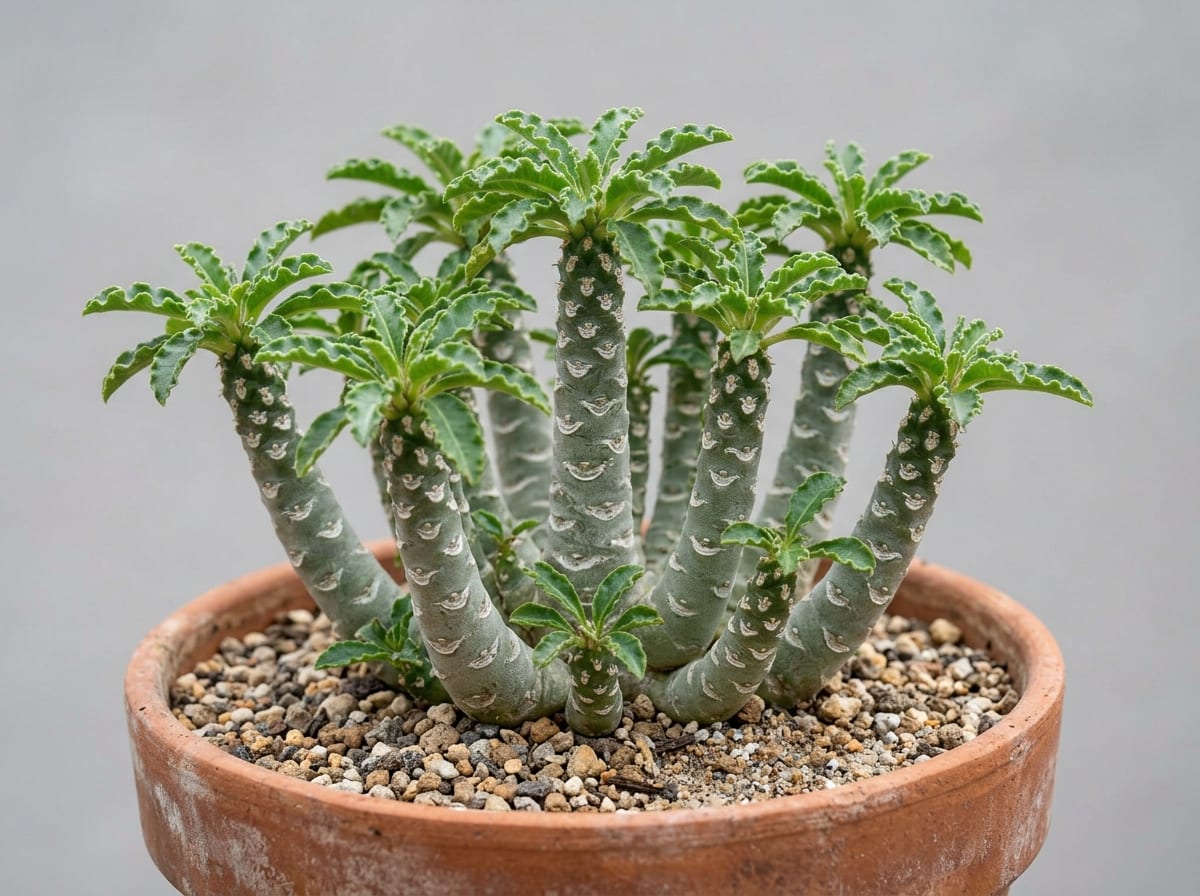
AI-generated image
Dorstenia lavrani
IntermediateDorstenia lavrani
An endemic of northern Somalia that raises many waxy succulent stems patterned with spiralling white leaf scars, each topped by a rosette of crisped leaves. It looks like a tiny palm grove and, unusually for Dorstenia, is dioecious.
About
Dorstenia lavrani is a succulent perennial in the fig family (Moraceae), known only from the Taba'a Gap north of Erigavo in northern Somalia. Described in 2008, it has also circulated under names such as "Dorstenia Taba'a Gorge" and "Dorstenia sp. Mait Plateau". It is thought to grow at 100–1,750 m in shady, moss-filled cracks in a limestone gorge, which hints at the conditions it needs in cultivation. Offsetting from the base, it forms a symmetrical grove of many stems. The waxy succulent stems are 1–2.5 cm thick and up to about 20 cm tall, patterned with spiralling rows of whitish leaf scars. Each is topped by a crowded rosette of elliptic to obovate leaves 1.5–4.5 cm long with finely toothed, strongly wavy margins. The inflorescence is a flat receptacle 5–15 mm across with six to twelve linear appendages up to 16 mm long radiating from it, like a small green daisy. It is believed to be the only dioecious Dorstenia: unlike D. gigas or D. foetida, which set seed freely on a single plant, it needs both a male and a female plant to produce seed. In Japan potted plants are sold online and by specialist nurseries, and seed is also available.
Size of the Dorstenia lavrani
The Dorstenia lavrani grows to Stems 1–2.5 cm thick and up to about 20 cm tall, forming a clump.
Basic Info
Origin
Northern Somalia (Taba'a Gap north of Erigavo)
Lifespan
Long-lived perennial (little published data)
Size
Stems 1–2.5 cm thick and up to about 20 cm tall, forming a clump
Temperature
10〜35℃
Watering & Fertilizer
Once in the growing season at half strength
Growing Tips
Light & Placement
It takes bright light to partial or full shade; it grows in shady rock cracks in the wild, so avoid harsh direct sun.
Watering
In the growing season water fairly generously and let the mix dry slightly, but never completely; keep the air rather humid.
Dormancy Care
In winter it goes at least partly dormant and drops some leaves; give very little water then.
Temperature & Overwintering
It likes warm conditions; overwinter it indoors.
Soil & Repotting
Use a well-drained mix that does not stay soggy for long. Feed once in the growing season with a balanced fertilizer at half strength.
Propagation
Seed germinates readily at about 21°C, and cuttings also root. Being dioecious, it needs both a male and a female plant to set seed.
Dorstenia lavrani FAQ
QWhat is the growing difficulty level for Dorstenia lavrani?
Intermediate. A variety suitable for intermediate growers. Requires some cultivation experience and knowledge of environment management. Pay careful attention to temperature and humidity control.
QHow large does Dorstenia lavrani get?
The mature size of Dorstenia lavrani is Stems 1–2.5 cm thick and up to about 20 cm tall, forming a clump. This may vary slightly depending on cultivation environment and individual differences.
QHow should I water and fertilize Dorstenia lavrani?
Dorstenia lavrani: watering & fertilizer — Once in the growing season at half strength. Aim for appropriate frequency and amount.
QWhat is the typical price for Dorstenia lavrani?
The price of Dorstenia lavrani varies significantly by variety, characteristics, size, and lineage. Please check GrowerDirect's price guide for the latest market information.
Last updated: September 23, 2026
References & Sources
Edited & verified by: GrowerDirect Editorial Team
The classifications, regulations, and growing data on this page are created and verified based on the primary information database below.
Taxonomy & Authority
Regulations & Conservation Status
Not listed in CITES (checked on Species+). No special procedure is needed for transfers within Japan.
Sources: Species+ (CITES): Dorstenia lavrani
Regulations may change. Always verify the latest information with the relevant authorities.
Related Species
Find listings for this species
Related Articles
Dorstenia Cultivation Guide | Caudex Plant with Distinctive Leaves and Organs
Dorstenia is an African plant with distinctive floral organs and a caudex. Water management adjusted to seasonal cycles is the key to cultivation.
How to Grow Uncarina | Differences Between the Madagascar Endemic Species Grandidieri and Roeoesliana
An explanation of the appeal and cultivation methods of the Madagascar endemic caudex plant Uncarina genus. We introduce the differences between Uncarina grandidieri and roeoesliana, seedling cultivation, and repotting timing.
Complete Guide to Choosing Caudex Plants as Gifts | Recommended Varieties by Occasion and How to Include Care Notes
A guide to choosing caudex plants as gifts organized by occasion. We introduce how to select varieties based on the recipient's cultivation experience and how to include care notes for long-term enjoyment.
Diagnosing and Treating Poor Root Development in Caudex Plants | Causes and Solutions for Roots That Won't Emerge or Won't Grow
A detailed guide to root emergence problems in caudex plants. From diagnosis methods to solutions, practical techniques for promoting healthy root development are introduced.
🩺 Common diseases
Can't find the plant you're looking for?
Post your wishes for free and growers with matching plants will contact you with introductions.