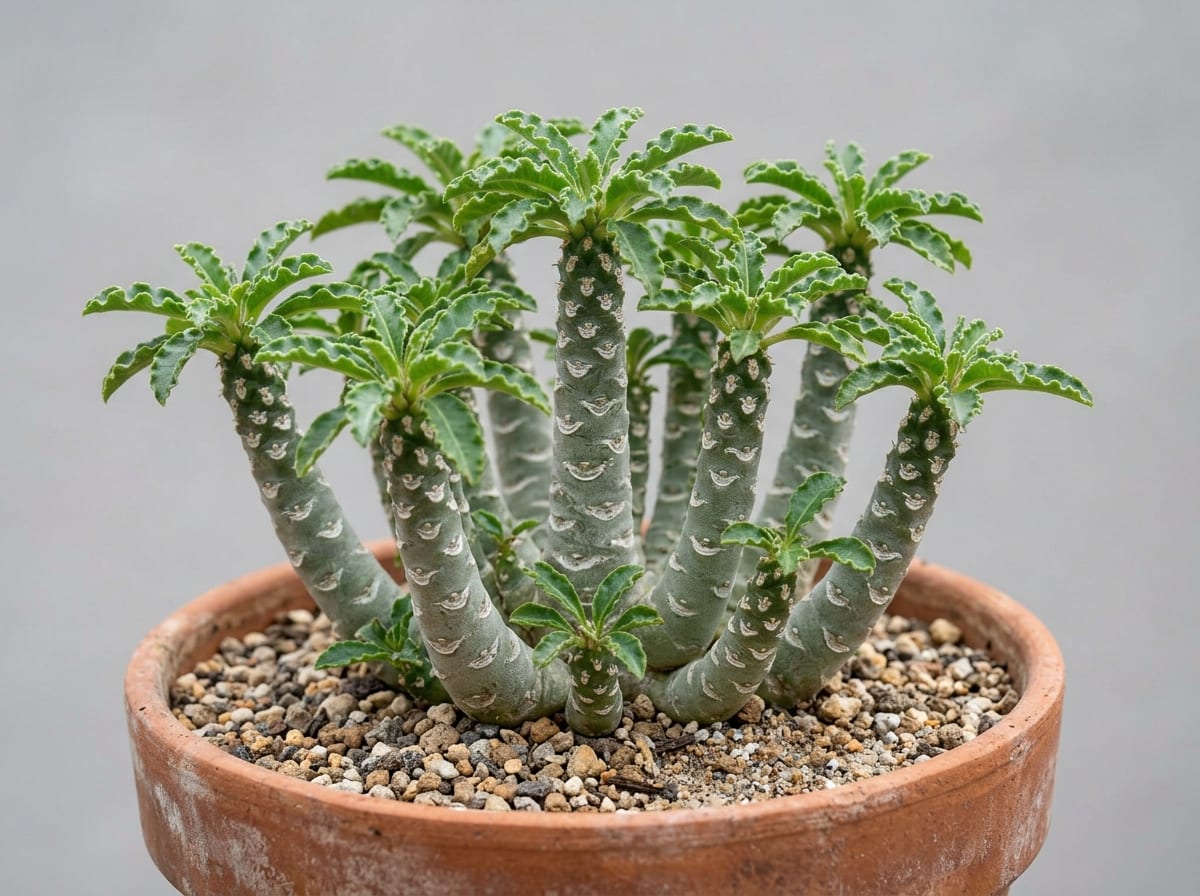
Dorstenia lavrani
Dorstenia lavrani is a caudiciform succulent native to a limited area of northern Somalia. It sends up several waxy, fleshy stems marked with a distinctive spiral pattern of white leaf scars, each stem topped with a rosette of crinkled leaves. Clustered together, a group of plants can resemble a miniature palm grove. Unlike most Dorstenia species, it is dioecious, meaning individual plants are either male or female, a rare trait worth observing as the plant matures. Cultivation calls for some intermediate-level experience, but this long-lived perennial readily produces offsets, rewarding patient growers with an evolving clustered form over the years.
View Dorstenia lavrani encyclopedia →0% commission on your first sales!Register by September 30, 2026 and your first 2 plants are commission-free!
Grower Wanted!
List your plants on GrowerDirect and sell directly to customers nationwide!
6 Transparency Commitments from GrowerDirect
Our Grower disclose all key information for Caudex Plants listings, ensuring complete transparency on variety, origin, light needs, and difficulty.
- Variety Disclosed
- Real Plant Photos
- Color Details
- Origin Disclosed
- Light Requirements
- Difficulty Level
Browse all 146 varieties
Light Requirements
Difficulty Level
Verified growers wanted for Caudex Plants
Growers are signing up now ahead of launch. Subscribe to be notified when new listings go live.
Getting alerts is free with a member account. When new listings match your saved search, we'll notify you by email and in-app.
Browse other categories
Verified growers (preview)
Are you growing caudex plants?
Register as a grower and connect with buyers directly.
Apply as a growerDorstenia lavrani key facts
- Growing Difficulty
- Intermediate
- Lifespan
- Long-lived perennial (little published data)
- Size
- Stems 1–2.5 cm thick and up to about 20 cm tall, forming a clump
- Watering
- Once in the growing season at half strength
- Light & Placement
- It takes bright light to partial or full shade; it grows in shady rock cracks in the wild, so avoid harsh direct sun.
- Watering
- In the growing season water fairly generously and let the mix dry slightly, but never completely; keep the air rather humid.
- Dormancy Care
- In winter it goes at least partly dormant and drops some leaves; give very little water then.
- Temperature & Overwintering
- It likes warm conditions; overwinter it indoors.
- Soil & Repotting
- Use a well-drained mix that does not stay soggy for long. Feed once in the growing season with a balanced fertilizer at half strength.
- Propagation
- Seed germinates readily at about 21°C, and cuttings also root. Being dioecious, it needs both a male and a female plant to set seed.
About Dorstenia lavrani
Dorstenia lavrani is a caudiciform succulent from northern Somalia, with waxy stems marked by spiral white leaf scars and rosettes of crinkled leaves. This dioecious, long-lived perennial forms clusters and suits intermediate growers.
7 things to know before growing Dorstenia lavrani
1Light and Placement
Dorstenia lavrani prefers bright light, but intense midday summer sun can scorch its leaves. A bright spot behind a sheer curtain, with soft filtered light, works well.
2Watering
During the growing season, water generously and let the mix dry slightly before the next watering, but never let it dry out completely. Keep the air fairly humid. In winter it at least partly goes dormant and drops its leaves, so give only very little water then.
3Well-Draining Soil
A mineral-heavy, well-draining mix formulated for caudiciforms or succulents suits this plant well. Soil that is too organic retains moisture and can stress the roots.
4Repotting Timing
Avoid disturbing the roots while they're settled, and repot once active growth resumes. If the roots have filled the pot, move it up to a slightly larger container.
5Seasonal Care Shifts
During active growth, give it plenty of light and regular watering; during slower periods, cut back on watering to let the plant rest. Keep conditions stable, since sudden temperature swings or cold can stress the plant.
6Being Dioecious
Unusually for Dorstenia, this species has separate male and female plants. Since sex isn't easy to tell by appearance alone, check with the source at purchase if breeding is your goal.
7Enjoying the Offsets
As it grows, the plant naturally produces offsets at its base, gradually forming a clustered habit. Left unseparated, the growing number of stems begins to resemble a miniature palm grove.
Frequently asked questions about Dorstenia lavrani
- Q.Is this a good plant for beginners?
- A.This species is generally considered suited to intermediate growers, so prior experience with other caudiciform plants helps. With careful attention to watering and soil drainage, first-time growers can still succeed.
- Q.How large does it grow?
- A.Stems typically reach about 1 to 2.5 cm in diameter and up to around 20 cm in height. Since it produces offsets and forms clusters, its overall width increases as it matures.
- Q.What does dioecious mean for this plant?
- A.It means each individual plant is either male or female, not both. This is an unusual trait within the Dorstenia genus, and producing seed requires having both a male and a female plant.
- Q.How long does it live?
- A.It's known as a long-lived perennial, though detailed lifespan data is limited. It's best thought of as a plant you cultivate into an increasingly clustered form over many years.
- Q.What should I look for when choosing a plant?
- A.Look for firm stems with a clearly visible spiral pattern of white leaf scars, a sign of healthy growth. A plant that has already begun producing offsets shows it's on its way to forming a nice cluster.
Handy Growing Tools for Dorstenia lavrani
Learn more about Dorstenia lavrani in the encyclopedia
View Dorstenia lavrani encyclopedia entry →
Care difficulty, size, origin and light needs — all basics covered.
More in this category
Can't find the plant you're looking for?
Post your wishes for free and growers with matching plants will contact you with introductions.