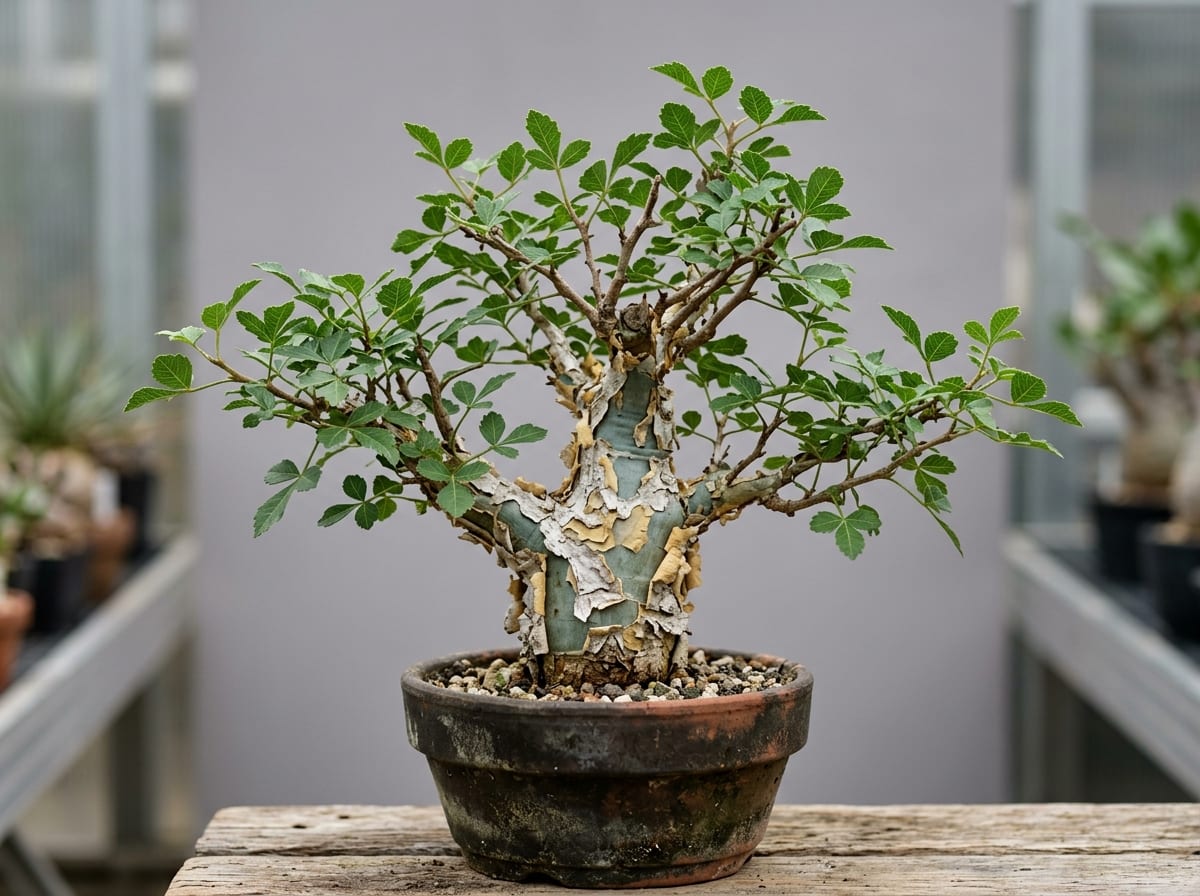
Commiphora kataf
Commiphora kataf is a caudex-forming species belonging to the myrrh-producing Commiphora genus. Its whitish-to-yellowish bark peels away like thin paper, revealing a bluish layer underneath—a striking texture that makes the trunk itself a focal point. The leaves are made up of three leaflets, but the amount of hair and the shape of the leaf-margin serration vary enormously from plant to plant, so no two specimens look quite alike. In the wild it can grow to about 8 meters, occasionally 10, yet in a pot it can be kept compact. With a bit of practice in pruning and watering, it's a rewarding species for growers with some prior experience.
View Commiphora kataf encyclopedia →0% commission on your first sales!Register by September 30, 2026 and your first 2 plants are commission-free!
Grower Wanted!
List your plants on GrowerDirect and sell directly to customers nationwide!
6 Transparency Commitments from GrowerDirect
Our Grower disclose all key information for Caudex Plants listings, ensuring complete transparency on variety, origin, light needs, and difficulty.
- Variety Disclosed
- Real Plant Photos
- Color Details
- Origin Disclosed
- Light Requirements
- Difficulty Level
Browse all 146 varieties
Light Requirements
Difficulty Level
Verified growers wanted for Caudex Plants
Growers are signing up now ahead of launch. Subscribe to be notified when new listings go live.
Getting alerts is free with a member account. When new listings match your saved search, we'll notify you by email and in-app.
Browse other categories
Verified growers (preview)
Are you growing caudex plants?
Register as a grower and connect with buyers directly.
Apply as a growerCommiphora kataf key facts
- Growing Difficulty
- Intermediate
- Lifespan
- Long-lived tree (little published data)
- Size
- To 8 m (occasionally 10 m) in habitat; can be kept small in a pot
- Watering
- A little during the growing season
- Light & Placement
- It prefers a sunny position. It grows vigorously, so give it full sun outdoors in the growing season.
- Watering
- Water when dry while in leaf. Most losses come from winter overwatering; the soft wood rots if kept wet in the dry season.
- Temperature & Overwintering
- It is frost-sensitive; overwinter it indoors away from frost with little water.
- Soil & Repotting
- Use a free-draining mix. It forms spreading fine roots rather than a deep taproot, so shallow pots work.
- Pruning & Shaping
- It tolerates hard pruning and its cuts and bark heal quickly, so it can be cut back and trained like a bonsai.
- Propagation
- Propagate by seed or cuttings; branches root readily.
About Commiphora kataf
Commiphora kataf is a myrrh-related caudex plant known for its paper-thin, peeling white-to-yellow bark over a bluish trunk. Suited to intermediate growers; stays compact in a pot.
7 things to know before growing Commiphora kataf
1Light & Placement
Commiphora kataf does best in a sunny spot with good air circulation. If kept outdoors, shelter it from direct rain—somewhere under an eave or overhang helps keep the bark from deteriorating.
2Watering Basics
During the growing season, water thoroughly once the soil surface has dried out. In the dormant period or cooler months, cut back on watering and keep the soil on the dry side to help avoid root rot.
3Choosing Soil
Use a well-draining mix as the base. A blend formulated for caudex plants, or a mix of akadama and pumice, keeps excess moisture from lingering around the roots.
4When to Repot
Repotting during the active growing season puts the least stress on the plant. If you notice the roots filling the pot, consider moving up to a slightly larger one.
5Seasonal Care
Growth slows as temperatures drop, so ease off on watering during cooler months. Since this species comes from warm regions, keeping it in a bright, warm spot when temperatures fall helps it stay healthy.
6Picking a Plant
Look at the bark's color, texture, and how full the foliage is to choose a healthy plant. Since hair density and leaf-margin serration vary a lot between individuals, part of the fun is picking the look you like.
7Pruning & Shaping
Prune overgrown branches during the growing season to help shape the plant. Cuts can ooze resin, so use clean tools and handle the plant with care.
Frequently asked questions about Commiphora kataf
- Q.Is Commiphora kataf suitable for beginners?
- A.It's generally considered suited to intermediate growers. Prior experience with succulents or caudex plants will make it easier to judge watering and placement.
- Q.How large does it grow?
- A.In the wild it can reach about 8 meters, occasionally up to 10. Grown in a pot, though, it can be kept much smaller with pruning and appropriate pot sizing.
- Q.Why do leaves look different from plant to plant?
- A.Commiphora kataf has compound leaves made of three leaflets, but hair density and leaf-margin serration vary widely between individuals. Even within the same variety, each plant can look distinctly different.
- Q.The bark is peeling—is my plant sick?
- A.Whitish-to-yellowish bark peeling away like paper to reveal a bluish layer underneath is a natural characteristic of this species. It's not a sign of disease—it's actually one of the plant's distinctive features.
- Q.How long does this plant live?
- A.It's known as a long-lived woody plant, though detailed data on its lifespan is limited. With good care, it can be a long-term companion in your collection.
Handy Growing Tools for Commiphora kataf
Learn more about Commiphora kataf in the encyclopedia
View Commiphora kataf encyclopedia entry →
Care difficulty, size, origin and light needs — all basics covered.
More in this category
Can't find the plant you're looking for?
Post your wishes for free and growers with matching plants will contact you with introductions.