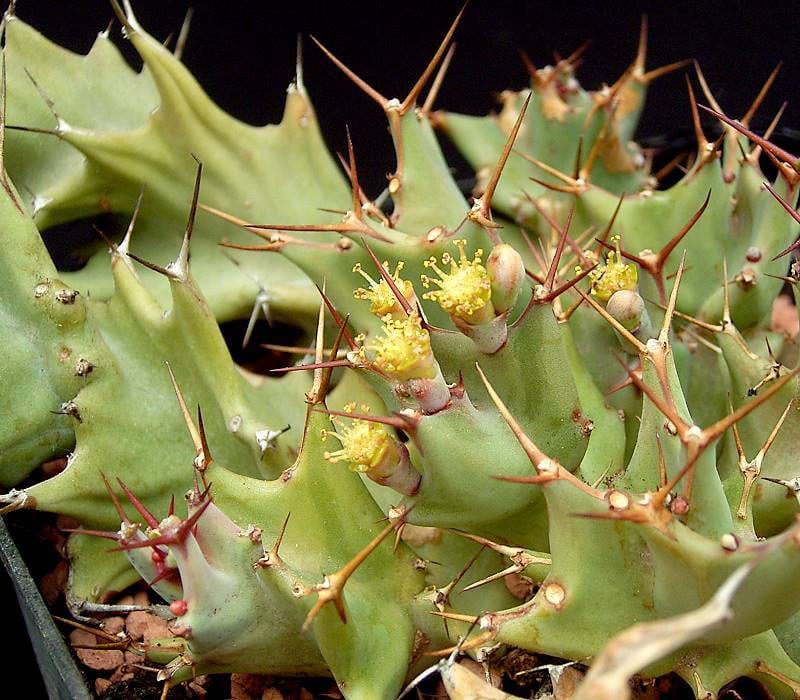
Source: Wikimedia Commons
Twisted Spurge
IntermediateEuphorbia tortirama
A South African spurge whose thick carrot-shaped tuber sends up a clump of three-angled branches that twist into tight spirals. The angles bear sharp spines up to 2.5 cm long.
About
Euphorbia tortirama is a small succulent spurge known only from northern South Africa (the Waterberg, Polokwane and Soutpansberg areas of Limpopo). It grows on stony soils in mopane woodland at 700-1,250 m. The main stem merges with the thick taproot to form a carrot-shaped tuber up to 30 cm long and 15 cm thick, mostly buried; in pots the tuber is usually raised above the soil for display. Numerous branches 6-30 cm long and 2-4.5 cm wide arise from the top; two- or three-angled when young, they become tightly spiralled and are constricted every 1.5-2 cm. The winged angles carry prominent tubercles and spines up to 2.5 cm long. The leaves are tiny and short-lived, and the flowers are about 7 mm across with yellow nectar glands. In Japan seedlings and cut branches are regularly sold through online shops and auction sites.
Size of the Twisted Spurge
The Twisted Spurge grows to Tuber up to 30 cm long and 15 cm thick; branches 6-30 cm long.
Basic Info
Origin
Northern South Africa (Limpopo)
Lifespan
Long-lived perennial (little published data)
Size
Tuber up to 30 cm long and 15 cm thick; branches 6-30 cm long
Temperature
10〜35℃
Watering & Fertilizer
A potassium-rich succulent fertiliser in the growing season
Growing Tips
Light & Placement
Heat-tolerant, it grows in sun to light shade. Full sun brings out its colour, but acclimatise shade-grown plants gradually.
Watering
Water regularly in the growing season, never letting water stand around the roots. Keep almost completely dry in winter.
Temperature & Overwintering
It has been reported to survive −6°C when dry, but it needs warmth and sun to look its best. Overwinter it dry and away from frost.
Soil & Repotting
Use an airy, mostly mineral mix of pumice or lava grit in pots with generous drainage. Even if the tuber is raised, keep most of the roots buried.
Pests & Cautions
Like all Euphorbia, its white latex irritates skin and eyes. Wear gloves when cutting or repotting and keep it away from eyes and mouth. The spines are sharp, so use thick gloves. Seedlings form a symmetrical tuber while cuttings usually do not form one, so choose seedlings for a caudex.
Twisted Spurge FAQ
QWhat is the growing difficulty level for Twisted Spurge?
Intermediate. A variety suitable for intermediate growers. Requires some cultivation experience and knowledge of environment management. Pay careful attention to temperature and humidity control.
QHow large does Twisted Spurge get?
The mature size of Twisted Spurge is Tuber up to 30 cm long and 15 cm thick; branches 6-30 cm long. This may vary slightly depending on cultivation environment and individual differences.
QHow should I water and fertilize Twisted Spurge?
Twisted Spurge: watering & fertilizer — A potassium-rich succulent fertiliser in the growing season. Aim for appropriate frequency and amount.
QWhat is the typical price for Twisted Spurge?
The price of Twisted Spurge varies significantly by variety, characteristics, size, and lineage. Please check GrowerDirect's price guide for the latest market information.
Last updated: September 23, 2026
References & Sources
Edited & verified by: GrowerDirect Editorial Team
The classifications, regulations, and growing data on this page are created and verified based on the primary information database below.
Taxonomy & Authority
Regulations & Conservation Status
Listed in CITES Appendix II (covered by the listing of succulent Euphorbia species). International trade needs an export permit, but no registration is required for transfers within Japan.
Sources: Species+ (CITES): Euphorbia tortirama
Regulations may change. Always verify the latest information with the relevant authorities.
Related Species
Find listings for this species
Related Articles
Top 15 Popular Euphorbia Ranking 2026: Valida, Obesa, White Ghost & More Compared
A ranking guide to popular Euphorbia species. Compare 15 species favored by collectors—including Valida, Obesa, White Ghost, Lactea, Neriifolia, and Suzannae—by characteristics, ease of care, and price range.
How to Grow Uncarina | Differences Between the Madagascar Endemic Species Grandidieri and Roeoesliana
An explanation of the appeal and cultivation methods of the Madagascar endemic caudex plant Uncarina genus. We introduce the differences between Uncarina grandidieri and roeoesliana, seedling cultivation, and repotting timing.
Complete Guide to Choosing Caudex Plants as Gifts | Recommended Varieties by Occasion and How to Include Care Notes
A guide to choosing caudex plants as gifts organized by occasion. We introduce how to select varieties based on the recipient's cultivation experience and how to include care notes for long-term enjoyment.
Diagnosing and Treating Poor Root Development in Caudex Plants | Causes and Solutions for Roots That Won't Emerge or Won't Grow
A detailed guide to root emergence problems in caudex plants. From diagnosis methods to solutions, practical techniques for promoting healthy root development are introduced.
🩺 Common diseases
Can't find the plant you're looking for?
Post your wishes for free and growers with matching plants will contact you with introductions.