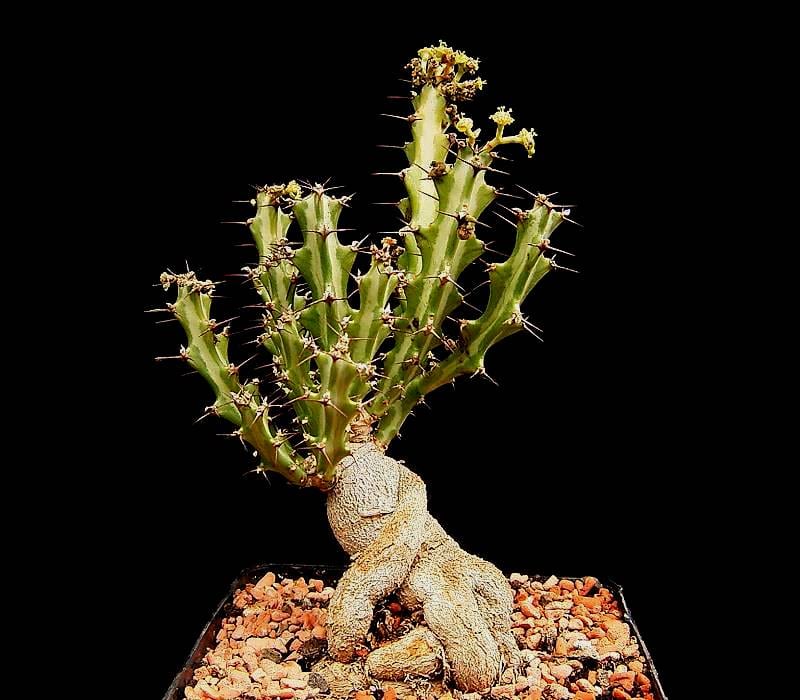
Source: Wikimedia Commons
Euphorbia knuthii
BeginnerEuphorbia knuthii
A small southern African spurge whose twisting tuberous caudex sends up many slender three- to four-angled branches striped grey-green. Tough and easy to root from cuttings, it is a good first caudiciform Euphorbia.
About
Euphorbia knuthii is a small, spiny succulent spurge from Mozambique, South Africa (Mpumalanga, KwaZulu-Natal) and Eswatini. It grows at around 300 m in seasonally wet black soils. A tuberous main root continues into a twisting caudex whose top produces crowded branches, so at ground level it looks like a group of separate plants; underground rhizomes may also be present. Branches are 3-15 cm long (much longer in cultivation), up to 12 mm wide and three- or four-angled, light green with grey-green longitudinal stripes, reddening in very bright light; the tubercles carry paired spines up to 8 mm long. Small yellowish-green flowers appear in mid to late summer, and the capsules ripen about a month later and burst to scatter the seed. Subsp. johnsonii is usually solitary with two- or three-angled branches. In Japan it is also sold under the name Kunushi-kirin, and cut branches and rooted cuttings are common on online auction sites.
Size of the Euphorbia knuthii
The Euphorbia knuthii grows to Branches 3-15 cm long (longer in cultivation).
Basic Info
Origin
Mozambique, eastern South Africa and Eswatini
Lifespan
Perennial (the tuber enlarges over many years)
Size
Branches 3-15 cm long (longer in cultivation)
Temperature
10〜35℃
Watering & Fertilizer
A potassium-rich succulent fertiliser in summer
Growing Tips
Light & Placement
Tough and tolerant of lower light, but good sun keeps branches short and colourful. It benefits from summer outdoors.
Watering
Very drought-tolerant, but in the growing season water about once a week to keep the soil reasonably moist. Keep almost dry in winter.
Temperature & Overwintering
It has survived −6°C and a little snow when dry, but needs warmth and sun to look its best. Overwinter it dry in a bright, cool spot.
Soil & Repotting
Use an airy mineral mix in well-drained pots. Raise the tuber above the soil for display only after about 8-12 years of growth underground.
Pruning & Shaping
Every year or two in early spring cut all branches back to the soil line to get many short, even branches; let it heal a week or more before watering.
Pests & Cautions
Like all Euphorbia, its white latex irritates skin and eyes. Wear gloves when cutting or repotting and keep it away from eyes and mouth. Cutting-raised plants form many thin, branched roots while seedlings tend to form larger single tubers, so seedlings suit caudex display.
Euphorbia knuthii FAQ
QWhat is the growing difficulty level for Euphorbia knuthii?
Beginner. A variety suitable for beginners. No special equipment or experience is required—you can grow it without problems by setting up a basic cultivation environment.
QHow large does Euphorbia knuthii get?
The mature size of Euphorbia knuthii is Branches 3-15 cm long (longer in cultivation). This may vary slightly depending on cultivation environment and individual differences.
QHow should I water and fertilize Euphorbia knuthii?
Euphorbia knuthii: watering & fertilizer — A potassium-rich succulent fertiliser in summer. Aim for appropriate frequency and amount.
QWhat is the typical price for Euphorbia knuthii?
The price of Euphorbia knuthii varies significantly by variety, characteristics, size, and lineage. Please check GrowerDirect's price guide for the latest market information.
Last updated: September 23, 2026
References & Sources
Edited & verified by: GrowerDirect Editorial Team
The classifications, regulations, and growing data on this page are created and verified based on the primary information database below.
Taxonomy & Authority
Regulations & Conservation Status
Listed in CITES Appendix II (covered by the listing of succulent Euphorbia species). International trade needs an export permit, but no registration is required for transfers within Japan.
Sources: Species+ (CITES): Euphorbia knuthii
Regulations may change. Always verify the latest information with the relevant authorities.
Related Species
Find listings for this species
Related Articles
Top 15 Popular Euphorbia Ranking 2026: Valida, Obesa, White Ghost & More Compared
A ranking guide to popular Euphorbia species. Compare 15 species favored by collectors—including Valida, Obesa, White Ghost, Lactea, Neriifolia, and Suzannae—by characteristics, ease of care, and price range.
How to Grow Uncarina | Differences Between the Madagascar Endemic Species Grandidieri and Roeoesliana
An explanation of the appeal and cultivation methods of the Madagascar endemic caudex plant Uncarina genus. We introduce the differences between Uncarina grandidieri and roeoesliana, seedling cultivation, and repotting timing.
Complete Guide to Choosing Caudex Plants as Gifts | Recommended Varieties by Occasion and How to Include Care Notes
A guide to choosing caudex plants as gifts organized by occasion. We introduce how to select varieties based on the recipient's cultivation experience and how to include care notes for long-term enjoyment.
Diagnosing and Treating Poor Root Development in Caudex Plants | Causes and Solutions for Roots That Won't Emerge or Won't Grow
A detailed guide to root emergence problems in caudex plants. From diagnosis methods to solutions, practical techniques for promoting healthy root development are introduced.
🩺 Common diseases
Can't find the plant you're looking for?
Post your wishes for free and growers with matching plants will contact you with introductions.