Source: Wikimedia Commons
Beaucarnea gracilis
BeginnerBeaucarnea gracilis
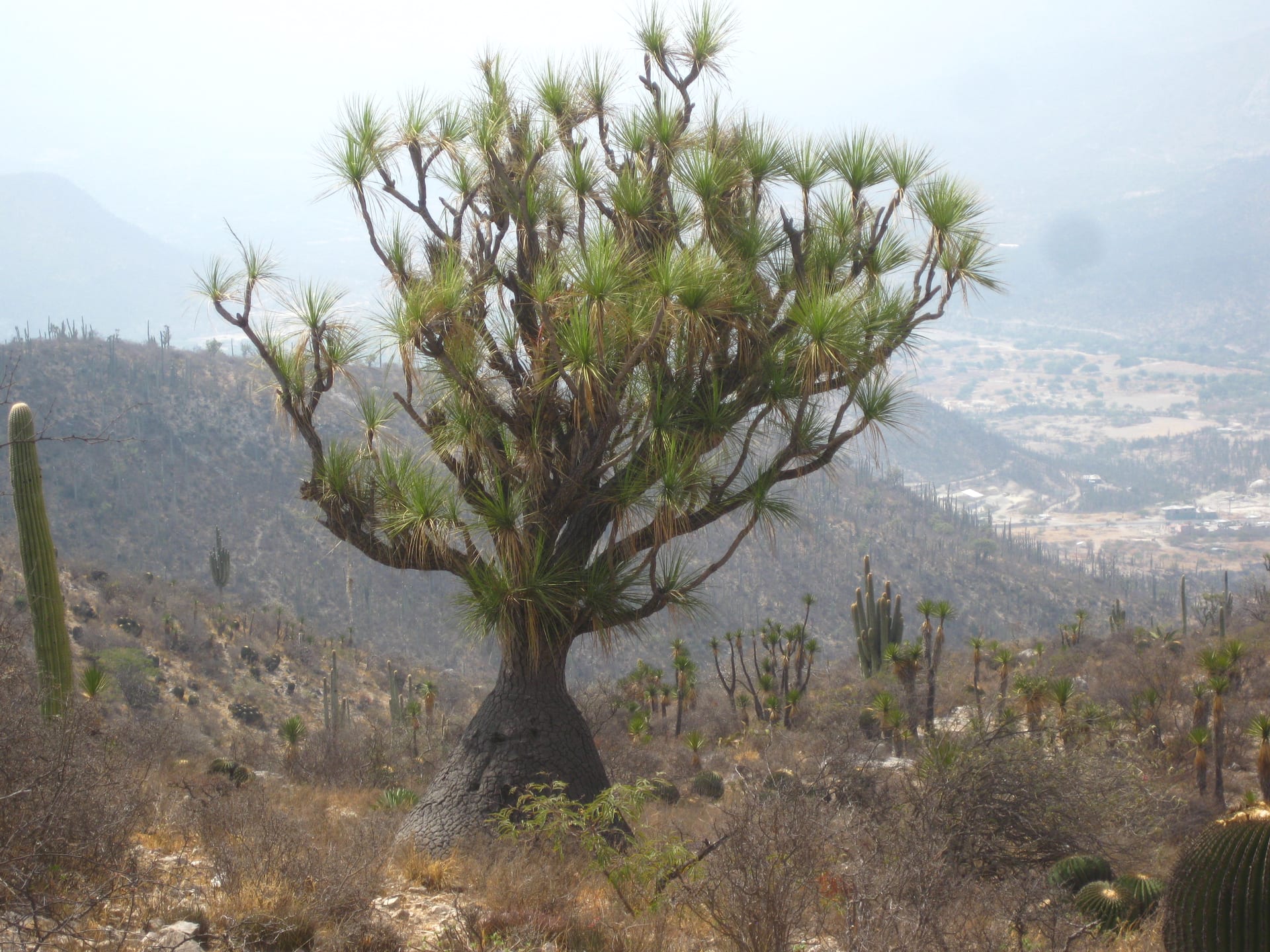
A ponytail-palm relative endemic to Mexico's Tehuacán Valley, raising several slender stems from a huge corky base like an elephant's foot. Unlike B. recurvata, its narrow, strongly blue-grey leaves stand stiffly upright.
About
Beaucarnea gracilis is an evergreen succulent tree in the Asparagaceae, endemic to the semi-arid Tehuacán Valley of Puebla and northern Oaxaca, Mexico. It has at times been placed in Nolina or Dasylirion, but it is now accepted as a species of Beaucarnea. The base of the trunk is enormously swollen and nearly circular in cross-section, much of it above ground, and is covered in thick, deeply fissured grey to brown corky bark that ages into polygonal plates, like an elephant's foot. From it rise several slender, curving stems that branch sparsely near the top; wild plants can reach 12 m, while garden plants usually stay at 3–5 m. The leaves form open ponytail-like rosettes at the stem tips; they are 30–60 cm long and only 3–7 mm wide, very glaucous blue-green, held stiffly erect, with finely and sharply roughened margins. These upright leaves separate it from Beaucarnea recurvata, whose leaves droop, and from the similar B. stricta, whose leaves are 8–15 mm wide. The species is dioecious. Small wild plants continue to be dug up for ornamental use, and the IUCN Red List category is Endangered. In Japan potted plants and seed are sold online.
Source: Wikipedia (CC BY-SA 4.0)
Size of the Beaucarnea gracilis
The Beaucarnea gracilis grows to Up to 12 m in the wild, usually 3–5 m in gardens; leaves 30–60 cm long.
Basic Info
Origin
Tehuacán Valley, Puebla and northern Oaxaca, Mexico
Lifespan
Long-lived woody plant (little published data)
Size
Up to 12 m in the wild, usually 3–5 m in gardens; leaves 30–60 cm long
Temperature
10〜35℃
Watering & Fertilizer
Light feeding in the growing season
Growing Tips
Light & Placement
It grows in light shade to full sun and, being very drought-tolerant, suits container culture.
Watering
Give moderate water while actively growing and little the rest of the time; established plants withstand drought well.
Temperature & Overwintering
It has withstood −5°C for short periods, but its exact hardiness is unknown; bring it indoors in cold regions.
Soil & Repotting
Use a free-draining mix. It likes to be slightly rootbound and can stay in the same pot for years.
Propagation
Propagate from seed or stem cuttings; leaf cuttings do not work. Being dioecious, it needs male and female plants to set seed.
Pests & Cautions
An Endangered species threatened by digging in the wild; choosing seed-grown plants reduces pressure on wild populations.
Beaucarnea gracilis FAQ
QWhat is the growing difficulty level for Beaucarnea gracilis?
Beginner. A variety suitable for beginners. No special equipment or experience is required—you can grow it without problems by setting up a basic cultivation environment.
QHow large does Beaucarnea gracilis get?
The mature size of Beaucarnea gracilis is Up to 12 m in the wild, usually 3–5 m in gardens; leaves 30–60 cm long. This may vary slightly depending on cultivation environment and individual differences.
QHow should I water and fertilize Beaucarnea gracilis?
Beaucarnea gracilis: watering & fertilizer — Light feeding in the growing season. Aim for appropriate frequency and amount.
QWhat is the typical price for Beaucarnea gracilis?
The price of Beaucarnea gracilis varies significantly by variety, characteristics, size, and lineage. Please check GrowerDirect's price guide for the latest market information.
Last updated: September 23, 2026
References & Sources
Edited & verified by: GrowerDirect Editorial Team
The classifications, regulations, and growing data on this page are created and verified based on the primary information database below.
Taxonomy & Authority
Regulations & Conservation Status
Listed in CITES Appendix II (covered by the genus listing for Beaucarnea). International trade needs an export permit, but no registration is required for transfers within Japan. The IUCN Red List category is Endangered.
Sources: Species+ (CITES): Beaucarnea gracilis / IUCN Red List category via GBIF: Beaucarnea gracilis
Regulations may change. Always verify the latest information with the relevant authorities.
Related Species
Find listings for this species
Related Articles
Pot Selection and Growth Rate Management for Pachypodium Gracilius
Cultivating Pachypodium gracilius requires careful pot selection and growth rate management. By combining proper drainage, staged repotting, and coordinated management of fertilization, light, and temperature, you can develop healthy specimens with enlarged trunk diameters.
How to Grow Uncarina | Differences Between the Madagascar Endemic Species Grandidieri and Roeoesliana
An explanation of the appeal and cultivation methods of the Madagascar endemic caudex plant Uncarina genus. We introduce the differences between Uncarina grandidieri and roeoesliana, seedling cultivation, and repotting timing.
Complete Guide to Choosing Caudex Plants as Gifts | Recommended Varieties by Occasion and How to Include Care Notes
A guide to choosing caudex plants as gifts organized by occasion. We introduce how to select varieties based on the recipient's cultivation experience and how to include care notes for long-term enjoyment.
Diagnosing and Treating Poor Root Development in Caudex Plants | Causes and Solutions for Roots That Won't Emerge or Won't Grow
A detailed guide to root emergence problems in caudex plants. From diagnosis methods to solutions, practical techniques for promoting healthy root development are introduced.
🩺 Common diseases
Can't find the plant you're looking for?
Post your wishes for free and growers with matching plants will contact you with introductions.