Source: Wikimedia Commons
Madagascar ocotillo
BeginnerAlluaudia procera
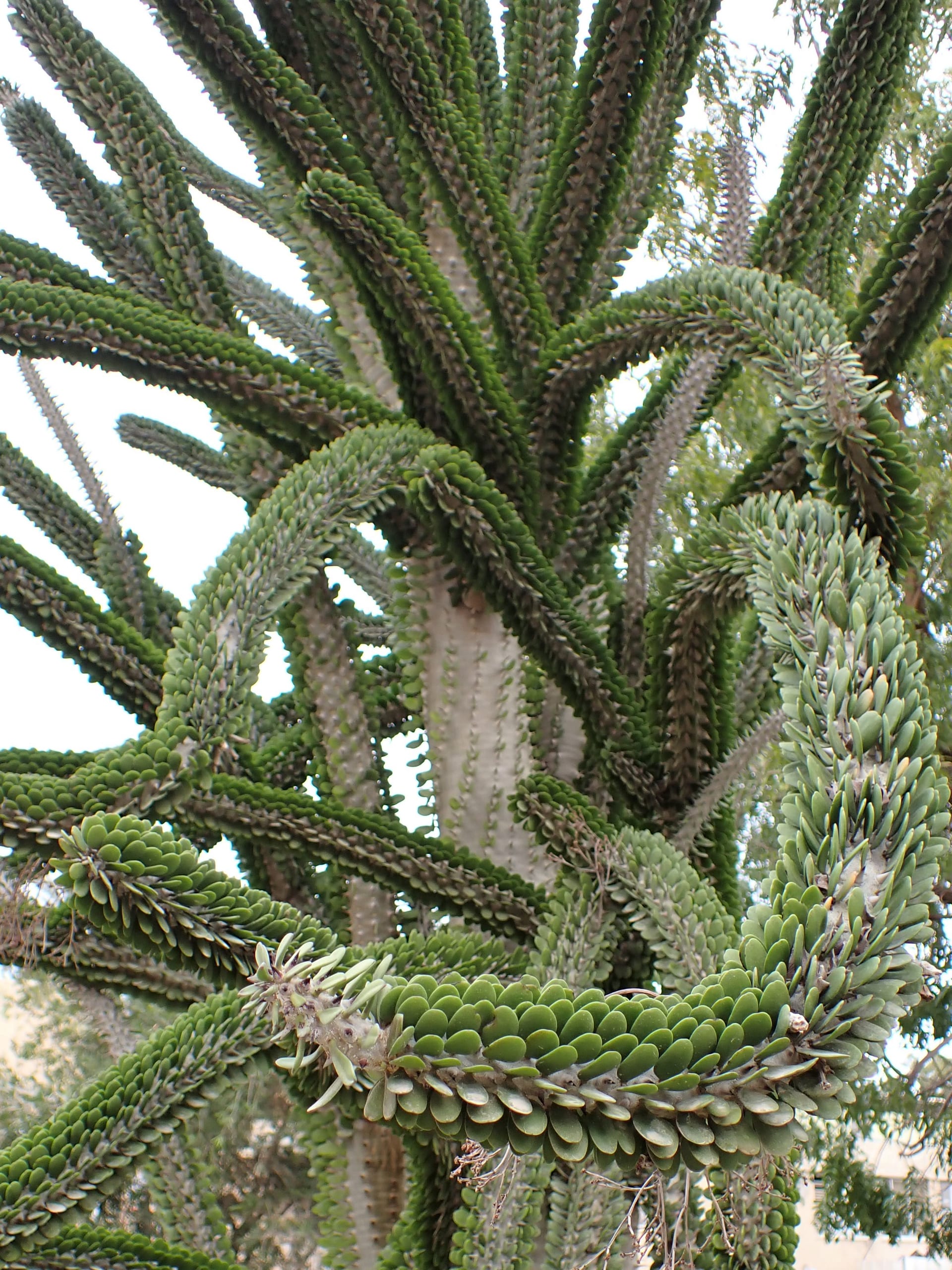
The "Madagascar ocotillo" of the southern spiny forest, with bone-white stems lined with conical spines and small round leaves. It looks much like the American ocotillo but belongs to an unrelated family.
About
Alluaudia procera is a deciduous succulent tree in the Didiereaceae, a family endemic to Madagascar. It grows with Pachypodium in the spiny forest of the semi-arid south and south-west (Toliara) and can endure more than a year without rain. Young plants form a tangle of stems; after several years a strong central trunk develops, the basal stems die off, and the plant becomes tree-like. It exceeds 15 m in the wild but usually stays at 1.5–3 m as a potted indoor plant. The bone-white stems carry sharp conical spines and small oval leaves 1–5 cm long in vertical rows spiralling up the trunk; the leaves appear in the wet season and fall in the dry season or in winter. The species is dioecious, and the yellowish-white flowers, clustered in balls at the branch tips, appear only on mature plants over 3 m tall. It closely resembles the American ocotillo (Fouquieria splendens) but belongs to a different family, a textbook case of convergent evolution. It is the most common Alluaudia in cultivation, and in Japan potted plants are widely sold online and in garden centres.
Source: Wikipedia (CC BY-SA 4.0)
Size of the Madagascar ocotillo
The Madagascar ocotillo grows to Over 15 m in the wild; 1.5–3 m as a potted indoor plant.
Temperature & humidity for the Madagascar ocotillo
The ideal temperature for the Madagascar ocotillo is 20〜30℃.
Basic Info
Origin
Southern and south-western Madagascar (Toliara)
Lifespan
Long-lived woody plant (little published data)
Size
Over 15 m in the wild; 1.5–3 m as a potted indoor plant
Temperature
20〜30℃
Watering & Fertilizer
Dilute feeding in the growing season
Growing Tips
Light & Placement
Give it full sun, or very bright light indoors, with good air circulation.
Watering
Water, then let the mix dry out thoroughly before watering again.
Temperature & Overwintering
Indoors it does best at 20–30°C, with around 10°C in winter. Established plants are said to tolerate about 0°C, but keep it frost-free. Give no water once it drops its leaves in winter.
Soil & Repotting
Use a very free-draining mix. If you feed, dilute the fertilizer well below the label rate.
Pruning & Shaping
It does not branch freely. Once settled after potting, cutting it back to 7–10 cm encourages branching, and the removed piece can be rooted.
Propagation
Cuttings taken in spring root easily; seed can be used when available.
Pests & Cautions
The spines are sharp; wear thick gloves when repotting or pruning.
Madagascar ocotillo FAQ
QWhat is the growing difficulty level for Madagascar ocotillo?
Beginner. A variety suitable for beginners. No special equipment or experience is required—you can grow it without problems by setting up a basic cultivation environment.
QWhat is the ideal temperature for Madagascar ocotillo?
The ideal temperature for Madagascar ocotillo is 20〜30℃. Avoid sudden temperature changes and maintain a stable environment.
QHow large does Madagascar ocotillo get?
The mature size of Madagascar ocotillo is Over 15 m in the wild; 1.5–3 m as a potted indoor plant. This may vary slightly depending on cultivation environment and individual differences.
QHow should I water and fertilize Madagascar ocotillo?
Madagascar ocotillo: watering & fertilizer — Dilute feeding in the growing season. Aim for appropriate frequency and amount.
QWhat is the typical price for Madagascar ocotillo?
The price of Madagascar ocotillo varies significantly by variety, characteristics, size, and lineage. Please check GrowerDirect's price guide for the latest market information.
Last updated: September 23, 2026
References & Sources
Edited & verified by: GrowerDirect Editorial Team
The classifications, regulations, and growing data on this page are created and verified based on the primary information database below.
Taxonomy & Authority
Regulations & Conservation Status
Listed in CITES Appendix II (covered by the listing of the family Didiereaceae). International trade needs an export permit, but no registration is required for transfers within Japan.
Sources: Species+ (CITES): Alluaudia procera / IUCN Red List category via GBIF: Alluaudia procera
Regulations may change. Always verify the latest information with the relevant authorities.
Related Species
Find listings for this species
Related Articles
How to Grow Uncarina | Differences Between the Madagascar Endemic Species Grandidieri and Roeoesliana
An explanation of the appeal and cultivation methods of the Madagascar endemic caudex plant Uncarina genus. We introduce the differences between Uncarina grandidieri and roeoesliana, seedling cultivation, and repotting timing.
Complete Guide to Choosing Caudex Plants as Gifts | Recommended Varieties by Occasion and How to Include Care Notes
A guide to choosing caudex plants as gifts organized by occasion. We introduce how to select varieties based on the recipient's cultivation experience and how to include care notes for long-term enjoyment.
Diagnosing and Treating Poor Root Development in Caudex Plants | Causes and Solutions for Roots That Won't Emerge or Won't Grow
A detailed guide to root emergence problems in caudex plants. From diagnosis methods to solutions, practical techniques for promoting healthy root development are introduced.
Complete Guide to Growing Jatropha podagrica (Buddha's Navel) | Cultivation Management to Enjoy Its Distinctive Caudex and Coral-Red Flowers
Characteristics and cultivation methods of the caudex plant Jatropha podagrica. Detailed explanation of watering management during dormancy, soil, and propagation methods.
🩺 Common diseases
Can't find the plant you're looking for?
Post your wishes for free and growers with matching plants will contact you with introductions.