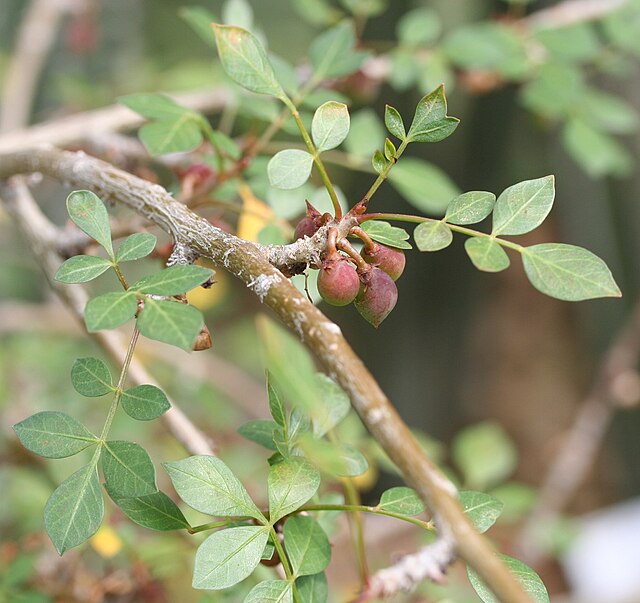
Source: Wikimedia Commons
Bursera Fagaroides
IntermediateBursera fagaroides
A Mexican aromatic caudex with peeling bark and fragrant resin.
About
Bursera fagaroides grows widely across Mexican dry zones from the Sonoran Desert to Oaxaca, belonging to the Burseraceae family. It is recognized by its peeling, papery bark and the fragrant resin that oozes from any damage—the plant has long been used in Mexico as a source of copal resin. The trunk becomes swollen and caudex-like with age, and the plant is deciduous in dry seasons. Pinnate leaves create a lush appearance during growth. Growth is slow. Full sun, high temperatures, and extremely porous soil suit it well. Moderate watering during growth and complete drought in winter dormancy are correct. Some frost sensitivity requires protection in cold climates. The aromatic resin, peeling bark texture, and bonsai-like branching structure make it one of the premier Mexican caudex plants.
Lifespan of the Bursera Fagaroides
The Bursera Fagaroides lives 30+ years.
Size of the Bursera Fagaroides
The Bursera Fagaroides grows to 20-60cm.
Basic Info
Origin
Mexico (Sonora to Oaxaca)
Lifespan
30+ years
Size
20-60cm
Temperature
10〜35℃
Growing Tips
Light & Placement
It prefers full sun and hot, dry conditions. In the growing season, keep it outdoors in a sunny, well-ventilated spot.
Watering
Water moderately in the growing season after the soil dries. Withhold water during winter dormancy and let it rely on moisture stored in the trunk.
Temperature & Overwintering
Cold tolerance is somewhat low, so protect it from frost. Overwinter in a bright, frost-free indoor spot.
Soil & Repotting
An extremely fast-draining mix suits it. Growth is slow, so repot every few years at the start of the growing season.
Dormancy Care
It sheds leaves in the dry season and rests over winter. Stop watering once leaves drop and resume when it leafs out in spring.
Bursera Fagaroides FAQ
QWhat is the growing difficulty level for Bursera Fagaroides?
Intermediate. A variety suitable for intermediate growers. Requires some cultivation experience and knowledge of environment management. Pay careful attention to temperature and humidity control.
QWhat is the lifespan of Bursera Fagaroides?
The average lifespan of Bursera Fagaroides is 30+ years. With proper cultivation environment and nutrient management, you can keep it healthy for a long time.
QHow large does Bursera Fagaroides get?
The mature size of Bursera Fagaroides is 20-60cm. This may vary slightly depending on cultivation environment and individual differences.
QWhat is the typical price for Bursera Fagaroides?
The price of Bursera Fagaroides varies significantly by variety, characteristics, size, and lineage. Please check GrowerDirect's price guide for the latest market information.
Last updated: July 5, 2026
References & Sources
Edited & verified by: GrowerDirect Editorial Team
The classifications, regulations, and growing data on this page are created and verified based on the primary information database below.
Taxonomy & Authority
Accepted name: Bursera fagaroides (Kunth) Engl.
Synonyms: Bursera covillei (Rose) Engl., Terebinthus odorata (Brandegee) Rose, Bursera purpusii Brandegee, Elaphrium schaffneri (S.Watson) Rose, Elaphrium fagaroides Kunth, Elaphrium purpusii (Brandegee) Rose, Elaphrium lonchophyllum (Sprague & L.Riley) J.G.Ortega, Bursera obovata Turcz., Bursera fagaroides f. bourgeauana Engl., Bursera fagaroides f. elliptica Engl., Bursera lonchophylla Sprague & L.Riley, Terebinthus schaffneri (S.Watson) Rose, Bursera fagaroides f. crenulata Engl., Terebinthus fagaroides (Kunth) W.Wight ex Rose, Bursera odorata Brandegee, Bursera fagaroides var. purpusii (Brandegee) McVaugh & Rzed., Bursera fagaroides var. elongata McVaugh & Rzed., Amyris fagaroides Spreng., Amyris ventricosa La Llave ex Schltdl., Bursera fagaroides f. ramosissima Engl., Bursera aptera Ramírez, Bursera schaffneri S.Watson, Bursera tenuifolia Rose, Elaphrium covillei Rose, Elaphrium obovatum (Turcz.) Rose, Elaphrium tenuifolium Rose, Elaphrium odoratum (Brandegee) Rose
Authority databases: GBIF · POWO
Nomenclature follows global taxonomic authority databases.
Regulations & Conservation Status
Not listed in either CITES Appendix I or II. Also not subject to Japan's designated invasive species or specified animals regulations (being a plant).
Sources: CITES Appendix I species list / CITES Appendix II species list / Ministry of the Environment List of Specified Invasive Alien Species
Regulations may change. Always verify the latest information with the relevant authorities.
Related Species
Find listings for this species
Related Articles
How to Grow Uncarina | Differences Between the Madagascar Endemic Species Grandidieri and Roeoesliana
An explanation of the appeal and cultivation methods of the Madagascar endemic caudex plant Uncarina genus. We introduce the differences between Uncarina grandidieri and roeoesliana, seedling cultivation, and repotting timing.
Complete Guide to Choosing Caudex Plants as Gifts | Recommended Varieties by Occasion and How to Include Care Notes
A guide to choosing caudex plants as gifts organized by occasion. We introduce how to select varieties based on the recipient's cultivation experience and how to include care notes for long-term enjoyment.
Diagnosing and Treating Poor Root Development in Caudex Plants | Causes and Solutions for Roots That Won't Emerge or Won't Grow
A detailed guide to root emergence problems in caudex plants. From diagnosis methods to solutions, practical techniques for promoting healthy root development are introduced.
Complete Guide to Growing Jatropha podagrica (Buddha's Navel) | Cultivation Management to Enjoy Its Distinctive Caudex and Coral-Red Flowers
Characteristics and cultivation methods of the caudex plant Jatropha podagrica. Detailed explanation of watering management during dormancy, soil, and propagation methods.
🩺 Common diseases
Can't find the plant you're looking for?
Post your wishes for free and growers with matching plants will contact you with introductions.