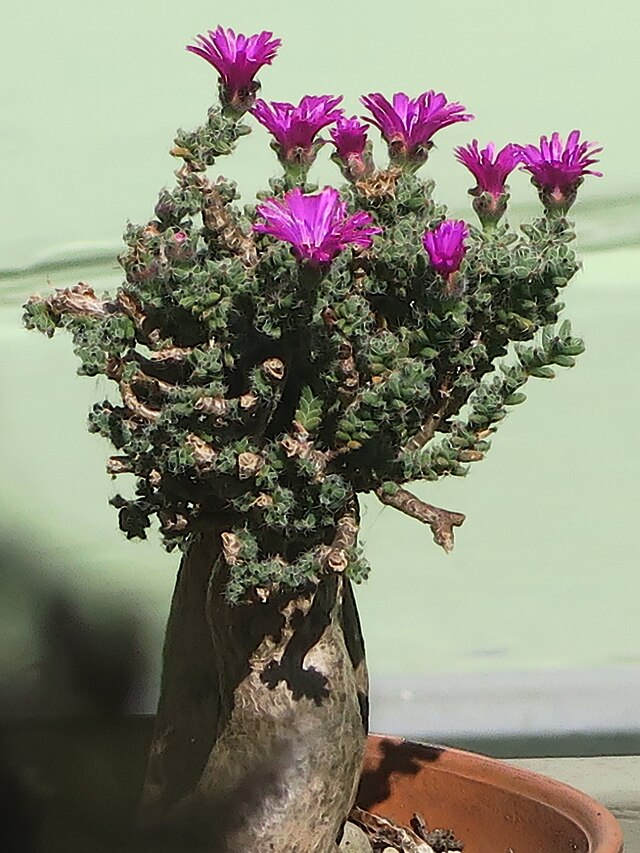
Source: Wikimedia Commons
Trichodiadema Bulbosum
BeginnerTrichodiadema bulbosum
A small mesemb caudex with bonsai-like form and cute pink flowers, easy from seed.
About
Trichodiadema bulbosum grows on rocky, dry terrain in the Eastern Cape of South Africa, belonging to the Aizoaceae family (mesembs). A gnarled, small tuber produces branching stems with small succulent leaves tipped with white, bristle-like trichomes resembling cactus areoles. Pink daisy-like flowers are charming and freely produced. The miniature bonsai-like form is a major appeal. Growth is relatively fast and the plant is easy to raise from seed. It can be managed as a winter grower or maintained year-round in moderate climates. Full sun and well-draining soil are appropriate. Moderate watering during growth with reduced irrigation in summer suits it well. Reasonable cold tolerance. Its compact size, cute flowers, and bonsai-like character make it an accessible entry into mesemb caudex collecting.
Lifespan of the Trichodiadema Bulbosum
The Trichodiadema Bulbosum lives 10+ years.
Size of the Trichodiadema Bulbosum
The Trichodiadema Bulbosum grows to 5-15cm.
Basic Info
Origin
Eastern Cape, South Africa
Lifespan
10+ years
Size
5-15cm
Temperature
5〜35℃
Growing Tips
Light & Placement
It prefers full sun, so keep it in a sunny spot with good airflow. Too little light makes the branches stretch and the plant loses its compact form.
Watering
During the growing season water moderately when the soil dries. In summer water sparingly to avoid sogginess.
Temperature & Overwintering
It can be grown as a winter grower (autumn to spring) and has some cold tolerance. Keep it in sun through winter to continue growth, but avoid extreme cold.
Soil & Repotting
Use a well-draining mix. Gradually raising the caudex above the soil at each repotting lets you enjoy a bonsai-like form.
Propagation
It is easy to raise from seed and grows relatively fast. Seedlings develop a swollen caudex fairly quickly.
Pruning & Shaping
Thin branches grow into a bonsai-like shape, so cut back overlong branches during the growing season to maintain the form.
Trichodiadema Bulbosum FAQ
QWhat is the growing difficulty level for Trichodiadema Bulbosum?
Beginner. A variety suitable for beginners. No special equipment or experience is required—you can grow it without problems by setting up a basic cultivation environment.
QWhat is the lifespan of Trichodiadema Bulbosum?
The average lifespan of Trichodiadema Bulbosum is 10+ years. With proper cultivation environment and nutrient management, you can keep it healthy for a long time.
QHow large does Trichodiadema Bulbosum get?
The mature size of Trichodiadema Bulbosum is 5-15cm. This may vary slightly depending on cultivation environment and individual differences.
QWhat is the typical price for Trichodiadema Bulbosum?
The price of Trichodiadema Bulbosum varies significantly by variety, characteristics, size, and lineage. Please check GrowerDirect's price guide for the latest market information.
Last updated: July 5, 2026
References & Sources
Edited & verified by: GrowerDirect Editorial Team
The classifications, regulations, and growing data on this page are created and verified based on the primary information database below.
Taxonomy & Authority
Accepted name: Trichodiadema bulbosum (Haw.) Schwantes
Synonyms: Trichodiadema bulbosum (Haw.) Schwantes, Mesembryanthemum intonsum var. rubicundum Haw., Trichodiadema concinnum L.Bolus, Mesembryanthemum bulbosum Haw., Mesembryanthemum intonsum Haw.
Authority databases: GBIF · POWO
Nomenclature follows global taxonomic authority databases.
Regulations & Conservation Status
Not listed in either CITES Appendix I or II. Also not subject to Japan's designated invasive species or specified animals regulations (being a plant).
Sources: CITES Appendix I species list / CITES Appendix II species list / Ministry of the Environment List of Specified Invasive Alien Species
Regulations may change. Always verify the latest information with the relevant authorities.
Related Species
Find listings for this species
Related Articles
How to Grow Uncarina | Differences Between the Madagascar Endemic Species Grandidieri and Roeoesliana
An explanation of the appeal and cultivation methods of the Madagascar endemic caudex plant Uncarina genus. We introduce the differences between Uncarina grandidieri and roeoesliana, seedling cultivation, and repotting timing.
Complete Guide to Choosing Caudex Plants as Gifts | Recommended Varieties by Occasion and How to Include Care Notes
A guide to choosing caudex plants as gifts organized by occasion. We introduce how to select varieties based on the recipient's cultivation experience and how to include care notes for long-term enjoyment.
Diagnosing and Treating Poor Root Development in Caudex Plants | Causes and Solutions for Roots That Won't Emerge or Won't Grow
A detailed guide to root emergence problems in caudex plants. From diagnosis methods to solutions, practical techniques for promoting healthy root development are introduced.
Complete Guide to Growing Jatropha podagrica (Buddha's Navel) | Cultivation Management to Enjoy Its Distinctive Caudex and Coral-Red Flowers
Characteristics and cultivation methods of the caudex plant Jatropha podagrica. Detailed explanation of watering management during dormancy, soil, and propagation methods.
🩺 Common diseases
Can't find the plant you're looking for?
Post your wishes for free and growers with matching plants will contact you with introductions.