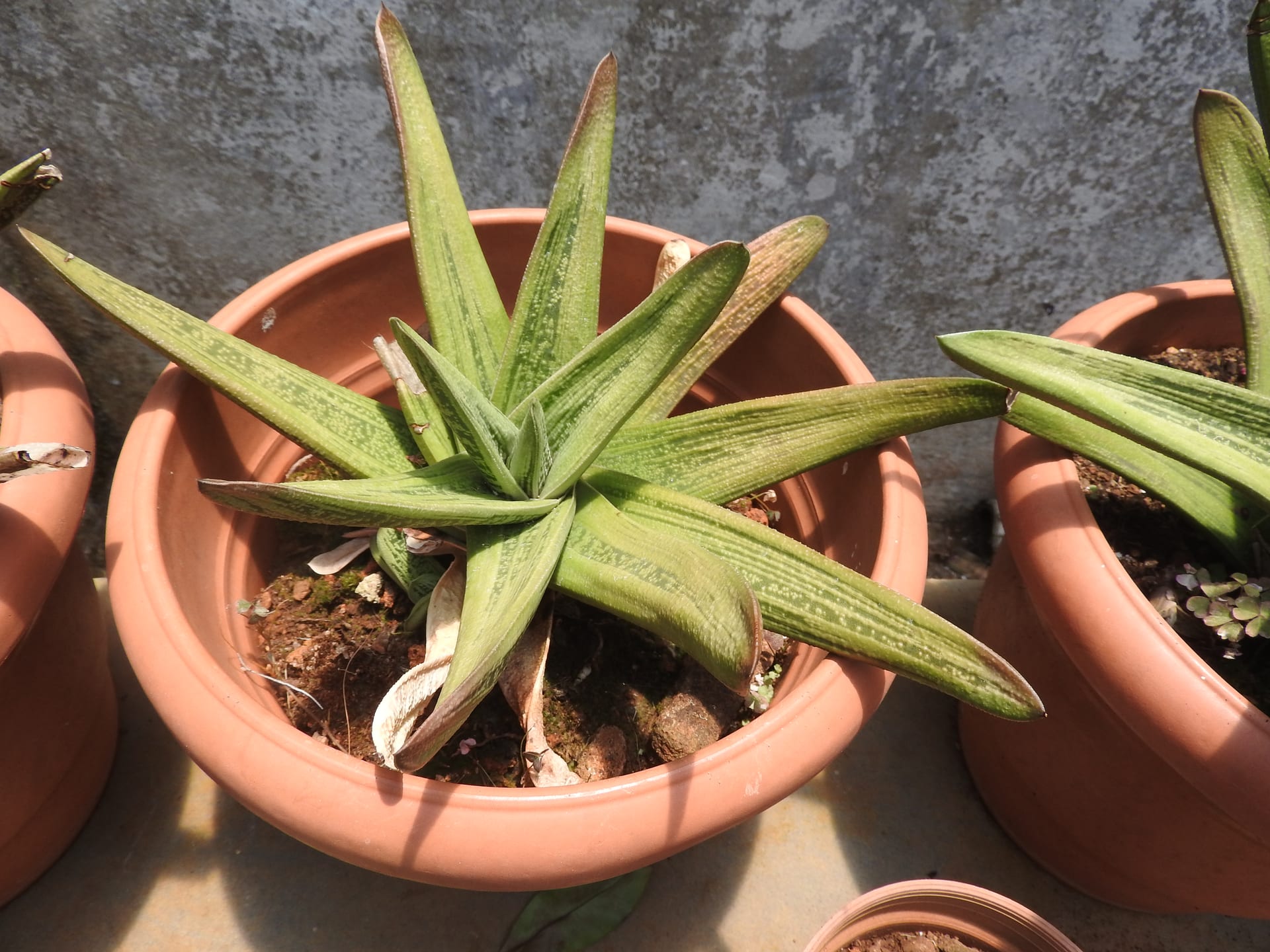
Source: Wikimedia Commons
Gasteria 'Little Warty'
BeginnerGasteria 'Little Warty'
A hybrid Gasteria with firm, tongue-shaped leaves marked with silvery-green stripes and pearly white warts. Bred in Australia, and plants differ slightly in how the pattern shows.
About
'Little Warty' is a garden hybrid in the genus Gasteria (Asphodelaceae), reportedly bred by Australian hybridiser David Cumming from G. batesiana and the cultivar 'Old Man Silver'. It is nearly stemless, with thick, firm leaves arranged in two ranks or a loose spiral. Leaves are bright green, darkening in strong light, and both faces carry raised pale silvery-green to olive stripes and many small pearly warts, which are the key to recognising it. The leaf tip is rounded with a short point. The cultivar is somewhat unstable, and several slightly different clones are sold under the same name. Similar hybrids such as 'Lime Warty' and 'Lizard Warts' exist, so check the stripe and wart pattern on the plant itself rather than relying on the label. It grows slowly but is tough, offsets well and tolerates bright shade, which makes it a good indoor plant. In Japan it is a staple succulent at garden centres and online shops, and variegated plants are also seen.
Basic Info
Origin
Garden hybrid (bred in Australia)
Lifespan
Long-lived perennial (little published data on lifespan)
Size
Nearly stemless rosette; little published data on size
Temperature
5〜35℃
Humidity
30〜50%
Watering & Fertilizer
A little slow-release fertiliser when repotting in spring
Growing Tips
Light & Placement
Keep it in bright shade with good airflow all year. Summer sun scorches the leaves; a little sun gives a reddish tint and a more compact plant.
Watering
Water thoroughly when the soil dries in spring and autumn; in midsummer and winter give only enough to moisten the surface. Pour from the pot rim so the leaves stay dry.
Temperature & Overwintering
It is not very cold-hardy; bring it indoors to a bright spot for winter.
Soil & Repotting
The roots are thick and long, so use a deep pot and a free-draining mix. Repot in April-May, removing dead roots and leaves, and take care not to let the roots dry out or snap.
Propagation
Detach offsets when repotting, or take a lower leaf, dry the cut for 2-3 days and insert it shallowly. As a hybrid it does not come true from seed.
Pests & Cautions
Watch for soft rot in hot, humid weather and keep it out of prolonged rain. Scale insects gather at the leaf bases in hot, dry spells; remove them as soon as you see them.
Gasteria 'Little Warty' FAQ
QWhat is the growing difficulty level for Gasteria 'Little Warty'?
Beginner. A variety suitable for beginners. No special equipment or experience is required—you can grow it without problems by setting up a basic cultivation environment.
QHow should I water and fertilize Gasteria 'Little Warty'?
Gasteria 'Little Warty': watering & fertilizer — A little slow-release fertiliser when repotting in spring. Aim for appropriate frequency and amount.
QWhat is the typical price for Gasteria 'Little Warty'?
The price of Gasteria 'Little Warty' varies significantly by variety, characteristics, size, and lineage. Please check GrowerDirect's price guide for the latest market information.
Last updated: September 23, 2026
References & Sources
Edited & verified by: GrowerDirect Editorial Team
The classifications, regulations, and growing data on this page are created and verified based on the primary information database below.
Taxonomy & Authority
Accepted name: Gasteria 'Little Warty'
Synonyms: Gasteria batesiana 'Little Warty', Gasteria maculata 'Little Warty'
Authority databases: GBIF · GBIF: Gasteria(属)
Nomenclature follows global taxonomic authority databases.
Regulations & Conservation Status
Gasteria is not listed in CITES (checked on Species+). This cultivar is not a registered variety under Japan's Plant Variety Protection Act, and no special procedure is needed for transfers within Japan.
Sources: Species+ (CITES): Gasteria / MAFF Plant Variety Registration Database
Regulations may change. Always verify the latest information with the relevant authorities.
Related Species
Find listings for this species
Related Articles
Complete Guide to Growing Gasteria | Species, Watering, and Propagation Explained
Complete guide to basic Gasteria care. This guide introduces popular varieties and their characteristics, location selection that makes use of strong shade tolerance, watering and fertilizer application, and propagation through leaf propagation and division.
Autumn Preparation Management for Summer-Type Succulents
A guide to autumn care for summer-type succulents, covering plant changes from September to November, timing for gradual watering reduction, placement and temperature management for transitioning plants indoors, autumn fertilizing and pest control, variety-specific care checkpoints, and preparation for winter dormancy.
Mealybug Control on Succulents | Complete Guide to Early Detection, Removal, and Prevention
Mealybugs hide easily at the base of succulent leaves and on new growth. This guide covers their characteristics, the environments where they thrive, tips for early detection, removal methods using cotton swabs and alcohol, and daily care practices to prevent recurrence.
Summer and Winter Type Succulents: Growth Cycles and Watering Management Strategy
This article explains the differences in growth types of succulent plants, their annual growth cycles, seasonal watering management strategies, common failures, and countermeasures.
🩺 Common diseases
Can't find the plant you're looking for?
Post your wishes for free and growers with matching plants will contact you with introductions.