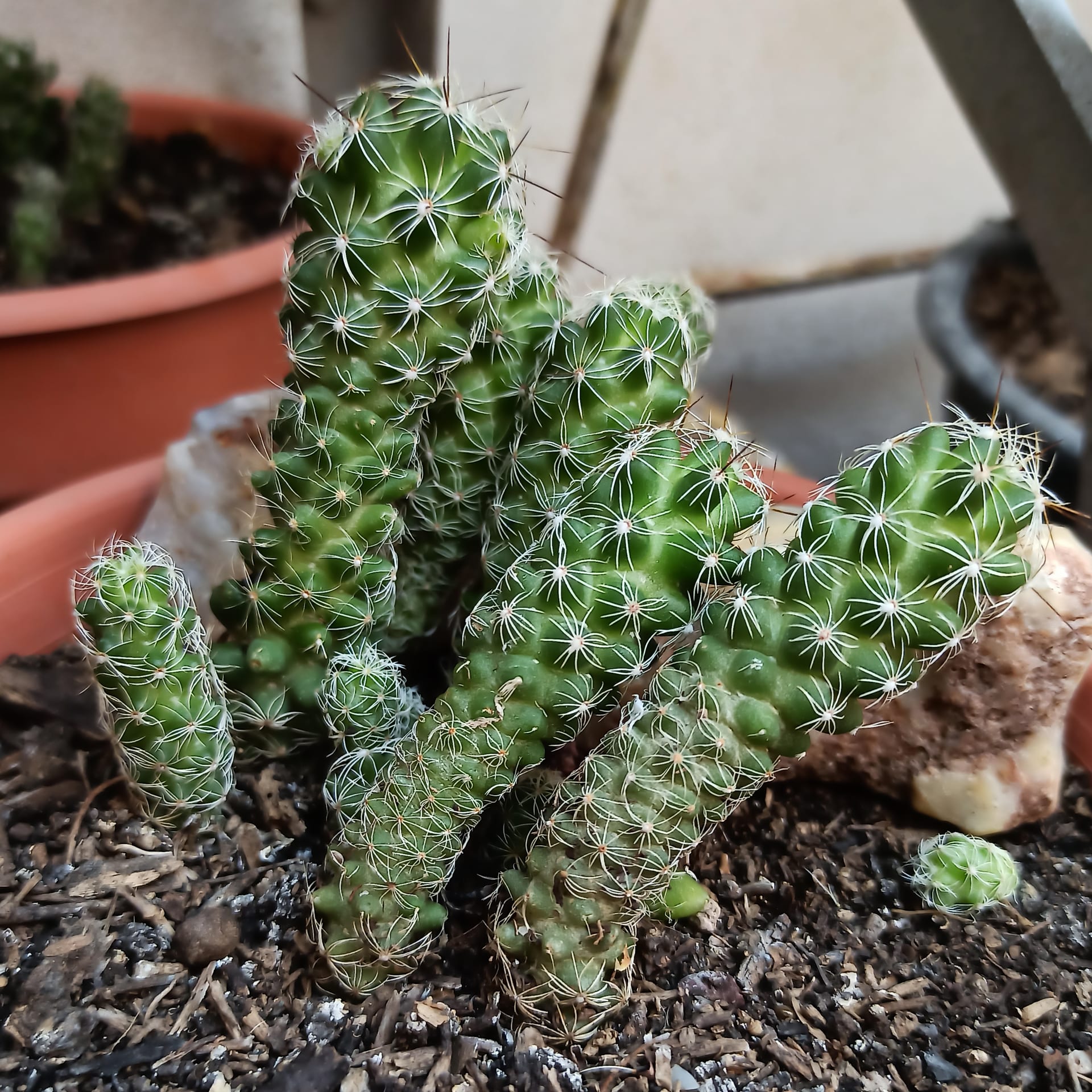
Source: Wikimedia Commons
Thimble cactus
BeginnerMammillaria vetula subsp. gracilis
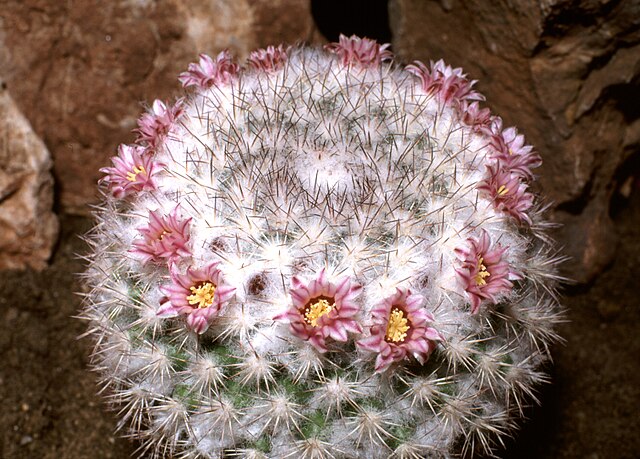
A Mammillaria whose small, slender cylindrical stems are clad in stiff white spines and cluster like handballs. Offsets drop off easily and root readily.
About
Mammillaria gracilis is now treated as a subspecies of M. vetula, though it is still widely sold under its old name. It comes from the Mexican states of Hidalgo and Querétaro. The slender, cylindrical, bright green stems are covered in fairly stiff white spines. It offsets freely from the sides and top to form clusters, and the offsets detach easily and root wherever they fall. In January-February it bears modest yellowish-cream flowers; a pink-flowered form is also sold. Its readily detached offsets and dense clusters of small stems distinguish it from other white-spined Mammillarias such as the hairy M. hahniana and M. bocasana. It is very tough, reportedly tolerating strong sun, long drought and light frost; growth is slow, and once settled it is content in the same pot and soil for years. In Japan it is sold as a mini cactus at garden centres and home stores, especially around flowering time.
Basic Info
Origin
Mexico (Hidalgo and Querétaro)
Lifespan
Perennial (little published data on lifespan)
Size
Small and clustering; little published data on stem size
Temperature
5〜35℃
Humidity
30〜50%
Watering & Fertilizer
Dilute liquid fertiliser about every two weeks in April to mid-July and September-October
Growing Tips
Light & Placement
It loves strong light; without enough sun it loses shape and will not flower. Grow it outdoors in full sun, in a greenhouse or a cold frame. Plants raised in shade burn if moved suddenly into strong sun, so acclimatise them gradually.
Watering
Cacti are grown much like summer-growing succulents. Water thoroughly when the soil dries, but less in midsummer, keeping it where water dries quickly. Growing it on the dry side gives a neat, compact plant. Keep it dry in winter.
Temperature & Overwintering
The safe minimum is about 3°C. It reportedly tolerates light frost, but keep it dry in a bright, frost-free place in winter.
Soil & Repotting
Use a mineral, free-draining mix. It grows slowly, so repot only once offsets fill the pot.
Propagation
Detached offsets root easily as cuttings in spring or summer; it can also be raised from seed.
Pests & Cautions
Offsets detach easily, so handle the plant gently when moving or repotting it; fallen offsets may root on their own around the pot.
Thimble cactus FAQ
QWhat is the growing difficulty level for Thimble cactus?
Beginner. A variety suitable for beginners. No special equipment or experience is required—you can grow it without problems by setting up a basic cultivation environment.
QHow should I water and fertilize Thimble cactus?
Thimble cactus: watering & fertilizer — Dilute liquid fertiliser about every two weeks in April to mid-July and September-October. Aim for appropriate frequency and amount.
QWhat is the typical price for Thimble cactus?
The price of Thimble cactus varies significantly by variety, characteristics, size, and lineage. Please check GrowerDirect's price guide for the latest market information.
Last updated: September 23, 2026
References & Sources
Edited & verified by: GrowerDirect Editorial Team
The classifications, regulations, and growing data on this page are created and verified based on the primary information database below.
Taxonomy & Authority
Accepted name: Mammillaria vetula subsp. gracilis (Pfeiff.) D.R.Hunt
Synonyms: Mammillaria gracilis Pfeiff., Mammillaria fragilis Salm-Dyck, Escobariopsis gracilis (Pfeiff.) Doweld
Authority databases: GBIF · GBIF: Mammillaria vetula subsp. gracilis
Nomenclature follows global taxonomic authority databases.
Regulations & Conservation Status
Listed in CITES Appendix II as part of Cactaceae spp. International trade requires permits; no registration is needed for transfers within Japan.
Sources: Species+ (CITES): Mammillaria vetula
Regulations may change. Always verify the latest information with the relevant authorities.
Related Species
Find listings for this species
Related Articles
Complete Guide to Growing Mammillaria | Enjoying the Charm of Small Cacti Through Multi-headed Plants
This guide explains how to grow Mammillaria, a small cactus that readily clusters. It covers soil, watering, spring blooming in flower-ring formations, and propagation using offsets—introducing in detail how to enjoy growing multi-headed plants.
Pot Selection and Growth Rate Management for Pachypodium Gracilius
Cultivating Pachypodium gracilius requires careful pot selection and growth rate management. By combining proper drainage, staged repotting, and coordinated management of fertilization, light, and temperature, you can develop healthy specimens with enlarged trunk diameters.
Autumn Preparation Management for Summer-Type Succulents
A guide to autumn care for summer-type succulents, covering plant changes from September to November, timing for gradual watering reduction, placement and temperature management for transitioning plants indoors, autumn fertilizing and pest control, variety-specific care checkpoints, and preparation for winter dormancy.
Mealybug Control on Succulents | Complete Guide to Early Detection, Removal, and Prevention
Mealybugs hide easily at the base of succulent leaves and on new growth. This guide covers their characteristics, the environments where they thrive, tips for early detection, removal methods using cotton swabs and alcohol, and daily care practices to prevent recurrence.
🩺 Common diseases
Can't find the plant you're looking for?
Post your wishes for free and growers with matching plants will contact you with introductions.