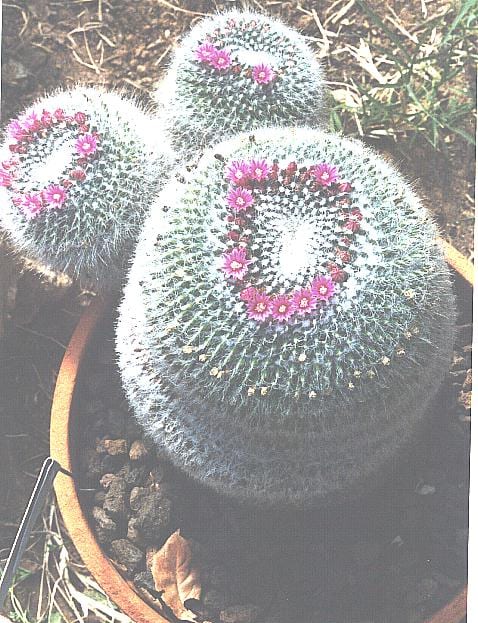
Source: Wikimedia Commons
Old lady cactus
BeginnerMammillaria hahniana
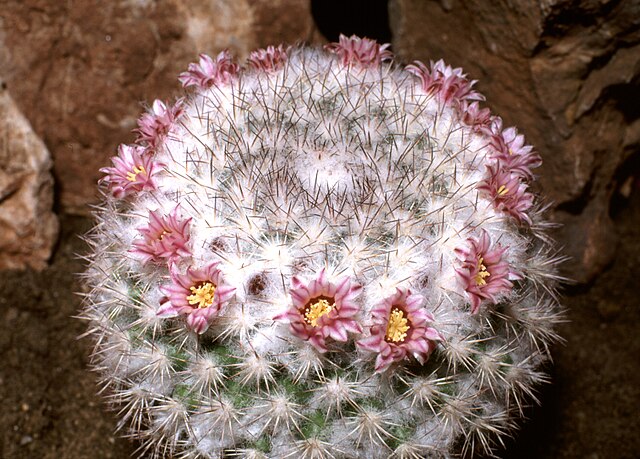
A Mammillaria whose globular stems are wrapped in long, fine white hairs. It rings the crown with small purplish-red flowers and blooms freely even when young.
About
Mammillaria hahniana is a cactus from central Mexico (Guanajuato, San Luis Potosí and Querétaro) at 750-2,200 m, on fairly steep slopes in submontane scrub and deciduous forest. Its small range, illegal collecting and deforestation have led the IUCN to list it as Near Threatened. Stems are globular at first, later cylindrical, up to about 9 cm tall and 10 cm across. Fine, soft white hairs grow from the axils, up to 5 cm long in some plants, covering the whole body and becoming denser and longer with age, its chief feature. Spines are 20-30 white, hair-like radials and 1-4 short, red-tipped centrals. From late winter to spring it produces purplish-red to pink flowers 12-15 mm across in a ring around the crown, followed by red club-shaped fruit. It grows fairly quickly and offsets into clumps that can reach about 50 cm wide. It holds the RHS Award of Garden Merit and is easy to grow. In Japan it is a standard white-haired Mammillaria sold everywhere from garden centres to specialists.
Source: Wikipedia (CC BY-SA 4.0)
Size of the Old lady cactus
The Old lady cactus grows to Stems about 9 cm tall and 10 cm across; clumps may reach about 50 cm wide.
Basic Info
Origin
Central Mexico (Guanajuato, San Luis Potosí, Querétaro; 750-2,200 m)
Lifespan
Perennial (little published data on lifespan)
Size
Stems about 9 cm tall and 10 cm across; clumps may reach about 50 cm wide
Temperature
5〜35℃
Humidity
30〜50%
Watering & Fertilizer
A little potassium-rich fertiliser in summer
Growing Tips
Light & Placement
It likes sun: outdoors give full sun or afternoon shade, and indoors a bright spot with some direct sun.
Watering
Cacti are grown much like summer-growing succulents. Water regularly in summer but avoid overwatering, as it rots easily; keep it dry in winter.
Temperature & Overwintering
Kept dry it is fairly cold-tolerant, reportedly to about -5°C, but in frost-prone areas winter it indoors or in a frame.
Soil & Repotting
Use a very porous mix in a well-drained pot, and allow room for it to spread into a clump.
Propagation
Propagate by dividing clumps or from seed.
Pests & Cautions
It rots easily when overwatered, so keep it somewhere airy where the soil dries quickly. It grows fast and clumps, so give it plenty of space.
Old lady cactus FAQ
QWhat is the growing difficulty level for Old lady cactus?
Beginner. A variety suitable for beginners. No special equipment or experience is required—you can grow it without problems by setting up a basic cultivation environment.
QHow large does Old lady cactus get?
The mature size of Old lady cactus is Stems about 9 cm tall and 10 cm across; clumps may reach about 50 cm wide. This may vary slightly depending on cultivation environment and individual differences.
QHow should I water and fertilize Old lady cactus?
Old lady cactus: watering & fertilizer — A little potassium-rich fertiliser in summer. Aim for appropriate frequency and amount.
QWhat is the typical price for Old lady cactus?
The price of Old lady cactus varies significantly by variety, characteristics, size, and lineage. Please check GrowerDirect's price guide for the latest market information.
Last updated: September 23, 2026
References & Sources
Edited & verified by: GrowerDirect Editorial Team
The classifications, regulations, and growing data on this page are created and verified based on the primary information database below.
Taxonomy & Authority
Accepted name: Mammillaria hahniana Werderm.
Synonyms: Neomammillaria hahniana (Werderm.) Y.Itô, Mammillaria woodsii Krainz
Authority databases: GBIF · GBIF: Mammillaria hahniana
Nomenclature follows global taxonomic authority databases.
Regulations & Conservation Status
Listed in CITES Appendix II as part of Cactaceae spp. International trade requires permits; no registration is needed for transfers within Japan.
Sources: Species+ (CITES): Mammillaria hahniana
Regulations may change. Always verify the latest information with the relevant authorities.
Related Species
Find listings for this species
Related Articles
Complete Guide to Growing Mammillaria | Enjoying the Charm of Small Cacti Through Multi-headed Plants
This guide explains how to grow Mammillaria, a small cactus that readily clusters. It covers soil, watering, spring blooming in flower-ring formations, and propagation using offsets—introducing in detail how to enjoy growing multi-headed plants.
Autumn Preparation Management for Summer-Type Succulents
A guide to autumn care for summer-type succulents, covering plant changes from September to November, timing for gradual watering reduction, placement and temperature management for transitioning plants indoors, autumn fertilizing and pest control, variety-specific care checkpoints, and preparation for winter dormancy.
Mealybug Control on Succulents | Complete Guide to Early Detection, Removal, and Prevention
Mealybugs hide easily at the base of succulent leaves and on new growth. This guide covers their characteristics, the environments where they thrive, tips for early detection, removal methods using cotton swabs and alcohol, and daily care practices to prevent recurrence.
Summer and Winter Type Succulents: Growth Cycles and Watering Management Strategy
This article explains the differences in growth types of succulent plants, their annual growth cycles, seasonal watering management strategies, common failures, and countermeasures.
🩺 Common diseases
Can't find the plant you're looking for?
Post your wishes for free and growers with matching plants will contact you with introductions.