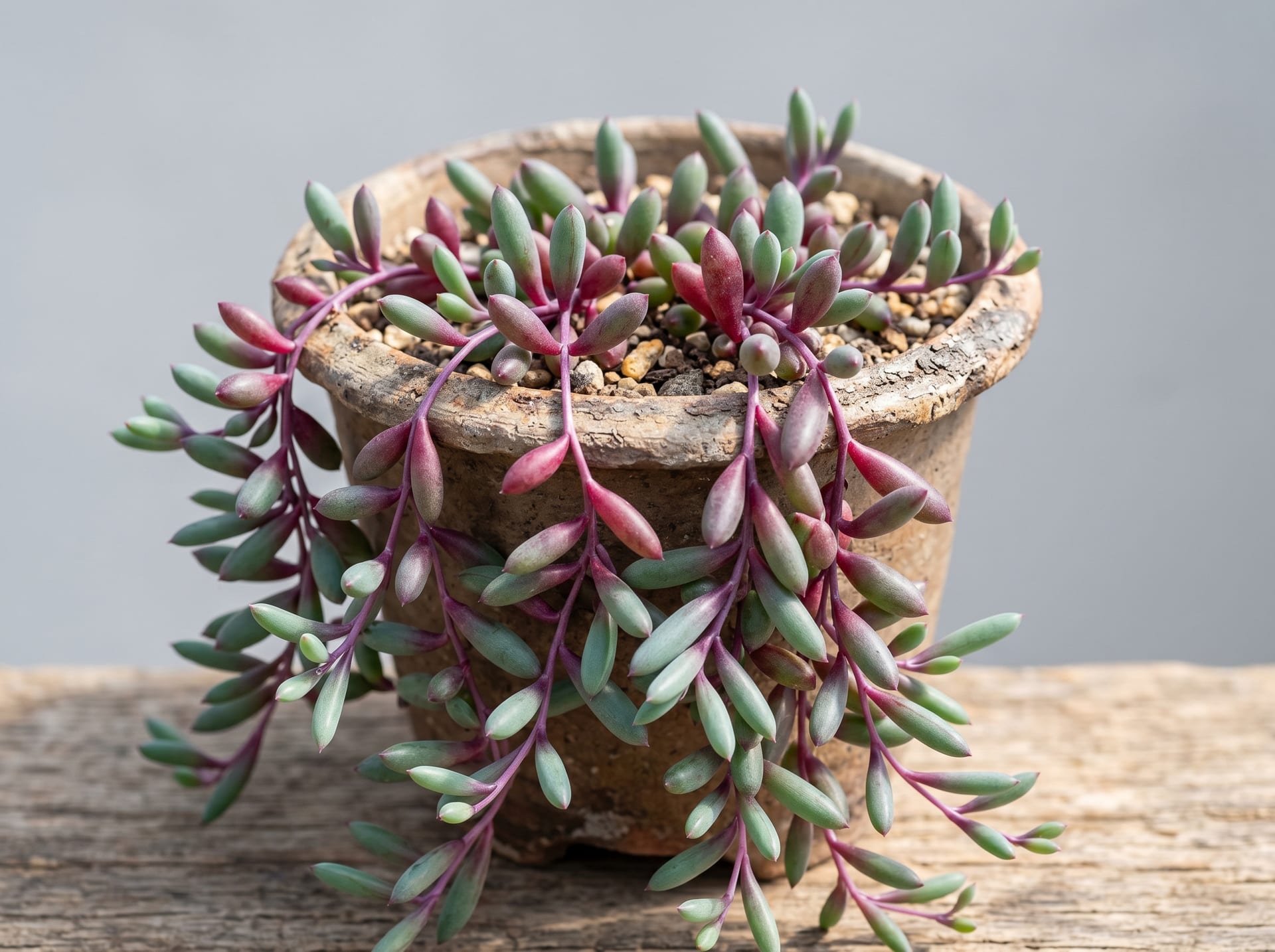
AI-generated image
Ruby Necklace
BeginnerOthonna capensis
A purple-tinged red trailing succulent. Leaves turn vivid purple-red when temperatures drop. Similar care to String of Pearls, popular for hanging displays.
About
Ruby Necklace (Othonna capensis) is a trailing succulent in the family Asteraceae, native to the Cape Province of South Africa. In standard conditions the plant produces elongated, banana-shaped leaves in green to blue-green, but cool temperatures, bright sun, and drought stress trigger vivid coloration ranging from deep purple to ruby-red—the source of its popular name. It superficially resembles String of Pearls (Curio rowleyanus) but differs in leaf shape and more intense seasonal coloration. Small yellow flowers are produced in autumn. Stems trail 30–60 cm. Plants prefer bright light to full sun and tolerate direct sunlight better than many trailing succulents. Watering should be conservative with good drainage. Cold tolerance extends to approximately 0–5°C. Propagation by stem cuttings is straightforward.
Basic Info
Origin
South Africa (Cape Province)
Lifespan
Perennial
Size
Trailing (30-80cm)
Temperature
5〜30℃
Humidity
30〜50%
Watering & Fertilizer
Water sparingly. Keep on dry side
Growing Tips
Light
Sun intensifies ruby-red coloring
Watering
When soil dries. Reduce in winter
Color
Beautiful purple-red in autumn-winter cool
Display
Best displayed hanging
Ruby Necklace FAQ
QWhat is the growing difficulty level for Ruby Necklace?
Beginner. A variety suitable for beginners. No special equipment or experience is required—you can grow it without problems by setting up a basic cultivation environment.
QWhat is the ideal temperature for Ruby Necklace?
The ideal temperature for Ruby Necklace is 5〜30℃. Recommended humidity is 30〜50%. Avoid sudden temperature changes and maintain a stable environment.
QWhat is the lifespan of Ruby Necklace?
The average lifespan of Ruby Necklace is Perennial. With proper cultivation environment and nutrient management, you can keep it healthy for a long time.
QHow large does Ruby Necklace get?
The mature size of Ruby Necklace is Trailing (30-80cm). This may vary slightly depending on cultivation environment and individual differences.
QHow should I water and fertilize Ruby Necklace?
Ruby Necklace: watering & fertilizer — Water sparingly. Keep on dry side. Aim for appropriate frequency and amount.
QWhat is the typical price for Ruby Necklace?
The price of Ruby Necklace varies significantly by variety, characteristics, size, and lineage. Please check ボタちょく's price guide for the latest market information.
Last updated: June 24, 2026
References & Sources
Edited & verified by: BoTachoku Editorial Team
The classifications, regulations, and growing data on this page are created and verified based on the primary information database below.
Primary sources
Taxonomy & Authority
Regulations & Conservation Status
Sources: CITES Appendices — taxon not listed
Regulations may change. Always verify the latest information with the relevant authorities.
Related Species
Find listings for this species
Related Articles
How to Grow Senecio (String of Pearls) | Watering Trailing Succulents and Rejuvenation
Master watering tips for Senecio succulents like String of Pearls, Ruby Necklace, and String of Bananas. Learn how to address drooping or bursting beads, and rejuvenate plants through propagation.
How to Create Succulent Massed Plantings | Tips for Mixed Containers and Seasonal Management
Techniques for creating massed succulent plantings by combining multiple varieties in a single container. This guide provides practical explanations of the complete process: variety selection, soil and container choice, layout design, planting methods, and seasonal care.
Tips for Bringing Out Beautiful Fall Colors in Succulents | Seasonal Color Development Through Care Methods and Variety Selection
The secret to succulents' beautiful fall and winter colors. This guide explains the mechanisms of color development, light, temperature, and watering management to bring out vibrant autumn hues, and recommendations for the best colored varieties.
A Complete Guide to Growing Aloe | Sunlight, Watering, and Propagation by Offsets
From the basic characteristics of aloe, a drought-hardy succulent, to detailed guidance on sunlight, watering, repotting, propagation through offset division, and root rot prevention.