Complete Guide to Growing Bucephalandra | Attachment Methods and Choosing Popular Varieties
Detailed guide on how to cultivate Bucephalandra, an aquatic plant native to Borneo. We introduce attachment methods, water quality management, propagation techniques, and popular varieties' characteristics and selection tips.
Key Takeaways
Detailed guide on how to cultivate Bucephalandra, an aquatic plant native to Borneo. We introduce attachment methods, water quality management, propagation techniques, and popular varieties' characteristics and selection tips.
Related Species
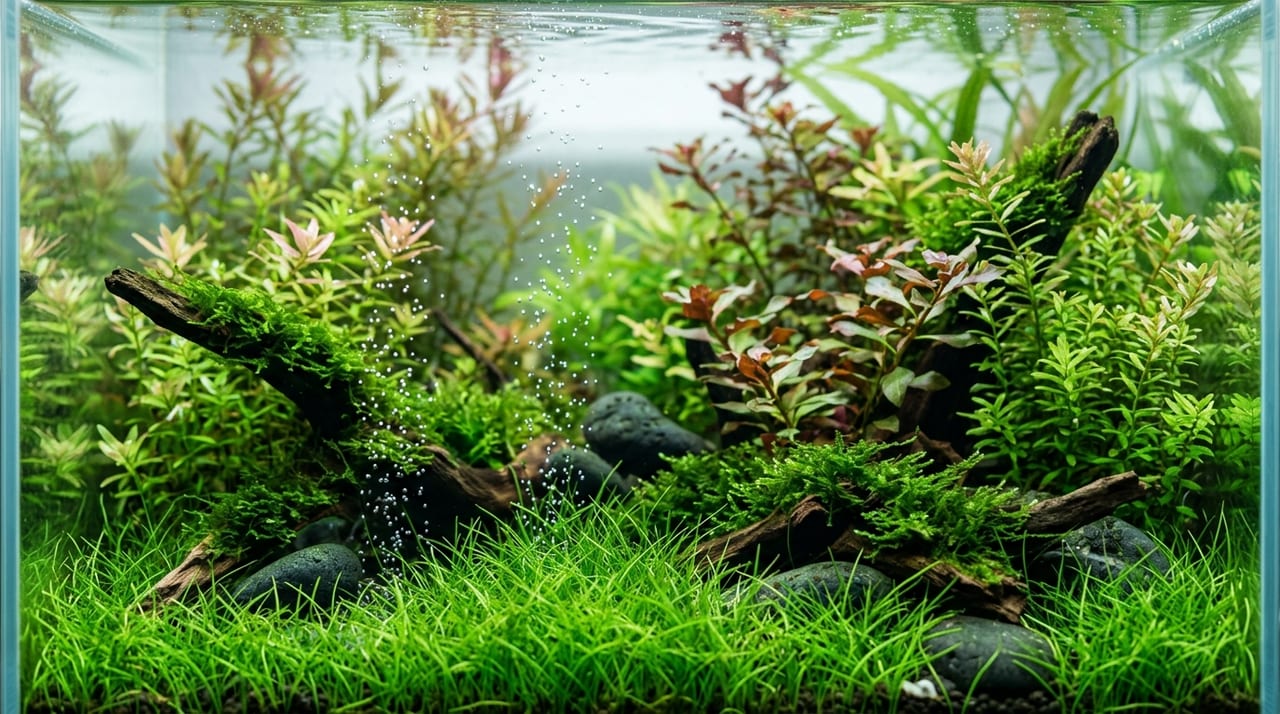
Bucephalandra is an aquatic plant of the Araceae family native to rivers in Borneo, and it's popular for its beautiful leathery leaves and diverse variations. It's hardy, easy to grow, and can thrive under low light, making it recommended for beginners, but it's also popular among collectors for its depth and complexity. In this article, we'll introduce how to cultivate Bucephalandra and popular varieties.
Characteristics and Appeal of Bucephalandra
Bucephalandra is an Araceae aquatic plant closely related to Anubias, native to rocky areas in rivers and streams of Borneo (Kalimantan). Its greatest appeal is the beauty of its leaves, which come in diverse colors depending on the variety—green, blue, reddish-purple, and deep navy. The leaves have a distinctive shimmer-like luster (iridescent brilliance) on the surface, which gleams like a jewel when illuminated underwater. There's also plenty of variation in leaf shape—some varieties have wavy leaf margins, others have narrow elongated leaves, and still others have round leaves. Growth is extremely slow, with only 1–2 new leaves unfolding per month, but this also means trimming requires almost no effort. It can be grown not only submerged but also emersed, and since the emersed leaves are sufficiently beautiful, it can also be used in terrariums and paludariums. It can also produce flowers, and the sight of small white flowers extending from underwater toward the water surface is another point of interest.
Attachment Methods and Planting
The basic approach is to cultivate Bucephalandra by attaching it to driftwood or stones. It's a rhizomatous plant, and since burying the rhizome can lead to rot, avoid planting it directly in the substrate. There are several methods for attachment.
- The cotton thread method is the most popular; the cotton thread naturally dissolves within a few weeks, by which time the Bucephalandra will have attached itself on its own.
- The fishing line (nylon thread) method maintains holding power for an extended period, but since the thread remains after attachment, it somewhat affects the appearance.
- Bonding directly to driftwood or stones with instant adhesive (gel type) is also common. The adhesive will whiten in water but will eventually be hidden by algae or other aquatic plants.
- There's also a method using stainless steel specialized pins for fixation.
Regardless of the method, the key to successful attachment is securing the rhizome so it makes close contact with the surface of the driftwood or stone.
Water Quality and Environmental Management
Bucephalandra adapts to a wide range of water conditions. The cultivation guidelines are as follows.
| Item | Guideline |
|---|---|
| Water Quality | Prefers soft water with weak acidity to neutral pH (6.0–7.5) |
| Water Temperature | 22–28°C is appropriate. Sustained high temperatures (30°C or above) risk leaf melt |
| Lighting | Low to moderate light is sufficient. Excessively strong light easily leads to algae attachment |
| CO2 Addition | Not essential, but addition slightly accelerates growth and intensifies leaf color |
| Fertilizer | It's safest to apply liquid fertilizer at around half the recommended dose |
| Water Changes | Perform weekly, aiming for about one-third of the total |
Excess nutrients cause algae, and since slow-growing Bucephalandra is easily covered by algae, care is needed. Sudden water quality changes cause "melt," so avoid large water changes. A few leaves may melt shortly after introduction to a new environment, but once acclimated, it will begin to unfold new leaves, so there's no need to worry.
Propagation and Trimming
Division is the basic method of propagating Bucephalandra. Once the rhizome has grown and multiple growth points have formed, divide it with clean scissors or a cutter. Dividing so that each division retains at least 3–4 leaves will speed recovery after division. Keep the cut surface clean to prevent contamination from entering through the wound. The best time for division is when the plant is in good condition; avoid doing it immediately after introduction or during unstable conditions. Trimming is basically unnecessary, but old or damaged leaves should be cut off at the base and removed. Algae easily attaches to old leaves, and leaving them will spoil the appearance of the entire plant, so tidy up regularly. Because growth is slow, it's difficult to propagate in large quantities, but a well-developed colony cultivated over time is extremely impressive.
Popular Varieties Guide to Bucephalandra
While there are countless varieties of Bucephalandra, we'll introduce some of the most popular ones.
- 'Kedah' is the flagship Bucephalandra variety, featuring deep green leaves with a strong shimmer. It's easy to obtain and easy to grow, making it recommended for a first Bucephalandra.
- 'Ghost' is a variety with translucent thin leaves that have an ethereal atmosphere. It's somewhat delicate but displays unique brilliance under lighting.
- The 'Brownie' series is a group of varieties with leaf color ranging from brown to reddish-brown, with variations including Brownie Ghost and Brownie Blue.
- 'Shintan' is characterized by narrow, elongated leaves, and its unique form stands out in stone-based layouts.
- 'Biblis' is a large variety with strongly wavy leaves.
Identifying varieties is difficult, and even the same name can look different depending on origin or individual. Purchasing from a trusted grower with origin information is the best way to ensure variety accuracy.
Bucephalandra Troubleshooting
We'll introduce common troubles encountered when cultivating Bucephalandra and their solutions.
| Symptom | Cause | Solution |
|---|---|---|
| "Leaves melted" | Sudden environmental change | Avoid abrupt changes in water quality and temperature, and maintain a stable environment. Remove melted leaves promptly; if the rhizome is firm and healthy, new leaves will unfold within a few weeks |
| "Algae on leaves" | Lighting too strong or fertilizer excessive | Reduce lighting duration by 1–2 hours and decrease liquid fertilizer. Introducing algae-eating fauna (Amano shrimp, plecos) is also effective |
| "Growth stopped" | Insufficient nutrient absorption due to poor rhizome attachment to driftwood or stone | Check the rhizome's attachment status and review the fixation |
| "Leaf color faded" | Deficiency of trace elements (especially iron) | Add a small amount of liquid fertilizer containing iron |
Bucephalandra Flowers and Propagation
Bucephalandra can produce flowers both submerged and emersed. The flowers are small and white, with the spathe shape characteristic of the Araceae family. Flowering itself is evidence of plant health and requires no special care. Since the flower stalk extends toward the water surface, if the water level is low, the flowers emerge above water and are easier to observe. Propagation is mainly by division, but it's theoretically possible to collect seeds from flowers and propagate from them. However, growing from seed is extremely time-consuming, so division is more practical.
Acquire Rare Bucephalandra at GrowerDirect
Bucephalandra has an enormous number of varieties, with countless variations depending on origin and type, such as Kedah, Ghost, Shintan, and Brownie. Rare varieties have limited distribution and are often difficult to find in shops. Through GrowerDirect, you can purchase directly from growers specializing in Bucephalandra cultivation and get accurate variety identification information and cultivation advice. Because it's such a highly collectible aquatic plant, we recommend obtaining it from a trusted grower.