Complete Guide to Growing Calathea | Management Techniques for Maintaining Beautiful Leaf Patterns
A thorough explanation of Calathea varieties and growing techniques. We introduce humidity management, watering, the causes and solutions for leaf curling and wilting problems, and how to choose varieties for beginners.
Key Takeaways
A thorough explanation of Calathea varieties and growing techniques. We introduce humidity management, watering, the causes and solutions for leaf curling and wilting problems, and how to choose varieties for beginners.
Related Species
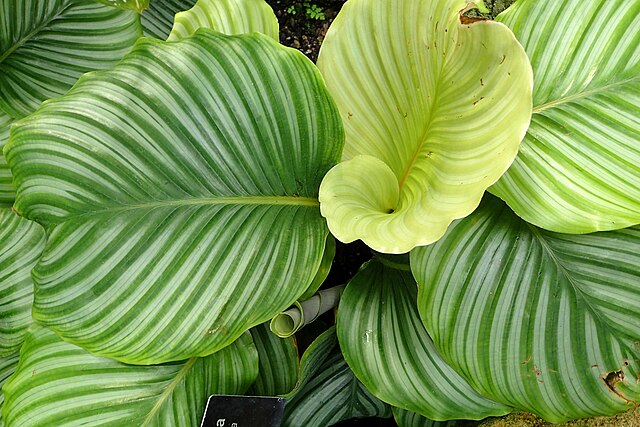
Calathea (Calathea) is a foliage plant native to the tropical rainforests of South America, prized for its exquisitely detailed geometric patterned leaves. At night it folds its leaves upright, and in the morning it opens them—a characteristic "sleep movement" that has earned it the nickname "living art." However, despite its beauty, it requires careful management, and it is a plant that beginners often struggle to keep alive. Here we explain in detail the key points for growing Calathea beautifully.
Popular Calathea Varieties and Characteristics
Calathea has many varieties in circulation, with abundant variation in leaf patterns and colors. In recent taxonomic classification, it has been reclassified to the genus Goeppertia, but in horticulture the name Calathea continues to be widely used. Representative varieties and their characteristics are as follows.
| Variety | Leaf Characteristics | Cultivation Points |
|---|---|---|
| Calathea orbifolia | Large rounded leaves with silver-toned striped patterns; the large, impactful leaves make it perfect as a centerpiece in interior design | Relatively hardy; recommended as an introductory Calathea |
| Calathea makoyana (Peacock Plant) | A representative variety with peacock feather-like patterns on the leaf surface. The reverse is red-purple, creating beautiful contrast between the front and back | Requires some attention to care, but its beauty is exceptional |
| Calathea lancifolia | Slender leaves with distinctive dark green patterns | Somewhat more drought-tolerant than other varieties; an easy-to-grow variety even for beginners |
| Calathea White Star | A beautiful variety with white variegation, highly popular with collectors | The more variegated portions present, the more prone to sunburn; careful attention to placement is necessary |
| Calathea Dottie | A small variety with deep purple-tinted green leaves with pink lines | Compact and space-saving; can be enjoyed even on a desk |
Humidity Management is the Key to Calathea Cultivation
Calathea grows in the lower layer of tropical rainforests and strongly prefers high humidity. Humidity management is the most critical factor determining success or failure in Calathea cultivation.
The ideal humidity is 60–80%. In Japan's summer months, naturally high humidity creates ideal conditions and Calathea thrives at its best, but in winter the heating from air conditioning causes extreme dryness in the room, with humidity sometimes dropping to 30–40%. This dryness is the primary cause of leaf tip browning and leaf curling in Calathea.
Methods to increase humidity include the following:
- Using a humidifier: The most effective method. Place an ultrasonic humidifier near the plant and run it continuously. However, white powder (mineral deposits) can accumulate on the leaves, so if this is a concern, consider a steam or hybrid model.
- Pebble tray: A method of placing a pot on stones arranged in a water-filled tray. Humidity around the pot rises slightly as water evaporates, providing supplementary humidity management. Be careful not to let the pot base become submerged in water.
- Grouping: Placing plants together increases surrounding humidity through transpiration. It is recommended to group Calathea with other high-humidity-loving plants such as Calathea relatives and ferns.
- Leaf misting (spray bottle): Has only temporary effect, but doing it regularly keeps leaves clean and helps prevent spider mites. Making morning misting a daily routine is recommended.
Watering, Light, and Temperature Management
Daily care for Calathea centers on three pillars: "appropriate moisture," "bright indirect light," and "stable temperature."
| Item | Points |
|---|---|
| Watering | The basic rule is to water when the soil surface is dry. Complete drying causes leaves to curl immediately or edges to brown, while constantly wet soil causes root rot; with well-draining soil, aim for the timing of "water when dry." Also, some Calathea varieties are sensitive to chlorine and fluorine in tap water, and direct use can cause leaf tips to turn brown; using water left to sit overnight or filtered water reduces such problems. |
| Light | Bright indirect light is ideal. Since Calathea grows in the forest understory, direct sunlight causes leaf burn. A north-facing window or soft light filtered through sheer curtains is optimal. Too little light causes leaf patterns to become unclear and the plant to become leggy, ruining its shape. |
| Temperature | 18–28°C is ideal. Below 15°C growth stops, and below 10°C the risk of death increases. In winter, place it in the center of a warm room and avoid window-side cold drafts and direct air-conditioner airflow. |
Common Problems and Solutions
Calathea is sensitive to environmental changes and problems occur easily. Representative symptoms and solutions are as follows.
| Symptom | Main Cause | Solution |
|---|---|---|
| Leaf tips turn brown | Most commonly caused by insufficient humidity. Water quality (chlorine) can also be a cause. | Increase humidity by introducing a humidifier or increasing misting frequency. Since browned leaf tips cannot be restored to their original state, trim the dried portion with scissors if appearance is a concern. Also try switching to stored water or filtered water. |
| Leaves curl (curling) | Sign of water shortage or insufficient humidity | Water immediately and mist the entire leaf with a spray bottle. Usually recovers within hours to half a day, but repeated curling accumulates leaf damage. |
| Leaf color becomes pale / patterns become unclear | Sign of insufficient light (conversely, if leaves appear whitish and burned, it indicates light is too strong) | Move to a brighter location or supplement light with plant grow LED lights. If light is too strong, avoid direct sunlight. |
| Spider mite damage | Occurs easily in dry environments; tiny red insects or cobweb-like threads visible on leaf undersides | Once discovered, immediately rinse leaves with a shower and increase humidity to prevent recurrence. |
Frequently Asked Questions and Practical Advice
Q. Why do leaf tips turn brown? A. This is the most common concern with Calathea, and the cause is almost always dry air or tap water minerals. Increase humidity with a humidifier or misting, and if improvement doesn't occur, try storing water or switch to filtered water. Also check that air conditioner airflow is not hitting the plant directly.
Q. The leaves stand upright at night. Is this abnormal? A. This is normal. Calathea performs sleep movement, folding its leaves at night and opening them in the morning. In fact, if the movement stops, that is a sign of poor health, so watch for that instead.
Q. The leaf patterns are becoming lighter. A. This happens both when light is too strong and when too weak. Leaves fade under direct sunlight, while patterns do not appear clearly on new leaves in too-dark conditions. Use a bright spot filtered through sheer curtains as a baseline, and adjust based on the color of newly emerging leaves.
Calathea Repotting and Propagation
Repot Calathea once every 1–2 years, in spring to early summer (May–July).
The soil balance between water retention and drainage is important. A mix of standard foliage plant potting soil with perlite or bark chips at 20–30% is suitable. Adding peat moss tilts it slightly acidic, creating an environment favored by Calathea.
Repot into a pot one size larger. A pot that is too large keeps soil moist too long and causes root rot, so limit increases to 1–2 sizes. Plastic pots have high water retention and are suitable for Calathea.
Propagation is done primarily by division. As Calathea grows, new shoots emerge from underground stems, enlarging the plant. At repotting time, divide the roots, ensuring each section has sufficient roots and leaves before planting. Keep humidity high after division and avoid direct sunlight.
Calathea varieties vary in difficulty level, so purchasing a healthy plant from a trusted grower is the fastest path to success. On GrowerDirect, you can consult directly with growers for advice on growing conditions and care, allowing beginners to enjoy the beauty of Calathea with confidence.