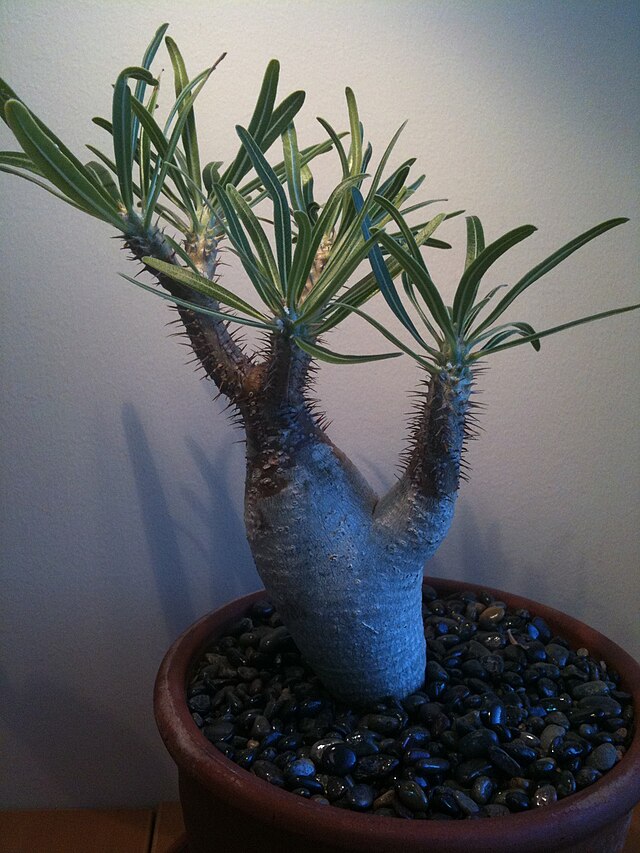
Source: Wikimedia Commons
Pachypodium Gracilius
IntermediatePachypodium gracilius
The quintessential caudex plant from Madagascar. Round caudex body with yellow flowers. Wild-collected specimens with unique forms command high prices. Seed-growing is also very popular.
Overview
Pachypodium gracilius, endemic to southwestern Madagascar, is one of the most celebrated caudex plants in cultivation. It grows in rocky arid landscapes of the central-south to southwestern parts of the island (around the Isalo massif, among other areas), developing a dramatically swollen, pear-shaped to spherical trunk covered in silver-gray skin with dense short spines. The caudex stores water and nutrients to survive extended dry seasons. Narrow, glossy leaves emerge at branch tips during the growing season, and bright yellow five-petaled flowers appear in spring to early summer. Growth is exceptionally slow, requiring decades to form a large specimen. Cultivation demands full direct sun, highly porous soil dominated by akadama, pumice, and volcanic aggregate, generous watering in the growing season, and complete drought during winter dormancy. Its sculptural form and rarity make it the icon of caudex collecting.
Source: Wikipedia (CC BY-SA 4.0)
Lifespan of the Pachypodium Gracilius
The Pachypodium Gracilius lives Several decades or more.
Size of the Pachypodium Gracilius
The Pachypodium Gracilius grows to 10-40cm (caudex diameter).
Temperature & humidity for the Pachypodium Gracilius
The ideal temperature for the Pachypodium Gracilius is 20〜35℃.
Minimum temperature is around 10°C.
Basic Info
Origin
Madagascar
Lifespan
Several decades or more
Size
10-40cm (caudex diameter)
Temperature
10〜40℃
Watering & Fertilizer
Water: thoroughly when dry in growth season / withhold after leaf drop
Growing Tips
Light & Placement
Full sun is essential. Insufficient light causes a thin caudex and etiolation, so grow it outdoors in full sun during the growing season.
Watering
In the growing season, water thoroughly once the soil dries. After leaf drop, withhold water to prevent root rot.
Temperature & Overwintering
The ideal range is 20-35°C, within an overall range of 10-40°C. Bring it indoors before temperatures fall below 10°C, and withhold water completely after leaf drop.
Soil & Repotting
An ultra-fast-draining blend based on akadama, hyuga pumice, and pumice is the rule. Repot at the start of the growing season.
Pests & Cautions
Root rot is the greatest enemy. The combination of wet soil and cold is lethal, so keep it dry through winter.
Pachypodium Gracilius FAQ
QWhat is the growing difficulty level for Pachypodium Gracilius?
Intermediate. A variety suitable for intermediate growers. Requires some cultivation experience and knowledge of environment management. Pay careful attention to temperature and humidity control.
QWhat is the ideal temperature for Pachypodium Gracilius?
The ideal temperature for Pachypodium Gracilius is 20〜35℃. Avoid sudden temperature changes and maintain a stable environment.
QWhat is the lifespan of Pachypodium Gracilius?
The average lifespan of Pachypodium Gracilius is Several decades or more. With proper cultivation environment and nutrient management, you can keep it healthy for a long time.
QHow large does Pachypodium Gracilius get?
The mature size of Pachypodium Gracilius is 10-40cm (caudex diameter). This may vary slightly depending on cultivation environment and individual differences.
QHow should I water and fertilize Pachypodium Gracilius?
Pachypodium Gracilius: watering & fertilizer — Water: thoroughly when dry in growth season / withhold after leaf drop. Aim for appropriate frequency and amount.
QWhat is the typical price for Pachypodium Gracilius?
The price of Pachypodium Gracilius varies significantly by variety, characteristics, size, and lineage. Please check GrowerDirect's price guide for the latest market information.
Last updated: October 2, 2026
Growing Specifications
- USDA Zone
- 10–11
References & Sources
Edited & verified by: GrowerDirect Editorial Team
The classifications, regulations, and growing data on this page are created and verified based on the primary information database below.
Taxonomy & Authority
Regulations & Conservation Status
Pachypodium spp. (at genus level) listed in CITES Appendix II.
Sources: CITES Appendix II species list / CITES Appendices (valid from 2023)
Regulations may change. Always verify the latest information with the relevant authorities.
Related Species
Find listings for this species
Related Articles
Pachypodium gracilius Care Guide | Growing Thick Caudex from Seed
A practical guide to caring for Pachypodium gracilius, a popular caudex plant. Covers seed propagation and cultivation, choosing the right soil and pots, summer growing season and winter dormancy management, and secrets to watering and fertilization for developing thick caudexes.
Pachypodium Species Guide | Characteristics and Differences of Gracilis, Brevicaule, and Baronii
A detailed introduction to the most popular Pachypodium species. This guide explains the characteristics and differences of Gracilis, Brevicaule, Baronii, Lamerei, and Horombense, along with cultivation tips for each.
Pachypodium Seed Propagation Guide | From Sowing to Germination and Growth
This guide explains how to grow Pachypodium from seed. We cover everything from sourcing seeds and sowing to managing germination, caring for seedlings, and the unique joys of seed propagation.
Pachypodium gracilius Seed-Grown Plant Guide | From Seed Sowing to Cultivation
A detailed guide to cultivating Pachypodium gracilius from seed, covering seed sourcing, germination, and care management. Key points for managing temperature, light, and watering are included.
🩺 Common diseases
Can't find the plant you're looking for?
Post your wishes for free and growers with matching plants will contact you with introductions.