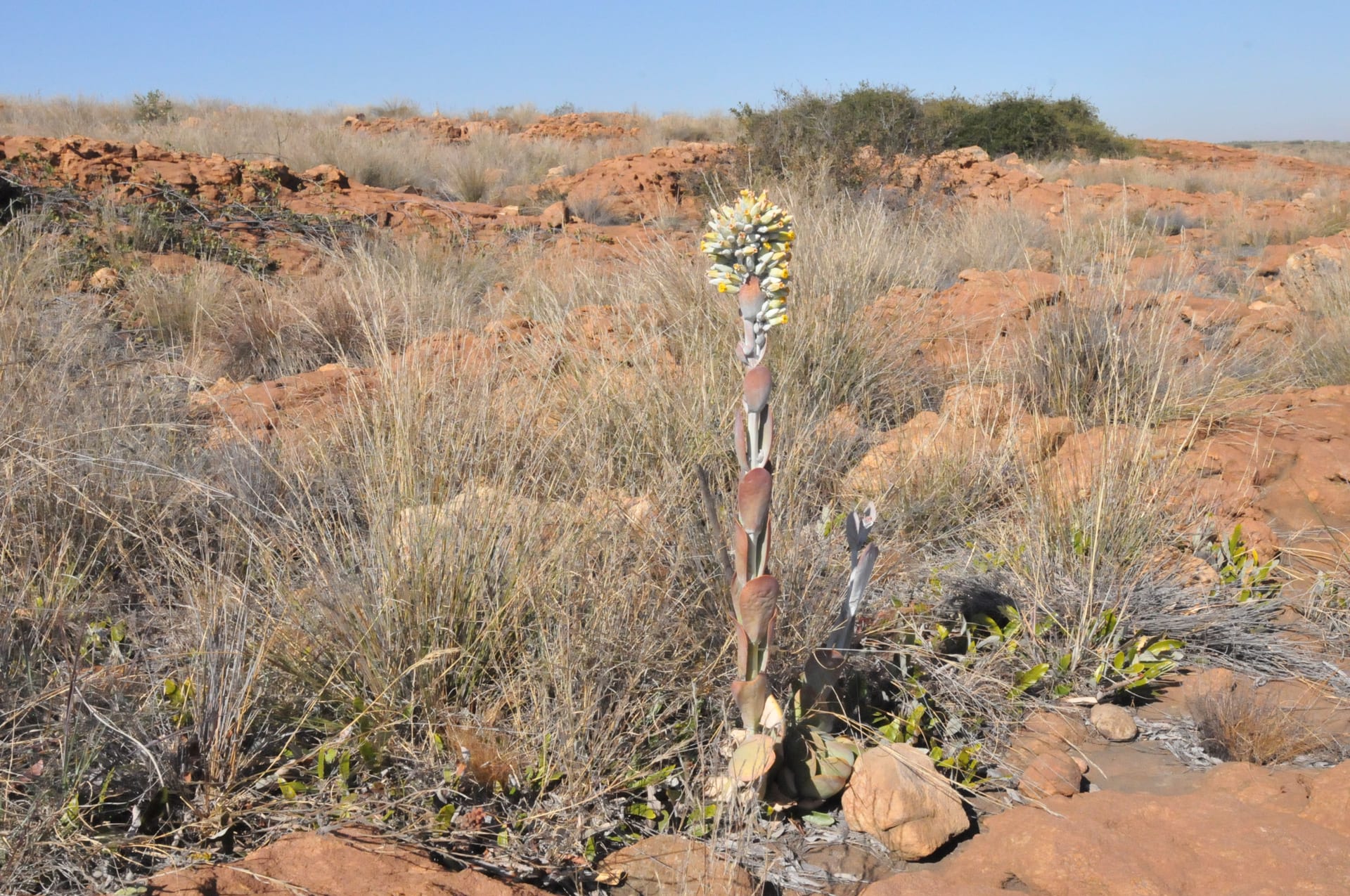
Source: Wikimedia Commons
Paddle plant
BeginnerKalanchoe thyrsiflora
A Kalanchoe with large, round, white-powdered leaves whose edges redden in sun. A rosette dies after flowering and is replaced by offsets from the base.
About
Kalanchoe thyrsiflora is a succulent in the Crassulaceae native to South Africa, Lesotho, Eswatini and Botswana, where it grows on rocky ridges in open bushveld. It forms a basal rosette of large, round, stalkless, fleshy leaves (6-)8-12(-14) cm long, grey-green under a white powdery bloom, with edges that redden in sun, and the leaves are held upright. A mature rosette sends up a single stout flowering stem 70-150 cm tall and dies after flowering and fruiting, while offsets from the base take its place. The white bloom protects the plant, so avoid touching it. Note that most plants sold as K. thyrsiflora in horticulture are reportedly the similar K. luciae. K. thyrsiflora is distinguished by its deep yellow corolla lobes and strongly sweet-scented flowers. Some Japanese garden references also give the scientific name of 'Touin' as K. luciae, so check flower features or the seller's description when buying. In Japan it is a standard large round-leaved Kalanchoe at garden centres and online, also sold as 'Desert Rose'.
Source: Wikipedia (CC BY-SA 4.0)
Size of the Paddle plant
The Paddle plant grows to Leaves (6-)8-12(-14) cm long; flowering stem 70-150 cm tall.
Basic Info
Origin
South Africa, Lesotho, Eswatini and Botswana
Lifespan
Each rosette dies after flowering and is renewed by offsets
Size
Leaves (6-)8-12(-14) cm long; flowering stem 70-150 cm tall
Temperature
5〜35℃
Humidity
30〜50%
Watering & Fertilizer
A little slow-release or liquid fertiliser in the summer growing season
Growing Tips
Light & Placement
It is a summer grower (April-September). Keep it outdoors in a sunny, airy spot while growing; it handles heat well and keeps growing through summer.
Watering
Water thoroughly when the surface dries while growing. From October to March keep it dry apart from misting once or twice a month, and resume watering gradually when new growth starts in spring.
Temperature & Overwintering
It is cold-tender: growth slows below about 10°C, so overwinter it in a bright room. Cool nights redden the leaves, but protect it from hard freezes.
Soil & Repotting
Use a free-draining mix and repot every 2-3 years just before or early in the growing season.
Propagation
Propagate by removing offsets from the base. Note that K. luciae, often sold as this plant, is said not to root from leaf cuttings.
Pests & Cautions
Scale insects and aphids may attack stems and leaves and root mealybugs the roots. Slug damage scars the leaves permanently. Avoid handling the leaves, as the white bloom rubs off.
Paddle plant FAQ
QWhat is the growing difficulty level for Paddle plant?
Beginner. A variety suitable for beginners. No special equipment or experience is required—you can grow it without problems by setting up a basic cultivation environment.
QHow large does Paddle plant get?
The mature size of Paddle plant is Leaves (6-)8-12(-14) cm long; flowering stem 70-150 cm tall. This may vary slightly depending on cultivation environment and individual differences.
QHow should I water and fertilize Paddle plant?
Paddle plant: watering & fertilizer — A little slow-release or liquid fertiliser in the summer growing season. Aim for appropriate frequency and amount.
QWhat is the typical price for Paddle plant?
The price of Paddle plant varies significantly by variety, characteristics, size, and lineage. Please check GrowerDirect's price guide for the latest market information.
Last updated: September 23, 2026
References & Sources
Edited & verified by: GrowerDirect Editorial Team
The classifications, regulations, and growing data on this page are created and verified based on the primary information database below.
Taxonomy & Authority
Accepted name: Kalanchoe thyrsiflora Harv.
Synonyms: Kalanchoe alternans Eckl. & Zeyh.
Authority databases: GBIF · GBIF: Kalanchoe thyrsiflora · Wikipedia: Kalanchoe thyrsiflora
Nomenclature follows global taxonomic authority databases.
Regulations & Conservation Status
Kalanchoe thyrsiflora is not listed in CITES (checked on Species+). No special procedure is needed for transfers within Japan.
Sources: Species+ (CITES): Kalanchoe thyrsiflora
Regulations may change. Always verify the latest information with the relevant authorities.
Related Species
Find listings for this species
Related Articles
Complete Guide to Growing Kalanchoe tomentosa (Panda Plant) | Tips for Keeping Fuzzy Leaves and Edge Markings Beautiful
Kalanchoe tomentosa (Panda Plant), popular for its leaves covered with fuzzy hairs that resemble rabbit ears. This guide explains how to care for it, including placement, watering, soil, and propagation methods, while keeping its fuzzy leaves and leaf-tip markings beautiful.
Autumn Preparation Management for Summer-Type Succulents
A guide to autumn care for summer-type succulents, covering plant changes from September to November, timing for gradual watering reduction, placement and temperature management for transitioning plants indoors, autumn fertilizing and pest control, variety-specific care checkpoints, and preparation for winter dormancy.
Mealybug Control on Succulents | Complete Guide to Early Detection, Removal, and Prevention
Mealybugs hide easily at the base of succulent leaves and on new growth. This guide covers their characteristics, the environments where they thrive, tips for early detection, removal methods using cotton swabs and alcohol, and daily care practices to prevent recurrence.
Summer and Winter Type Succulents: Growth Cycles and Watering Management Strategy
This article explains the differences in growth types of succulent plants, their annual growth cycles, seasonal watering management strategies, common failures, and countermeasures.
🩺 Common diseases
Can't find the plant you're looking for?
Post your wishes for free and growers with matching plants will contact you with introductions.