Complete Guide to Choosing Agave Titanota | Characteristics by Type and Market Price
A comprehensive guide to selecting the rapidly growing Agave titanota. Introduces the characteristics of popular types such as White Whale, Caesar, and Hime-Gonryu, differences between seed-grown and imported plants, and how to determine fair prices.
Key Takeaways
A comprehensive guide to selecting the rapidly growing Agave titanota. Introduces the characteristics of popular types such as White Whale, Caesar, and Hime-Gonryu, differences between seed-grown and imported plants, and how to determine fair prices.
Related Species
Why Titanota is Popular and the Current Market State
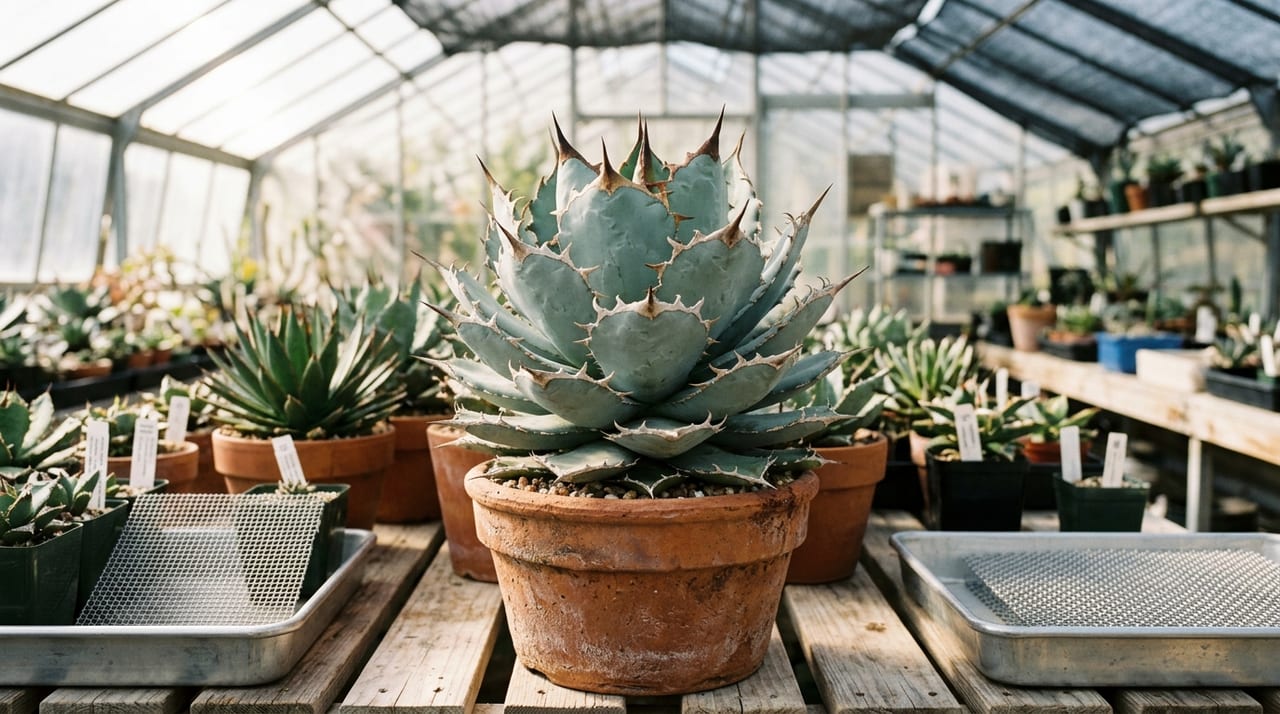
Agave titanota is a succulent native to the limestone regions of Oaxaca, Mexico, and its greatest appeal lies in its powerful form and distinctive sawtooth leaf margins. In recent years, it has gained explosive popularity primarily through SNS and is often called the "sneaker of the plant world" for its high collectibility.
The primary reason Agave titanota attracts many enthusiasts is the wealth of individual variation. Even plants of the same type name differ in sawtooth thickness, leaf thickness, and coloration from plant to plant, offering the pleasure of collecting each as a one-of-a-kind specimen. Furthermore, by adjusting sunlight exposure, watering frequency, and soil composition, the development of sawtooth margins and leaf color can change dramatically, making the "satisfaction of cultivation"—where grower management skill directly determines the final result—another major appeal. Rare types are recognized as having asset value, and the ability to propagate and sell offshoots has also contributed to their popularity.
As of 2026, the titanota market has seen an increase in the distribution of domestically seed-grown plants, resulting in more plants at accessible price points than before. Meanwhile, high-end varieties like Caesar and Hades maintain elevated prices, and the market is becoming increasingly polarized. For beginners, the environment for entry has become increasingly favorable. For an overview of the entire lineup of varieties, see also Agave Encyclopedia | Characteristics and Selection Guide for Popular Varieties.
Characteristics and Market Prices of Popular Types Including White Whale, Caesar, and Hime-Gonryu
Titanota encompasses numerous selected types, each with its own distinctive characteristics and market valuation. Here we introduce five of the most popular types in detail.
White Whale
The defining characteristic is its thick white sawtooth margins, and compact ball-shaped plants are preferred. With high availability and recommended for beginners, as plants mature the sawtooth margins develop thickly and overlap, creating distinctive visual impact. It's an established variety easily obtained as seed-grown or offset plants, with mid-sized seed-grown specimens typically priced around ¥5,000–¥30,000.
Caesar
Originating from a renowned Taiwanese nursery, it impresses with tightly packed short leaves densely populated by rough, thick sawtooth margins. Plants where the sawtooth margins develop in overlapping layers are called "works of art," and fine specimens frequently exceed ¥100,000. At ¥15,000–¥80,000 for small to mid-sized seed-grown plants, it commands premium prices, yet remains an object of desire for collectors as one of the highest-tier titanota varieties.
Hime-Gonryu
A small-growing type with pronounced sawtooth development, typically staying within 10–20 cm diameter, making it ideal for balcony or indoor cultivation. Offset plants readily develop, offering the pleasures of creating multi-plant clusters. With price ranges of ¥8,000–¥40,000, it's popular among those seeking compact enjoyment.
Hades
A luxury type featuring blackish leaf color and dark-toned sawtooth margins that evoke the gravitas befitting the name "lord of the underworld." With recent popularity surges, prices have climbed to ¥30,000–¥150,000 and beyond, and procurement remains difficult.
Red Cat Whiskers
A beautiful type featuring leaves that color red to reddish-brown. When exposed to strong sunlight and temperature fluctuations, stress coloring intensifies the red tones, giving it a distinctive presence unlike other titanota. Mid-sized specimens are typically priced around ¥10,000–¥50,000.
Understanding the Difference Between Seed-Grown and Imported Plants
Purchasing options for titanota fall into two main categories: "seed-grown" and "imported (bare root)" plants. Understanding the respective merits and drawbacks of each is important.
Imported (bare root) plants are wild or locally-cultivated plants grown in Mexico or other native regions, imported with roots cut off. The appeal lies in the rugged form characteristic of wild specimens, but rooting management is required, making it somewhat challenging for beginners. Always verify the presence of phytosanitary certificates and select specimens imported through authorized channels. Plants may be weakened by transport stress, making careful post-arrival care essential. Specific rooting procedures are detailed in Agave Imported Plant Rooting Manual | Rescue Guide for Bare Root Specimens.
Seed-grown plants are grown from seed domestically and are easy to manage since they are already adapted to Japanese climate. The primary advantage is well-established roots that allow normal care immediately after purchase. However, the plant may not develop identically to the parent plant, and it can take several years for type characteristics to become pronounced.
For beginners, we strongly recommend domestically seed-grown, rooted, mid-sized plants. Mid-sized plants with some characteristics already evident are easier to envision in their mature form, and the risk of cultivation failure is substantially reduced.
Five Checkpoints for Purchasing
To avoid purchasing mistakes, be sure to check the following five points.
- Root condition: Are roots established or bare root? For beginners, choosing rooted plants is essential.
- Leaf condition: Are there any blackened areas or abnormal softness? These are signs of disease or root rot.
- Growth point check: Is the center a healthy green? Damage to the growth point is a fatal issue.
- Type reliability: Does the seller clearly state the variety name's origin and sourcing?
- Photo quality: Are the images edited or taken at extreme angles to exaggerate? Sellers providing multiple unedited photos from various angles are highly trustworthy.
The key to determining fair prices is comparing the market rates for the same type and size across multiple vendors. Past auction transaction history on SNS and other platforms can also be helpful. When prices are exceptionally low, there is often doubt about type name accuracy, so caution is warranted. For guidance on handling plants showing blackening or root rot signs, see Agave Pest Management and Causes of Plant Death.
How Cultivation Environment Affects Final Plant Development
Often overlooked when considering titanota purchases is the impact cultivation environment has on plant development. Even plants of the same type can differ significantly in sawtooth thickness and leaf thickness between outdoor full-sun grown plants and indoor LED-cultivated plants.
Outdoor full-sun cultivation tends to produce plants with short, fleshy leaves and well-developed sawtooth margins. Exposure to abundant ultraviolet light deepens leaf coloration, resulting in a robust overall appearance. If you can provide similar conditions after purchase, choosing outdoor-grown plants is recommended.
Indoor LED cultivation results in development determined by LED quality and exposure duration. Plants exposed to high-output full-spectrum LEDs for extended periods can rival outdoor-grown specimens in quality. At purchase, confirming "what PPFD level and for how many hours per day" makes it easier to predict replicability in your own environment. If considering indoor cultivation, also consult Complete Guide to LED Cultivation of Agave | Light Intensity (Lux, PPFD), Exposure Duration, and Distance Guidelines.
When cultivation environment changes significantly after purchase, allow 1–2 months for the plant to acclimate to its new conditions. Rather than changing conditions abruptly, gradual transition is essential.
Finding Agave Titanota on GrowerDirect
GrowerDirect features numerous growers specializing in Agave titanota. Listings are characterized by clear disclosure of variety name, cultivation history, and parent plant information, and you can message growers directly with questions before purchasing. All transactions complete on-platform for peace of mind, with a wide range of options from seed-grown to imported rooted plants. Find your perfect specimen.