Aquatic Plant Trimming Guide | Techniques and Tips for Maintaining Beautiful Layouts
Aquatic plant trimming is essential for maintaining tank aesthetics. This guide explains trimming techniques for stem plants, rosette plants, and mosses, along with appropriate frequencies and methods for reusing and replanting cut plants.
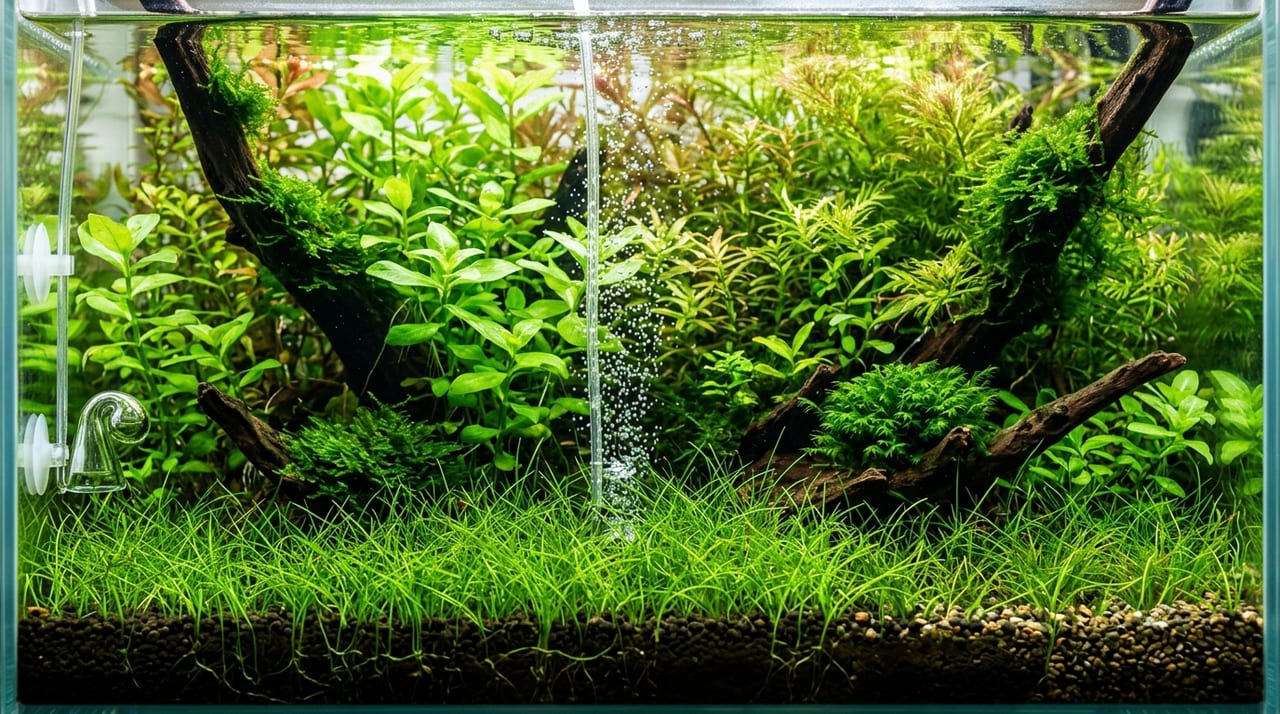
Key Takeaways
Aquatic plant trimming is essential for maintaining tank aesthetics. This guide explains trimming techniques for stem plants, rosette plants, and mosses, along with appropriate frequencies and methods for reusing and replanting cut plants.
Related Species
Maintaining a beautiful aquatic plant tank requires regular trimming. Many people worry about how much to cut or fear they'll kill the plants by cutting too much, but trimming is not difficult once you learn the correct methods for each plant type. This article provides detailed guidance on type-specific trimming techniques, tool selection, and post-cutting management.
Why Trimming Is Necessary
As aquatic plants grow, lower leaves become prone to dying from insufficient light. Neglecting trimming causes a cascade of problems:
- Dead leaves decay and degrade water quality
- Organic matter accumulates in the substrate, making algae proliferation more likely
- Dense plant growth blocks light and CO2 circulation
- Background plants overgrow foreground plants, disrupting layout balance
In particular, fast-growing stem plants like Rotala and Ludwigia can completely cover the water surface if left untrimmed for just a month. To maintain beautiful layouts, ideal trimming frequency is approximately once every 2–4 weeks.
Basic Trimming Tools
Aquatic Plant Scissors (Aquarium-Specific) Designed with long handles and precision blades for underwater work, these scissors come in two main types: straight-blade models for bundled cuts on stem plants, and curved-blade models for detailed work and foreground plant trimming. Kitchen scissors can be used as a substitute, but dull blades easily damage plant cut surfaces; aquarium-specific scissors are recommended.
Long Tweezers Used for collecting cut plant fragments and replanting. Fine-tipped, curved-end tweezers allow you to work without damaging dense foreground plant carpets.
Siphon or Gravel Vacuum Use to quickly remove floating cut fragments. Fitting a fine-mesh sponge over the intake to prevent fragments from being sucked into the filter is also recommended.
Trimming Methods by Plant Type
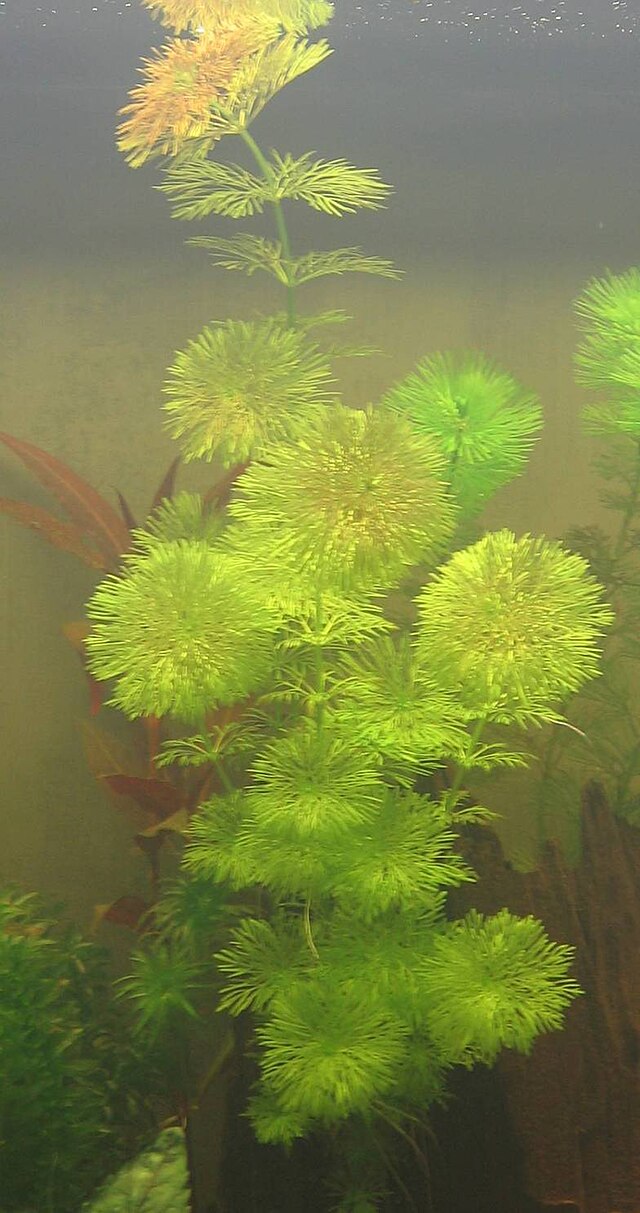
Stem Plants (Rotala, Ludwigia, Ambuia, etc.)
Stem plants grow quickly and require the most frequent trimming.
When they reach the water surface, cut at your desired height in a bundled motion. Creating a height gradient from the back (background) to the front (foreground) of the tank produces a three-dimensional layout. A few days after cutting, new shoots will develop from the stem nodes, creating denser growth.
For leaves showing yellowing or blackening at the base, "reset cutting"—pulling up the entire stem, cutting the healthy upper section, and replanting it—is effective. This rejuvenates stocks with poor root systems; incorporate it regularly for long-term maintenance. Trimming frequency varies: fast-growing Rotala about once every 2 weeks; Ambuia and Ludwigia every 3–4 weeks.
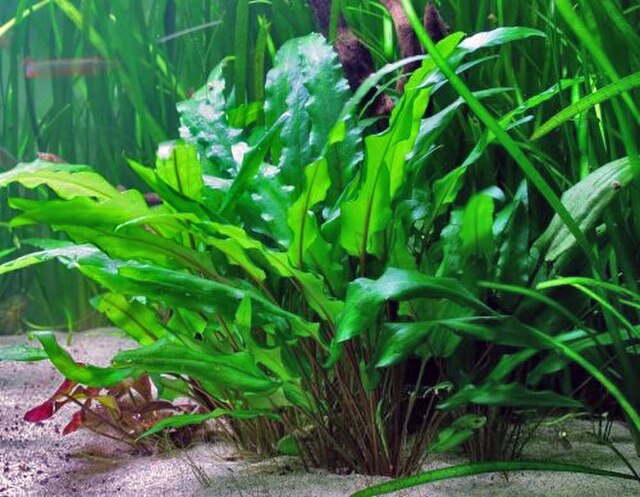
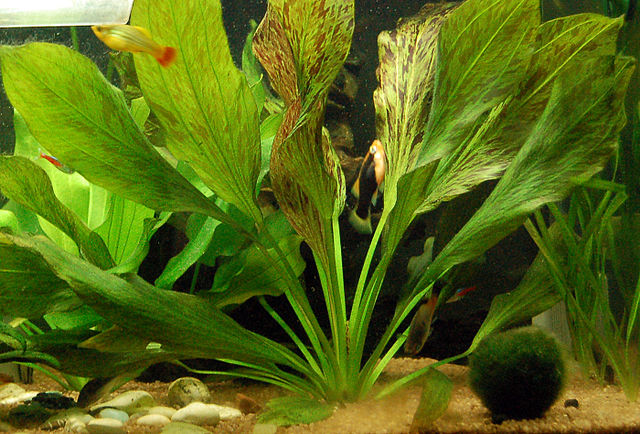
Rosette Plants (Echinodorus, Cryptocoryne, etc.)
These plants have leaves radiating from the base. Since they develop deep root systems, trim only the leaves.
Remove yellowed or blackened leaves by cutting at the very base, removing old outer leaves first while keeping new central leaves. Large species like Amazon sword are easier to manage when limited to about 10–15 leaves total. Pulling up the entire plant extends recovery time, so stick to leaf-only management. For spreading varieties like runners on Cryptocoryne or stolons on Vallisneria, thin the colony by separating and removing young plants when overgrown to maintain healthy density.
Mosses (Willow Moss, South American Willow Moss, etc.)
These mosses attach to driftwood or rocks and require specific management.
When moss becomes too thick, trim it back to leave 1–2 cm from the surface. Even thickness allows light to penetrate deeper and prevents dieback. Aggressive trimming before the moss is fully attached to its base can cause it to detach; confirm attachment before starting. Rather than discarding trimmed moss, you can create new moss-covered driftwood by thinly spreading the cuttings on fresh wood and securing them with fishing line.
Foreground Plants (Glossostigma, Cuba Pearl Grass, etc.)
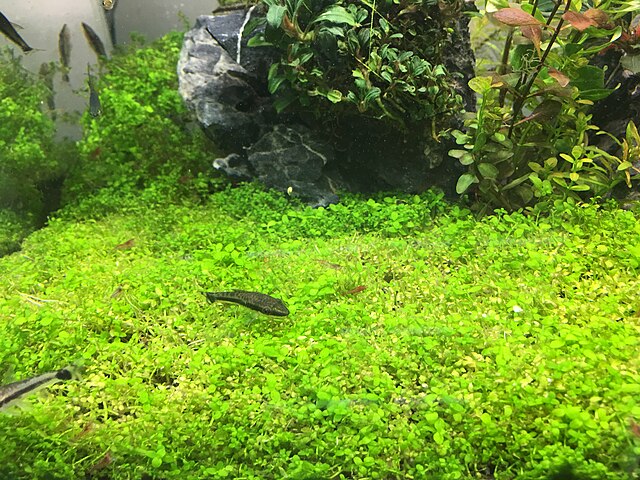
These carpet-forming plants cover the tank floor. Once the carpet becomes dense, trim it uniformly at 1–2 cm from the substrate. A single trimming session produces abundant floating fragments, so protect the filter intake with a sponge before trimming and carefully remove fragments with a siphon afterward. Organic matter easily accumulates under dense carpets; cleaning the substrate with a gravel vacuum after trimming effectively maintains water quality.
Post-Trimming Management and Precautions
Fertilizer Timing Plant nutrient absorption temporarily declines immediately after trimming. Resume liquid or solid fertilizer 2–3 days after cutting, once new shoots emerge. Excessive fertilizer application right after trimming promotes algae growth.
Water Changes Substrate disturbance during trimming can suspend organic matter, clouding the water. Performing a 30–50% water change on the same day or the next day helps stabilize water conditions.
CO2 Adjustment Immediately after trimming, total plant biomass temporarily decreases, reducing CO2 consumption. Slightly reducing CO2 injection for a while prevents pH crashes from excess CO2.
Effective Use of Cut Plants
Healthy upper sections of stem plants can be used directly as cuttings. Insert 2–3 cm into the substrate and secure with tweezers; they'll root and can be used for increasing plant count or transferring to other tanks. Surplus plants can often be taken by aquatic shops or aquarium hobby communities, creating a zero-waste trimming system. If you source plants directly from growers, ask about propagation or surplus plant exchanges—many are happy to discuss options.
Summary
Once you master the correct trimming method for each plant type, aquatic plant maintenance becomes straightforward. Trim stem plants to uniform height, remove only leaves on rosette plants at the base, maintain even moss thickness, and cut foreground plants close to the substrate—making these basics habitual significantly improves your layout's refinement. Combine regular trimming with water changes and fertilization to enjoy a thriving aquatic plant tank for years to come.