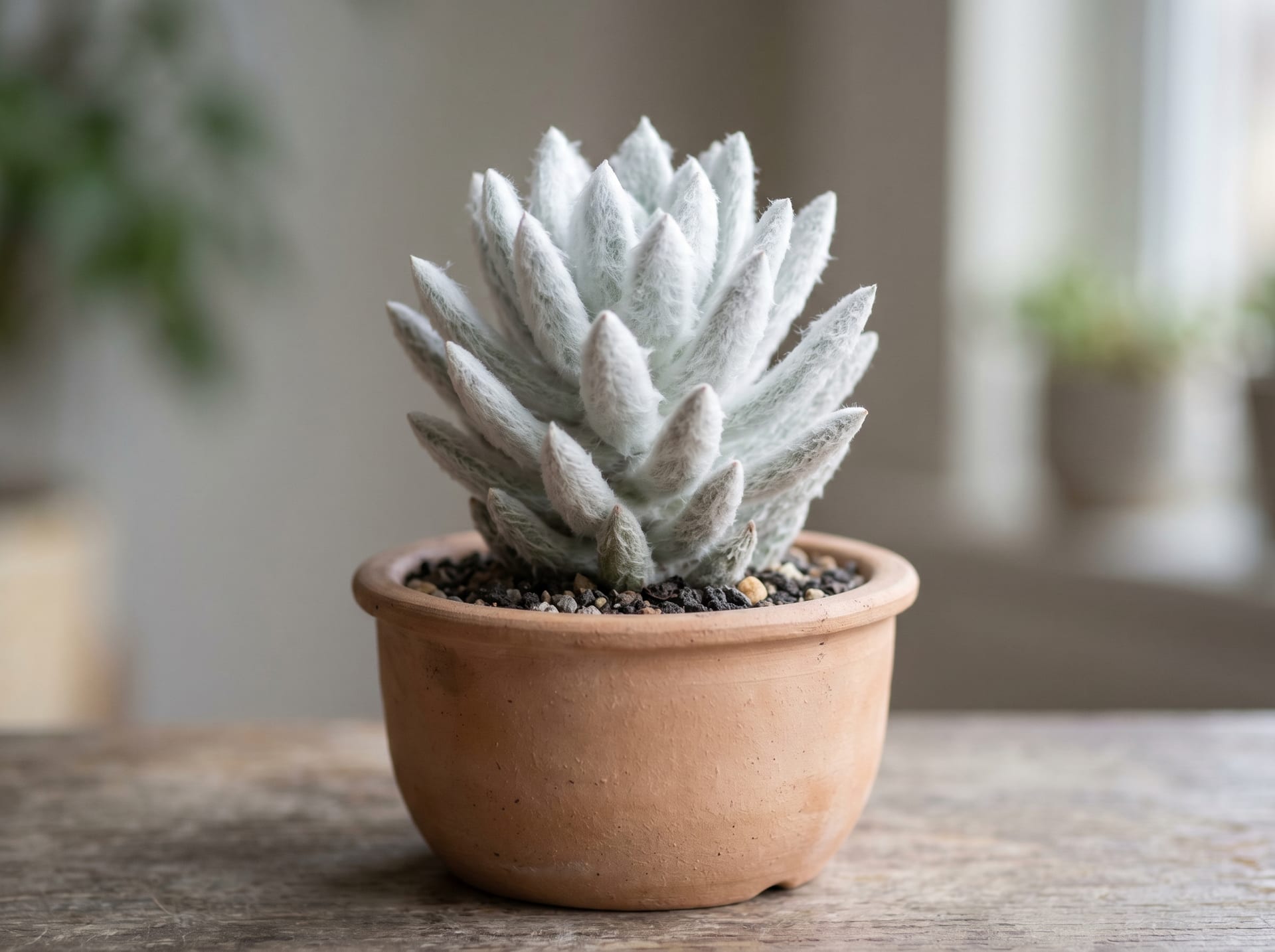
AI-generated image
Cocoon Plant
IntermediateCaputia tomentosa
A winter-growing succulent (formerly Senecio) with silvery-white hairy leaves resembling cocoons. Also known as the Cocoon Plant for its beautiful silver appearance.
Overview
Caputia tomentosa (Cocoon Plant, formerly Senecio haworthii) is a winter-growing succulent native to South Africa, covered entirely in dense, silky white hairs that give the plant a striking, glowing silver-white appearance. Cylindrical to fusiform leaves, resembling cocoons or caterpillars, are arranged alternately on erect stems that grow to 20–40 cm tall. Active growth occurs from autumn through spring; the plant enters dormancy in summer, during which the dense indumentum can trap moisture and cause rot in hot, humid conditions—making Japanese summers the most critical management period. Watering should follow the growth cycle: regular during cool months, nearly ceased in summer. Bright light with protection from the most intense direct sun is recommended. Stem cuttings propagate the plant readily. Its extraordinary silver appearance gives it enduring appeal among succulent collectors.
Size of the Cocoon Plant
The Cocoon Plant grows to 15-40cm.
Temperature & humidity for the Cocoon Plant
The ideal temperature for the Cocoon Plant is 5〜25℃.
Cold tolerance extends to approximately 3–5°C.
Basic Info
Origin
South Africa
Lifespan
Perennial
Size
15-40cm
Temperature
5〜25℃
Humidity
30〜50%
Watering & Fertilizer
Water mainly in autumn-spring as a winter grower
Growing Tips
Light
Bright sun enhances silver-white color
Watering
During the autumn-to-spring growing season, water once the soil dries. In summer withhold almost entirely, and always pour at the base so the felt stays dry.
Dormancy Care
A winter grower that rests in summer. The humid heat from Japan's rainy season through summer is its hardest period, so near-total withholding of water and good airflow are essential.
Temperature
Weak to heat and humidity. Keep cool
Temperature & Overwintering
Keep between 5 and 25°C; it tolerates lows of about 3 to 5°C. Since autumn to spring is its growing season, keep it in a bright spot through winter.
Pests & Cautions
Too much direct sun damages the felt, so keep it in a bright spot or under only mild direct light. Propagate by stem cuttings.
Cocoon Plant FAQ
QWhat is the growing difficulty level for Cocoon Plant?
Intermediate. A variety suitable for intermediate growers. Requires some cultivation experience and knowledge of environment management. Pay careful attention to temperature and humidity control.
QWhat is the ideal temperature for Cocoon Plant?
The ideal temperature for Cocoon Plant is 5〜25℃. Avoid sudden temperature changes and maintain a stable environment.
QHow large does Cocoon Plant get?
The mature size of Cocoon Plant is 15-40cm. This may vary slightly depending on cultivation environment and individual differences.
QHow should I water and fertilize Cocoon Plant?
Cocoon Plant: watering & fertilizer — Water mainly in autumn-spring as a winter grower. Aim for appropriate frequency and amount.
QWhat is the typical price for Cocoon Plant?
The price of Cocoon Plant varies significantly by variety, characteristics, size, and lineage. Please check GrowerDirect's price guide for the latest market information.
Last updated: June 24, 2026
References & Sources
Edited & verified by: GrowerDirect Editorial Team
The classifications, regulations, and growing data on this page are created and verified based on the primary information database below.
Primary sources
Taxonomy & Authority
Regulations & Conservation Status
Sources: CITES Appendices — taxon not listed
Regulations may change. Always verify the latest information with the relevant authorities.
Related Species
Find listings for this species
Related Articles
How to Care for Senecio (String of Pearls) | Watering Trailing Succulents and Rejuvenation
Explains watering tips for Senecio succulents such as String of Pearls, Ruby Necklace, and Crescent Necklace, how to address shriveled or burst beads, and rejuvenation techniques through stem propagation.
Autumn Preparation Management for Summer-Type Succulents
A guide to autumn care for summer-type succulents, covering plant changes from September to November, timing for gradual watering reduction, placement and temperature management for transitioning plants indoors, autumn fertilizing and pest control, variety-specific care checkpoints, and preparation for winter dormancy.
Mealybug Control on Succulents | Complete Guide to Early Detection, Removal, and Prevention
Mealybugs hide easily at the base of succulent leaves and on new growth. This guide covers their characteristics, the environments where they thrive, tips for early detection, removal methods using cotton swabs and alcohol, and daily care practices to prevent recurrence.
Summer and Winter Type Succulents: Growth Cycles and Watering Management Strategy
This article explains the differences in growth types of succulent plants, their annual growth cycles, seasonal watering management strategies, common failures, and countermeasures.
🩺 Common diseases
Can't find the plant you're looking for?
Post your wishes for free and growers with matching plants will contact you with introductions.