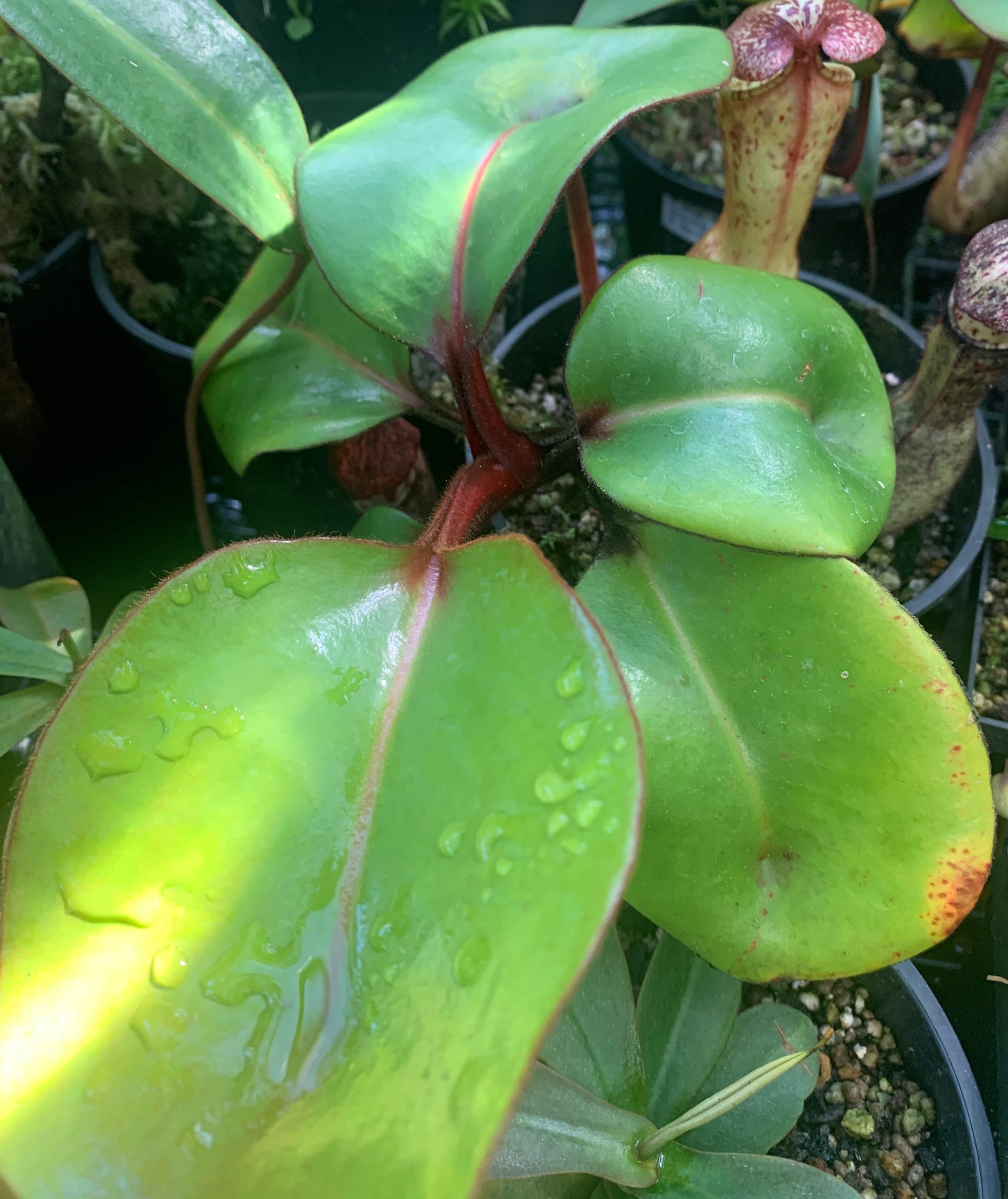
 © Michael Wolf (Webseite) / CC BY-SA 3.0
盾叶猪笼草
Nepenthes clipeata is a pitcher plant found only on the granite cliffs of Mount Kelam in Borneo. Its charm lies in the round, shield-shaped leaves, where the tendril attaches to the underside of the blade, and in the large pitchers that swell toward the base and reach up to 30 cm tall. The stem grows to about 2 m, yet this perennial does not climb. In the wild it is considered one of the species of greatest concern for extinction. Cultivation is rated for experienced growers, because stable light, humidity, and water quality are essential. It suits patient growers who enjoy careful, hands-on care.
View 盾叶猪笼草 encyclopedia →成交手续费0%!2026年9月30日前注册,前 2 株免佣金!
生产者 招募中!
在GrowerDirect上销售,直接面向全国客户销售吗?
GrowerDirect的 6 项透明性承诺
生产者在食虫植物出品时明示以下信息。确保品种、产地、所需光照、栽培难度的透明度。
- 品种明确
- 真实照片
- 颜色
- 产地明确
- 所需光照
- 难度明确
查看全部145个品种
盾叶猪笼草的基本数据
- 养护难度
- 适合高级者
- 寿命
- 多年生植物(非攀爬型)
- 体型
- 捕虫袋高度达30厘米·茎长约2米
- 浇水
- 使用极淡的肥料(通过捕捉昆虫获取营养)
- 光照·放置位置
- 原产地为开放式悬崖,喜好明亮的光照。
- 浇水
- 使用雨水或低矿物质含量的水,在用土完全干燥前浇水。不要让盆底积水,使用排水良好的用土以防根腐。由于该物种生长在岩石悬崖上,应注意不要使土壤保持过湿。
- 温度·越冬
- 生长在海拔600~800米的中间环境。不耐寒,冬季需加温,夏季应避免过度高温。
- 用土·换盆
- 种植在排水和通透性良好的用土中。常用纯泥炭苔或兰花专用用土混合泥炭苔和珍珠岩。
- 肥料
- 若使用化肥,应稀释至极淡浓度。偶尔在捕虫袋中放入昆虫即可维持充分生长。
- 病虫害·注意事项
- 在野生中列为IUCN极危(CR)物种。购买时应选择由播种或组织培养繁殖的植株。由于栽培中遗传系统稀少,繁殖的植株具有保护价值。
关于盾叶猪笼草
Nepenthes clipeata is a pitcher plant with round, shield-shaped leaves and large pitchers swollen at the base, up to 30 cm tall. The stem reaches about 2 m. Rated for experienced growers; key care points are covered here.
开始养护盾叶猪笼草前需要了解的7件事
1Placement and Light
Because it grows on granite cliffs in the wild, it prefers bright light. Place it by a bright window behind a sheer curtain, or under a grow light that delivers plenty of light. The stem can reach about 2 m but does not climb, so plan a spot with room for it to keep lengthening.
2Humidity and Airflow
Keeping humidity high is the key to growing healthy pitchers. Use a grow case or greenhouse to stabilize humidity, and add a gentle breeze so the air does not stagnate. Left in a dry room, the plant may fail to form pitchers or suffer damaged leaf tips.
3Watering and Water Quality
Do not let the medium dry out; keep it evenly moist. Rainwater or low-mineral water is best, since water rich in minerals can damage the roots. Go easy on fertilizer, and if you feed at all, use a diluted solution in small amounts.
4Choosing a Growing Medium
A free-draining, airy, low-nutrient medium suits this plant. Combine materials such as sphagnum moss, perlite, and pumice so air can reach the roots. Since it is a rock-dwelling species, avoid leaving the roots soaked and stuffy for long periods.
5Repotting Tips
The roots are easily damaged, so repot sparingly and move up a pot size without breaking apart the root ball. Repot when the medium has broken down or the pot feels cramped, during the growing season when temperatures are steady. Keep humidity high right afterward and let the plant recover.
6Seasonal Care
Spring through autumn is the growing season, so keep air moving and avoid excessive summer heat. It is sensitive to cold, so provide heating in winter and keep it protected from chills.
7Choosing a Plant
Since this is a species for experienced growers, look for a healthy plant with good leaf color and well-established roots. Check for dry or blackened leaf tips and for any wobble at the base. Before buying, ask the grower about the conditions the plant has been raised in and how to care for it after arrival.
盾叶猪笼草的常见问题
- Q.Can a beginner grow it?
- A.It is rated for experienced growers. It needs an environment where light, humidity, and water quality can be kept stable, so it is safer to gain experience with easier pitcher plants first.
- Q.How large do the pitchers and plant get?
- A.Pitchers grow up to 30 cm tall, and the stem of this perennial reaches about 2 m. Because it gets large, set aside enough space for its growth.
- Q.Should I train it up a support?
- A.This species does not climb, so training it up a support is generally not suitable. Plan how you position or hang the pot with the expectation that the stem will keep growing longer.
- Q.Is tap water okay for watering?
- A.Low-mineral water suits it best, and rainwater is ideal. If you use tap water, watch for signs such as damaged leaf tips, and switch to low-mineral water if the plant looks unwell.
- Q.Why is my plant not forming pitchers?
- A.The most common causes are too little light and too little humidity. Start by reviewing how bright the spot is and how humid the air is. Even after improving conditions, it can take some time before new pitchers form.
盾叶猪笼草种植的实用工具
在图鉴中详细了解盾叶猪笼草
查看盾叶猪笼草的图鉴条目 →
收录栽培难度、尺寸、原产地、日照等基础数据。