Complete Guide to Aquatic Plant Fertilization | Using Liquid, Solid, and Substrate Fertilizers
Learn how to choose and use fertilizers for aquatic plants. Understand the roles of nitrogen, phosphorus, potassium, and trace elements; how to differentiate between liquid, solid, and substrate fertilizers; signs of nutrient deficiency and excess shown in plant appearance; and tips for proper fertilization to prevent algae.
Key Takeaways
Learn how to choose and use fertilizers for aquatic plants. Understand the roles of nitrogen, phosphorus, potassium, and trace elements; how to differentiate between liquid, solid, and substrate fertilizers; signs of nutrient deficiency and excess shown in plant appearance; and tips for proper fertilization to prevent algae.
Related Species
Just as light and CO2 are essential for growing beautiful aquatic plants, so is fertilizer. However, many people wonder, "Which fertilizer should I choose?" or "How much should I add?" Fertilizers play different roles depending on their type, and it's important to use them appropriately based on the type of aquatic plants and the condition of your aquarium. This guide systematically explains everything from the basics of nutrients needed for aquatic plants to the types of fertilizers, how to choose them, and tips for application.
Understanding Nutrients Needed for Aquatic Plants
For aquatic plants, which are plants, to grow healthily, diverse nutrients are needed in addition to light, CO2, and water. Nutrients are broadly divided into "macro elements (primary nutrients)" and "micro elements (trace elements)."
Macro Elements (Primary Nutrients)
- Nitrogen (N): The most fundamental nutrient supporting the growth of leaves and stems. It is naturally supplied from fish waste and uneaten food, but becomes easily deficient when there are many aquatic plants or frequent water changes.
- Phosphorus (P): Involved in root development and flower bud formation. When deficient, growth slows; however, when excessive, it can trigger explosive algae blooms (especially cyanobacteria and black beard algae), so balance is important.
- Potassium (K): Essential for promoting photosynthesis and nutrient transport, and the most easily depleted element in aquariums. It becomes diluted with each water change, so regular supplementation is effective.
Micro Elements (Trace Elements)
Trace elements are needed in small quantities, but deficiency causes visible abnormalities in aquatic plants.
- Iron (Fe): Required for chlorophyll production; deficiency causes new shoots to turn white or yellow (iron chlorosis).
- Manganese (Mn): Involved in the oxygen-releasing reaction of photosynthesis.
- Zinc (Zn): Necessary for enzyme activation and promotes cell division.
- Copper (Cu): Needed in trace amounts, but highly toxic to shrimp, so caution is needed when using copper-containing fertilizers in shrimp tanks.
- Calcium (Ca) and Magnesium (Mg): When using tap water with medium or higher hardness, these are replenished through water changes; however, in tanks with many aquatic plants that prefer soft water, conscious supplementation may be necessary.
Types of Fertilizers and Their Characteristics | Using 3 Types Appropriately
Aquatic plant fertilizers are broadly divided into three types: "liquid fertilizer," "solid fertilizer (root tabs)," and "substrate fertilizer." Since each has different characteristics, it's ideal to use them in combination based on your aquarium's layout and plant types.
Liquid Fertilizer
This type dissolves in water and is added directly to the aquarium. Since it spreads uniformly throughout the water, it's especially effective for stem plants and floating plants that absorb nutrients through leaves.
- Benefits: High immediate effectiveness and easy fine-tuning of dosage
- Drawbacks: Washed out with each water change, requiring regular reapplication
- Main types: Potassium liquid fertilizer, trace element blend, all-in-one liquid fertilizer
- Application frequency guide: Daily to 2-3 times per week (follow product instructions)
In particular, potassium liquid fertilizer is routinely used by many aquarists as a basic supplement for planted tanks. Since nitrogen and phosphorus are easily supplied from fish waste, starting with potassium supplementation is the standard approach.
Solid Fertilizer (Root Tabs)
This type is buried in the substrate and is ideal for aquatic plants that absorb nutrients through roots.
- Benefits: Effects last 1-3 months for easy management. Low leaching into the water column and less likely to trigger algae growth
- Drawbacks: Position may shift when replanting
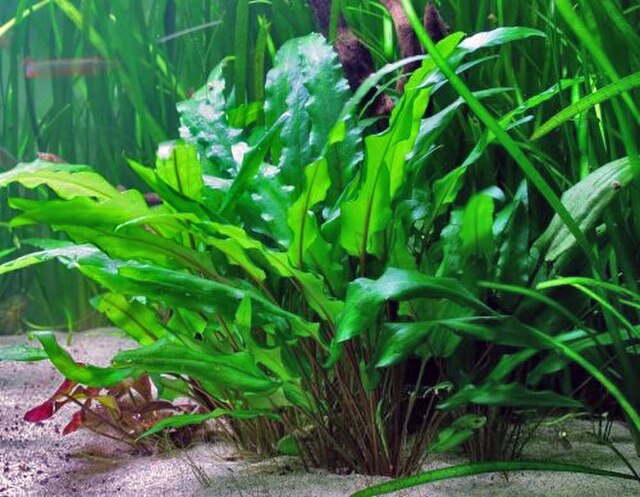
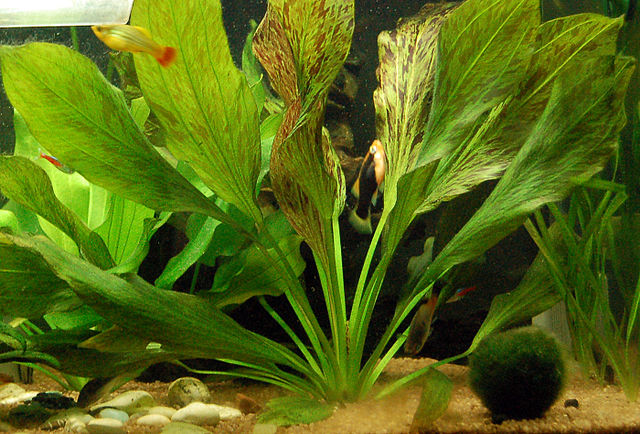
- Suitable plants: Echinodorus, Cryptocoryne, Vallisneria, Aponogeton, and other species with strong root systems
- Tips for use: Bury at a depth of approximately 3-5 cm in the substrate, 2-3 cm away from the base of the plant
Simply burying one tablet near the base when planting new aquatic plants greatly improves rooting.
Substrate Fertilizer (Base Fertilizer)
This is a fertilizer laid beneath the substrate layer during aquarium setup. It gradually supplies nutrients over a long period, serving as an unsung support.
- Benefits: Effects last for years once set up
- Drawbacks: Difficult to add or adjust later. Can only be used during substrate reset
- Popular products: ADA's Power Sand, JBL's Aqua Basis, and others
- Best for: Setting up serious Nature Aquariums or large stem plant tanks
Often used in combination with soil, it's an essential item in planted display tanks designed for long-term maintenance.
Reading Signs of Fertilizer Deficiency or Excess
By observing the condition of your aquatic plants, you can detect nutrient imbalances early. Use the following signs to review your fertilization plan.
| Symptom | Possible Cause |
|---|---|
| Older leaves turn yellow | Nitrogen deficiency |
| New shoots or young leaves turn white or yellow | Iron or manganese deficiency |
| Leaf edges turn brown and wither | Potassium deficiency |
| Small holes (pinholes) appear in leaves | Potassium or calcium deficiency |
| Overall growth is extremely slow | CO2 deficiency or phosphorus deficiency |
| Algae blooms suddenly increase | Nitrogen or phosphorus excess |
| Shrimp suddenly die | Copper excess or pesticide contamination |
When algae becomes noticeable, identifying the source is as important as adjusting fertilization. Specific countermeasures by cause are summarized in Complete Guide to Algae Control in Planted Tanks.
Tips for Successful Fertilization
More fertilizer is not necessarily better. Over-fertilization can trigger explosive algae growth and cause water quality deterioration. By following these points, even beginners can confidently manage fertilization.
- Start with small amounts and increase gradually while monitoring: Start at half the recommended dose and safely adjust after observing your plants' response for 1-2 weeks.
- Add liquid fertilizer after water changes: Since water changes dilute fertilizer, adding it immediately after a water change is most efficient.
- Consider the number of fish and amount of food: In tanks with many fish, nitrogen and phosphorus are naturally supplied, so focusing liquid fertilizer on just potassium and trace elements is often sufficient.
- Set up CO2 addition and lighting before fertilizing: To maximize fertilizer effectiveness, establishing the foundation for photosynthesis (light and CO2) must come first. Simply increasing fertilizer alone won't be absorbed by plants—it will only feed algae. If you're unsure about choosing CO2 equipment, also refer to Guide to Choosing CO2 Systems for Planted Tanks.
- Place solid fertilizer near roots: Burying it where roots are dense or around vigorous plants increases effectiveness.
Summary | Completing Your Planted Tank Through Proper Fertilizer Selection
Fertilizer management for aquatic plants may seem difficult at first, but it's not complex once you grasp the basics. Daily management with potassium-based liquid fertilizer, combined with supplemental solid fertilizer for plants with strong root systems, is the standard effective approach in most tanks. By daily observing your plants' leaf color and growth rate while fine-tuning fertilization amounts, you'll gradually find the rhythm that works best for your tank.
At GrowerDirect, you can purchase healthy aquatic plants grown with care in proper fertilization environments directly from growers. Since you can ask growers directly about their growing conditions and fertilizers used, you can confidently manage your plants after purchase. Please start creating your beautiful planted tank with GrowerDirect.