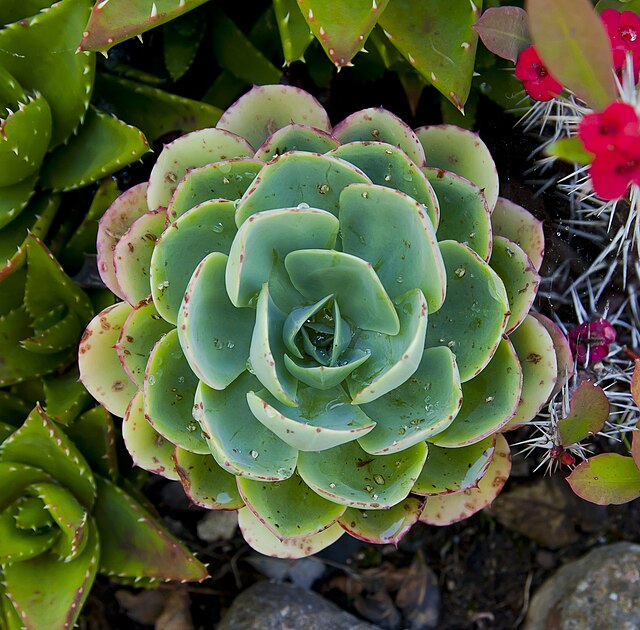
Source: Wikimedia Commons
Echeveria Elegans
BeginnerEcheveria elegans
An echeveria called 'Moonlight' with beautiful powdery coating. Classic species with most easily formed rosette.
Overview
Echeveria elegans (Mexican Snowball) is a species native to Hidalgo and San Luis Potosí states in Mexico, forming neat rosettes of pale blue-green leaves with a heavy white powdery coating. It is one of the most classic and widely grown Echeveria species, appreciated for its restrained, elegant form and ease of cultivation. Rosettes reach 8–15 cm across, and the species offsets freely, quickly forming attractive clusters. Coloration shifts to soft pink in autumn and winter under cool conditions. Full sun is optimal for compact growth and good color. Watering should be minimal, with thorough drying between sessions. It propagates easily by offsets or leaf cuttings and is a standard component of mixed succulent plantings.
Lifespan of the Echeveria Elegans
The Echeveria Elegans lives 5-10 years.
Size of the Echeveria Elegans
The Echeveria Elegans grows to 8-15cm.
Temperature & humidity for the Echeveria Elegans
The species is relatively hardy for Echeveria, tolerating temperatures down to 3–5°C.
Basic Info
Origin
Mexico (Hidalgo and San Luis Potosí states)
Lifespan
5-10 years
Size
8-15cm
Temperature
3〜35℃
Humidity
30〜50%
Growing Tips
Light & Placement
Prefers a sunny spot. With plenty of sun it blushes pale pink in autumn and winter.
Watering
Water very sparingly, only after the soil dries completely. It's fairly tough, but avoid wet soil and keep it on the dry side.
Temperature & Overwintering
Overwinters at lows of about 3-5°C. Keep it indoors or under eaves in winter, away from frost.
Propagation
It produces offsets vigorously and clumps, so dividing offsets is easy. Leaf cuttings also work.
Pests & Cautions
The white powdery bloom shows fingerprints when touched, so handle the plant by the pot rim.
Echeveria Elegans FAQ
QWhat is the growing difficulty level for Echeveria Elegans?
Beginner. A variety suitable for beginners. No special equipment or experience is required—you can grow it without problems by setting up a basic cultivation environment.
QWhat is the lifespan of Echeveria Elegans?
The average lifespan of Echeveria Elegans is 5-10 years. With proper cultivation environment and nutrient management, you can keep it healthy for a long time.
QHow large does Echeveria Elegans get?
The mature size of Echeveria Elegans is 8-15cm. This may vary slightly depending on cultivation environment and individual differences.
QWhat is the typical price for Echeveria Elegans?
The price of Echeveria Elegans varies significantly by variety, characteristics, size, and lineage. Please check GrowerDirect's price guide for the latest market information.
Last updated: July 5, 2026
Growing Specifications
- Hardiness (RHS)
- H2
Sources: RHS Find a Plant
References & Sources
Edited & verified by: GrowerDirect Editorial Team
The classifications, regulations, and growing data on this page are created and verified based on the primary information database below.
Primary sources
Taxonomy & Authority
Regulations & Conservation Status
Sources: CITES Appendices — taxon not listed
Regulations may change. Always verify the latest information with the relevant authorities.
Related Species
Find listings for this species
Related Articles
Complete Guide to Echeveria Types | Characteristics of Popular Varieties and How to Choose Plants for Arrangements
A comprehensive explanation of Echeveria variety classification, differences in characteristics, and how to combine plants for arrangements among popular succulents. We introduce tips for choosing varieties that both beginners and advanced growers can enjoy.
Popular Echeveria Varieties and Care Guide | Complete Guide for Beginners
Explains the characteristics of popular Echeveria varieties, basic care methods, and tips for watering, lighting, and repotting for beginners.
Echeveria Propagation and Leaf-Cutting Techniques
A practical guide to leaf propagation specialized for Echeveria. Detailed explanations covering leaf selection, callus formation and root management, failure factors specific to powdery varieties, and when to use division or stem cuttings.
Echeveria subsessilis Offset Propagation — Separation from Parent Plants, Root Promotion, and Parent Plant Recovery Management
Detailed guide on safely separating Echeveria subsessilis offsets from parent plants, promoting root development, and managing parent plant recovery after offset removal.
🩺 Common diseases
Can't find the plant you're looking for?
Post your wishes for free and growers with matching plants will contact you with introductions.