Winter-Type Succulent Care Guide | Management Methods for Aeonium, Orostachys, and Sedum
An explanation of winter-type succulents' characteristics and care during summer dormancy and autumn-winter growth periods, by variety. This guide also provides detailed tips on how to successfully guide winter-type succulents through the summer, as they often decline during this season.
Key Takeaways
An explanation of winter-type succulents' characteristics and care during summer dormancy and autumn-winter growth periods, by variety. This guide also provides detailed tips on how to successfully guide winter-type succulents through the summer, as they often decline during this season.
Related Species
What Are Winter-Type Succulents?
Succulents are broadly classified into three types by their growth cycle: "spring-autumn type," "summer type," and "winter type." This classification is based on the climate of their native regions. Winter-type succulents have an autumn-to-winter-to-spring growth period and summer dormancy—the opposite rhythm of typical Japanese plants.
Their native regions include the Canary Islands, Mediterranean coasts, and highlands of East Asia—areas that remain relatively warm and dry even in winter. In these regions, a dry season arrives in summer, so plants naturally stop their activity during summer and become active with the autumn rains and cooler temperatures.
Japan's summer is hot and humid, creating an extremely harsh environment for winter-type succulents. Overwatering or allowing humidity to build up during this season causes root rot and plant decay. Conversely, if you successfully guide them through summer, you can enjoy beautiful coloring and vigorous growth from autumn through spring. Representative genera include Aeonium, Orostachys, winter-type Sedum, and some Crassula species.
Aeonium | The Star of Winter-Type Succulents
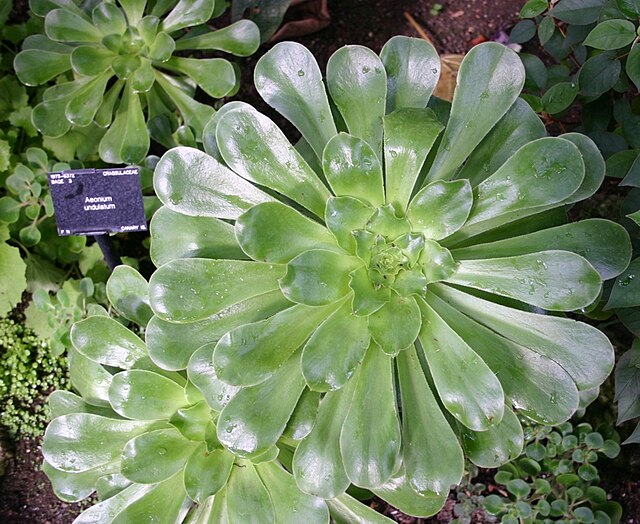
Aeonium (Aeonium) is a rosette-form succulent distributed mainly throughout the Canary Islands, with many popular varieties including Schwarzkopf, Sunburst, Cashmere Violet, and Canariensis. With a wide range of leaf colors—black, purple, yellow-green, and variegated white—its high collectibility makes it especially favored by succulent enthusiasts.
Summer Care (Dormancy Period)
Summer requires the most careful attention. When temperatures exceed 30°C, the leaves curl inward and the rosette becomes tightly formed—this is the "summer form," which is a sign of normal dormancy. During this period, follow these points strictly:
- Avoid direct sunlight and move to a well-ventilated partial shade location
- Water 1–2 times per month; give a small amount only after the soil has completely dried
- Keep away from rain (especially during rainy and typhoon seasons)
- Do not apply fertilizer
To prevent moisture buildup, the "light watering" method—stopping water just before it flows from the drainage hole—is also effective.
Autumn-Spring Care (Growth Period)
Around late September when temperatures drop below 25°C, Aeonium quickly resumes activity. When new leaves unfold and the rosette begins to open, it's a sign of the growth period.
- Place in a well-lit outdoor location or bright windowsill. See also Succulent Light & Lighting Guide for basics on choosing placement
- When temperatures reach 10–15°C, leaf color becomes vivid (Schwarzkopf turns deep black, Cashmere Violet becomes vivid purple)
- When the soil surface dries, water thoroughly but don't let water pool in the saucer
- Promote growth with liquid fertilizer about once a month or slow-release fertilizer
Propagation: Leaf cutting is the simplest method. Cut a leggy stem 5–10 cm long, let the cut end dry for 2–3 days, then insert it into well-draining soil (such as 1:1 volcanic soil to red volcanic soil). Avoid direct sunlight until roots appear; once roots begin to form, transition to normal care. See also Succulent Propagation Guide for more details.
Orostachys | A Hardy Winter-Type Succulent Native to Japan
Orostachys (Orostachys) originates from rocky areas and mountainous regions in Japan, China, and the Korean Peninsula. Because native species grow wild in Japan, they have high weather resistance and are valued as relatively easy-to-grow varieties for beginners.
Distinctive is their tendency to produce offsets via runners (stolons), with new plantlets spreading around the parent plant. When planted in the ground, they naturally form colonies, and after flowering in autumn, the parent plant dies while the offset becomes the main plant for the following year—a unique life cycle.
Winter Care
Orostachys have exceptional cold hardiness among succulents and can remain outdoors even with light frost. However, avoid complete freezing and prolonged snow cover; in cold regions, moving to an eaved area or protecting with non-woven fabric is safer. Even in winter, actively exposing them to sunlight on clear days develops tight, sturdy plants.
Summer Care
They dislike heat and humidity, requiring special attention from the rainy season through the remaining heat of summer. Place in a well-ventilated area protected from rain (such as under an eave), and limit watering to 1–2 times per month. Using breathable terracotta or shallow pots is also effective for preventing moisture buildup.
Repotting timing is best in spring or autumn during active growth. When offsets become too densely packed, air circulation suffers, so thin them out regularly and maintain proper spacing. Detailed instructions are in the Complete Succulent Repotting Guide.
Winter-Type Sedum Varieties | Enjoying Seasonal Color Changes
Sedum (Sedum) are predominantly spring-autumn type, but varieties such as Sedum nussbaumerianum, Sedum pachyphyllum, and 'Aurora' possess winter-type characteristics and display their most beautiful colors in autumn and winter.
Sedum nussbaumerianum has plump green leaves that turn orange-to-red in autumn and fiery red in winter. The keys to achieving good color are "sunlight," "reduced watering," and "temperature variation." Moving it outdoors from early autumn when day-night temperature differences are greatest and limiting water to 1–2 times per week significantly improves coloring.
'Aurora' is a variegated form with delicate gradations of pink, white, and yellow-green. However, it's prone to sunscald from intense summer sun, making partial shade essential from July to August. After autumn, gradually increase light exposure for optimal coloring.
Sedum pachyphyllum is characterized by slightly reddened leaf tips and creates volume when massed despite its small size. It is susceptible to moisture buildup, so during the rainy season through summer pay special attention to reducing water and ensuring air circulation.
Soil & Fertilizer | Master the Basics of Winter-Type Succulent Care
A key point common to all winter-type succulents is "well-draining soil." Start with commercial succulent-specific potting soil and add 20–30% red volcanic soil (small grade) or volcanic soil to improve drainage and aeration. Avoid general-purpose potting soil rich in organic matter, as it retains too much moisture.
Apply liquid fertilizer about once a month during the growth period (autumn–spring), or add slow-release granular fertilizer as a base dressing when repotting. Excess nitrogen causes legginess, so choose succulent-specific low-nitrogen fertilizer (with a low nitrogen ratio in the N-P-K formula). Stop fertilizing completely during the dormant period (summer).
Terracotta or other breathable pots prevent root moisture buildup and are especially helpful for summer humidity management. Repot every 2–3 years in autumn when growth resumes—this is ideal timing.
Finding Rare Winter-Type Succulents on GrowerDirect
Winter-type succulents often have limited distribution, and rare varieties—especially the latest Aeonium hybrids and unusual Orostachys variants—are rarely found in general home centers or garden shops. GrowerDirect features specialists in succulents, allowing you to ask questions directly about plant condition and summer care tips before purchasing.
If you're new to winter-type succulents, simply ask a grower, "What should I pay special attention to when managing this plant over summer?" and you'll receive specific advice tailored to that particular plant. Enrich your collection and find growers you can trust—begin with GrowerDirect.