Agave Encyclopedia
Encyclopedia of popular agave varieties with traits, care guides, and pricing.
Featured Agave
Showing 21 of 139 species
Agave oteroi 'Filigree'
Agave oteroi 'Filigree'
A selection with broad, very short grey-green leaves fringed with countless long, narrow, wavy teeth like eyelashes. Selected by a US nursery from an FO-076 seedling and released in 2010, it is formally a cultivar of Agave oteroi.
Agave titanota 'Ashura'
Agave titanota 'Ashura'
A Taiwan-raised titanota selection with short, pale blue-white leaves and large white teeth. Its giveaway is the downward-pointing secondary teeth, larger than the main ones, a trait shared with 'Tarantula' and 'Demon Dragon'.
Agave titanota 'Bakemono' (Super Titanota)
Agave titanota 'Bakemono'
A titanota selection with large leaves bearing long, white, writhing teeth, sometimes called the finest of the named selections. 'Akuma-kun', 'Bakemono' and 'Super Titanota' are names for the same plant.
Agave titanota 'Black and Blue'
Agave titanota 'Black and Blue'
A compact titanota with thick, pale bluish-grey leaves and near-black teeth, selected by Kelly Griffin in the US from seed collected in Oaxaca. Often abbreviated to 'B&B'.
Agave titanota 'Black Panther'
Agave titanota 'Black Panther'
A titanota selection with broad leaves, moderately narrow tooth bands and a long, sharp tip spine: leaf width close to Juggernaut, with a more aggressive silhouette.
Agave titanota 'Black Whale' (Kokugei)
Agave titanota 'Black Whale'
A Taiwan-raised titanota selection with short, thick leaves in a rounded rosette. Often mistaken for Hakugei with wet, darkened spines, but its form marks it as a separate line, closer to 'Azarashi' or 'Black and Blue'.
Agave titanota 'Caesar'
Agave titanota 'Caesar'
A titanota selection with broad, short, bright blue-grey leaves packed into a ball and many long, pure-white teeth that twist wildly. The waviness shows even on two-leaf pups.
Agave titanota 'Godzilla'
Agave titanota 'Godzilla'
One of the named titanota selections, sold as 'Godzilla'. Its traits and history are unclear, and plants under the name can differ, so judge teeth and leaf shape on the actual plant.
Agave titanota 'Hades'
Agave titanota 'Hades'
A Taiwan-born titanota selection with an exceptionally long, glossy black, wavering tip spine and brown teeth that give it a sinister look. Also sold under the Chinese name 黒帝斯.
Agave titanota 'Hakugei' (White Whale)
Agave titanota 'Hakugei'
A classic titanota selection: grown hard in strong light, short, rounded blue-grey leaves form a ball, edged with a thin white margin and small wavy teeth. Old Japanese stock and Taiwanese/Chinese imports both exist.
Agave titanota 'Himeganryu' (Dwarf titanota)
Agave titanota 'Himeganryu'
The name suggests a dwarf form of 'Ganryu', but in practice it is a loose trade name for small titanota types in general. Also called 'titanota dwarf', and plants vary widely.
Agave titanota 'Hoju'
Agave titanota 'Hoju'
A titanota selection with broad leaves and brown teeth. The name ('jewel') is said to refer to its ball-like habit, and it resembles Hakugei. Probably Taiwanese, but its history is unknown.
Agave titanota 'Juggernaut'
Agave titanota 'Juggernaut'
One of the representative titanota selections, whose thick leaves grow rounder with age. To tell it from hybrids with FO-076, it is sometimes labelled 'pure-blood Juggernaut'.
Agave titanota 'Lion's Mane'
Agave titanota 'Lion's Mane'
A titanota selection whose pale blue-white leaves broaden with age and develop deeply cut, wild teeth. Its spreading, slightly drooping habit is likened to a lion's mane.
Agave titanota 'Mamaru'
Agave titanota 'Mamaru'
A titanota selection that forms a round, compact ball set with large, devilishly wavy teeth. The contrast between the small, dense plant and its bold teeth makes it easy to spot among named selections.
Agave titanota 'Panda'
Agave titanota 'Panda'
A Taiwan-raised titanota selection with broad, blue-grey leaves. Its teeth are modest, so it reads as cool and composed rather than fierce. Also sold as 'Panda'.
Agave titanota 'Seiou'
Agave titanota 'Seiou'
A very compact titanota selection with broad white teeth, said to stay around 15 cm across even when mature, with a finely crafted look. Read 'Seiou'; also written with a simplified character.
Agave titanota 'South Africa Diamond'
Agave titanota 'South Africa Diamond'
A titanota selection nicknamed 'SAD', with huge white teeth that broaden in the middle. Said to have come from South Africa, though its history is unclear, and plants sold under the name vary.
Agave titanota 'Werewolf'
Agave titanota 'Werewolf'
A titanota selection with somewhat long leaves lined with large, fierce teeth, said to be among the most formidable of all named titanota. Also sold as 'Werewolf'; a variegated form exists.
Agave titanota 'White Ice'
Agave titanota 'White Ice'
A titanota selection that combines the bold shape of the green 'Sierra' type with whitish blue-grey leaves like the 'Rancho' type. Next to Hakugei its paler body is obvious.
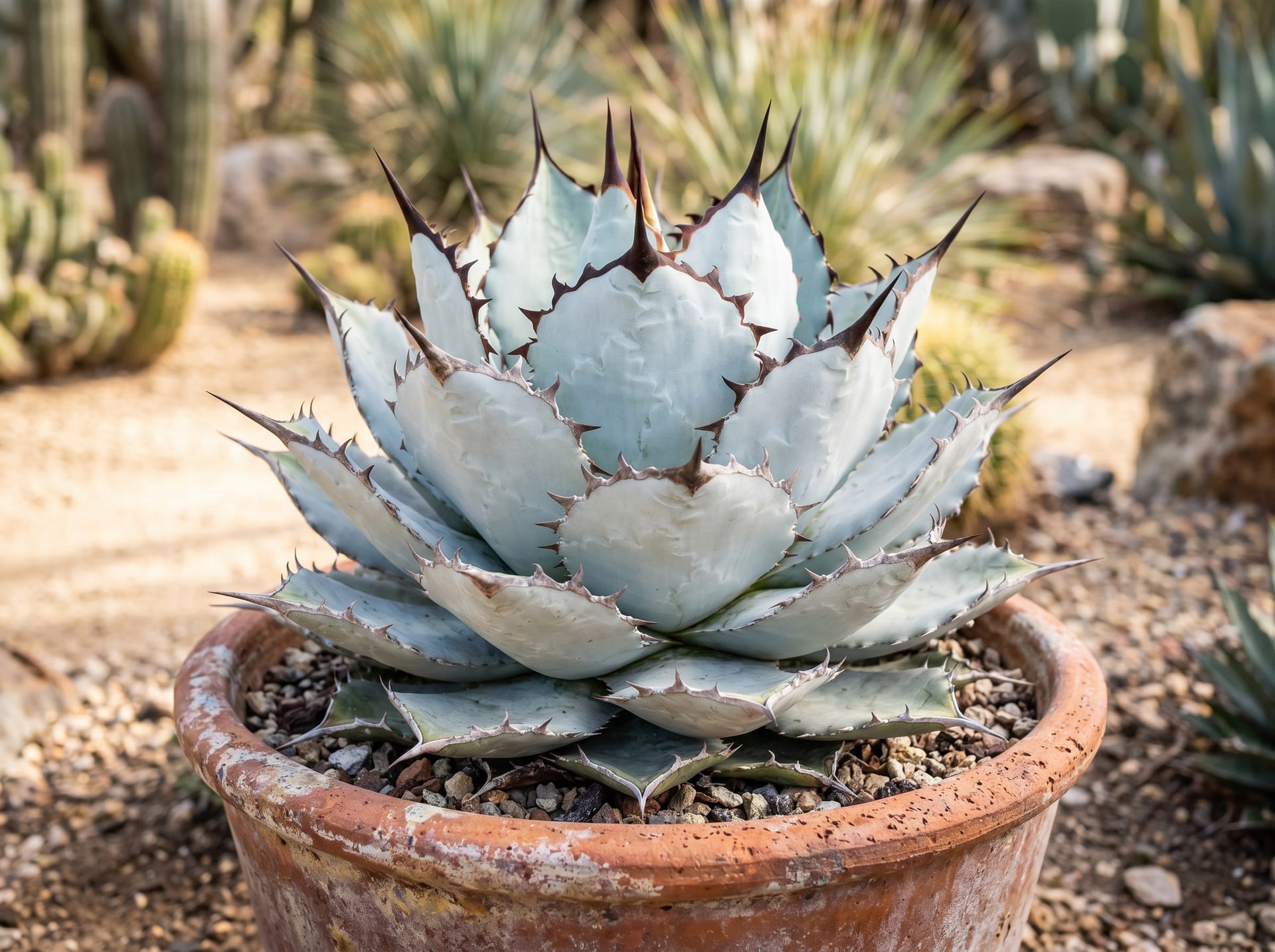
Agave Titanota FO-076
Agave titanota 'FO-076'
One of the most iconic locality forms circulated under the name Titanota, described in 2019 as the new species Agave oteroi. The name derives from Felipe Otero's collection number. Dense white teeth and compact form make it highly popular. Selected specimens command premium prices.
Related Content
Agave FAQ
- How much do agave cost?
- Small Titanota seedlings cost 2,000-10,000 yen, medium plants 10,000-50,000 yen, and select or rare varieties like Hakugei and Caesar can exceed 100,000 yen. Prices vary greatly by variety and condition.
- Can beginners grow agave?
- Agaves are drought-tolerant and hardy, making them easy for beginners. Place in a sunny spot with well-draining soil, and they're quite hard to fail with.
- What are the key points for growing agave?
- Sunlight, airflow, and drainage are the three essentials. Provide direct sunlight, use pumice or akadama-based soil, and water only when the pot is completely dry.
- What should I check when buying agave?
- Check whether it's rooted, leaves are developing healthily, and lower leaves aren't excessively dried. Imported bare-root plants require root establishment, so beginners should start with rooted domestically grown seedlings.
- How long do agave live?
- Agaves grow over decades and bloom only once in their lifetime before dying. However, they produce offsets, so with proper care you can enjoy them across generations.