Low-Maintenance Aquascapes with Shade-Loving Aquatic Plants Only
Introduces types of shade-loving aquatic plants that grow without CO2 injection and in low light, plus low-maintenance management methods for maintaining beautiful aquascapes with minimal effort.
Key Takeaways
Introduces types of shade-loving aquatic plants that grow without CO2 injection and in low light, plus low-maintenance management methods for maintaining beautiful aquascapes with minimal effort.
Related Species
Many people are interested in planted aquascapes but worried about the hassle of installing CO2 injection equipment and frequent trimming. With a low-maintenance aquascape centered on shade-loving plants, you can enjoy beautiful underwater landscapes even without CO2 injection and in low light. For those who want to learn more about aquatic plants that can be grown without CO2 injection, please also see Beginner-Friendly Aquatic Plants That Grow Without CO2 Injection.
What Are Shade-Loving Aquatic Plants?
Shade-loving aquatic plants are a general term for aquatic plants that can photosynthesize even in low light. In nature, they grow in the shade of large trees or in deep water areas and do not require strong light. In exchange for slow growth, they are robust and require minimal trimming—their greatest advantage.
Characteristics of Shade-Loving Aquatic Plants
- Grow without CO2 injection (growth accelerates if added)
- Sufficient with low to moderate light intensity
- Slow growth requires infrequent trimming
- Hardy and difficult to kill even for beginners
- Many types can attach to driftwood or rocks
Recommended Shade-Loving Aquatic Plants
Here are shade-loving aquatic plants suitable for low-maintenance aquascapes.
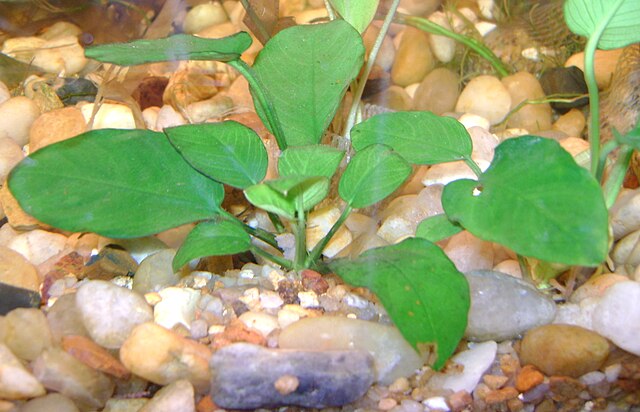
Anubias Nana The most readily available and easiest to grow shade-loving aquatic plant. It features thick, dark green leaves and is used by attaching it to driftwood or rocks. Growth is extremely slow, but this also means minimal maintenance effort. However, algae easily attaches to the leaves, so combining it with algae-eating creatures like shrimp is recommended. Varieties like Petite Nana and Golden are also attractive.
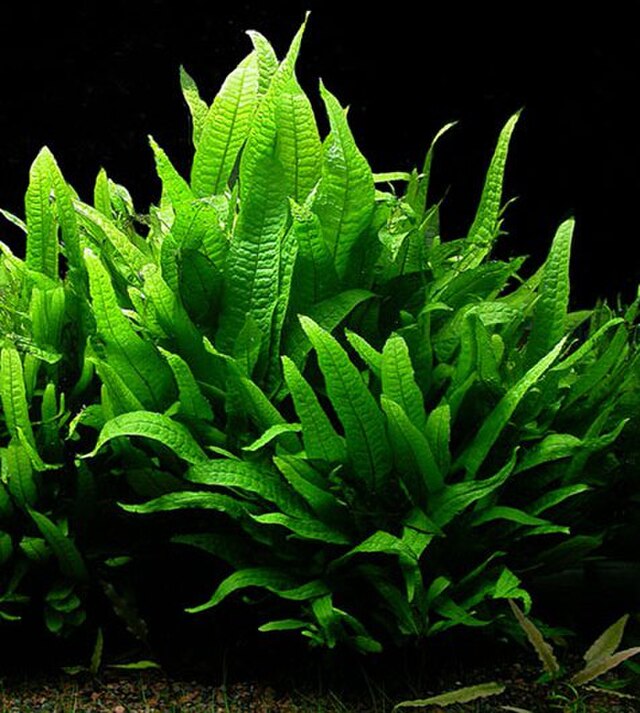
Microsorum A fern relative with beautiful, delicate leaves that appear to flow gracefully. When attached to driftwood, it creates a natural atmosphere. It has many varieties such as Windelov, Trident, and Pteropus, allowing you to enjoy variations in leaf shapes. Its unique reproduction method, where plantlets develop on the underside of leaves, is also characteristic.
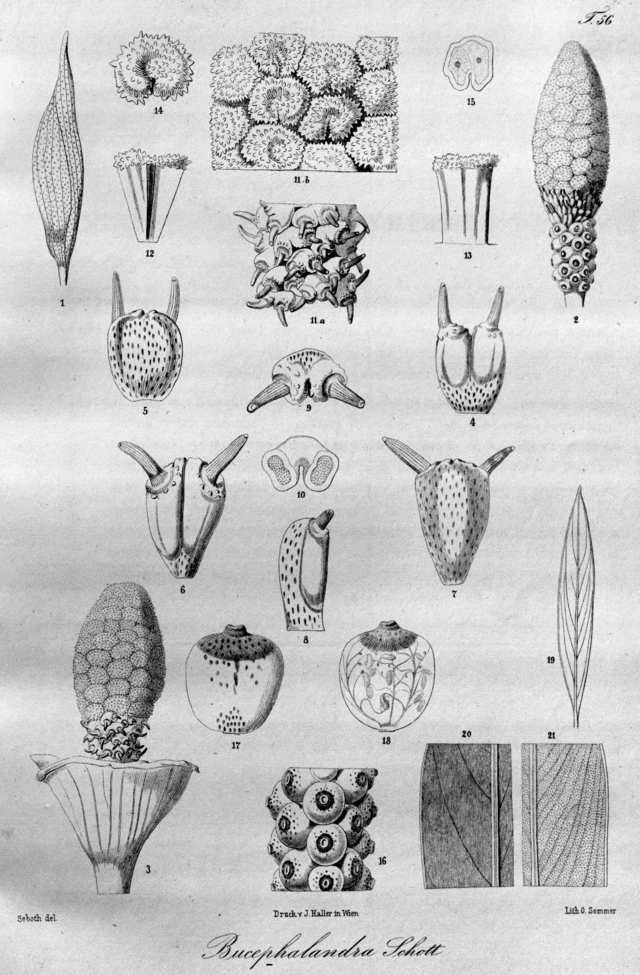
Bucephalandra A popular aquatic plant native to Borneo. The small leaves have a metallic sheen and glitter-like sparkle, which is their greatest appeal. With numerous varieties, it is highly collectible. Growth is extremely slow and its attachment strength is strong, so once positioned, it requires almost no maintenance. Rarer attached-species varieties are also featured in Rare Attached-Species Aquatic Plants Besides Anubias, Bucephalandra, and Willow Moss.
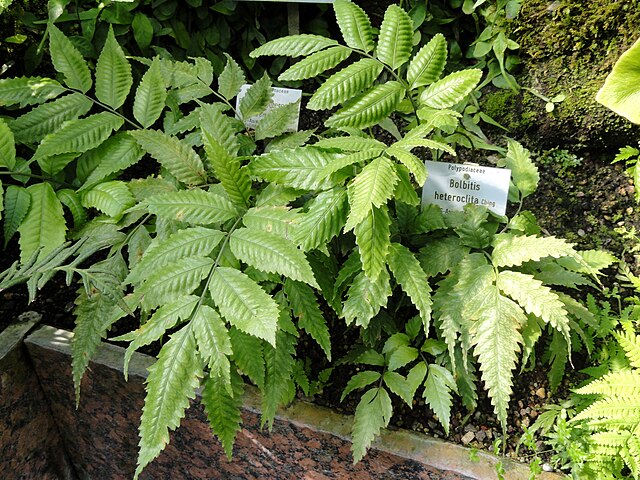
Bolbitis Heudelotii An African fern featuring translucent, dark green leaves. It attaches well to driftwood, and wrapping it around large pieces creates a striking layout. It prefers water flow and grows better when placed near filter discharge.
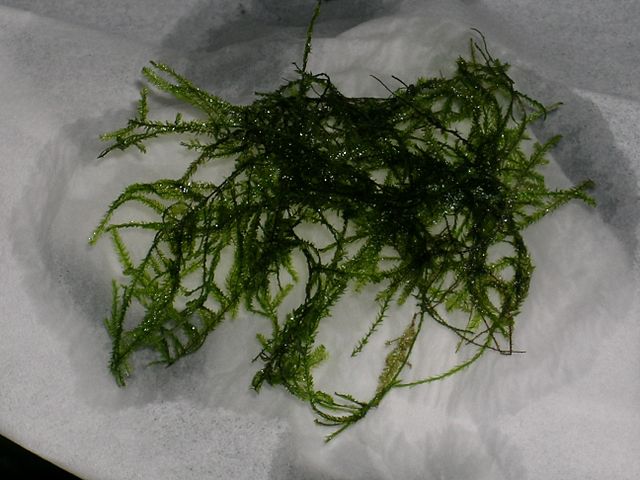
Willow Moss and South American Willow Moss A moss that attaches to driftwood or rocks by wrapping around them. It is a versatile player that creates a natural forest atmosphere. South American Willow Moss features triangular leaves that develop in an orderly pattern, creating a neater appearance. It also serves as a hiding place for shrimp, making it ideal for shrimp tanks.
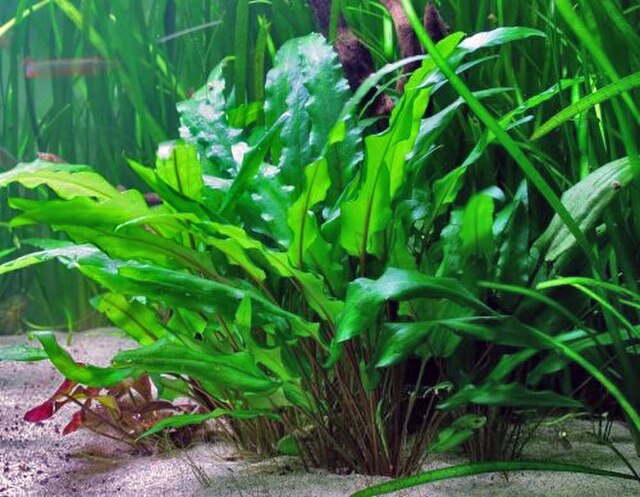
Cryptocoryne An aquatic plant native to Southeast Asia with a distinctive form, developing leaves from the base of the plant. It has numerous types such as Wendtii, Beckett, and Lutea, with leaf colors ranging from green to brown and red. It is a substrate-planting type but grows well even in low light.
Layouts for Low-Maintenance Aquascapes
Here are tips for layouts that make the most of shade-loving plants' characteristics.
Make Driftwood the Star Since most shade-loving plants attach to driftwood, the basic style is to position attractive driftwood as the framework of the aquascape and wrap plants around it. The choice of driftwood greatly affects the overall impression, so select pieces with good branching.
Create Height Variation Placing Bolbitis or Microsorum in the background, Anubias in the midground, and Anubias Petite Nana or Willow Moss in the foreground creates natural height variation. Cryptocoryne can be planted in the substrate and used as natural foreground vegetation.
Combining with Rock Arrangements Anubias and Bucephalandra can attach not only to driftwood but also to rocks. Combining driftwood and rocks creates more expressive layouts.
Daily Care Tips
Even with low-maintenance setups, basic care is still essential.
Water Changes The standard is a water change of about one-third weekly. Since shade-loving plants consume little nutrition, neglecting water changes causes nutrient buildup and leads to algae. Removing excess nutrients through water changes is key to preventing algae.
Fertilizer Shade-loving plants require little fertilizer, so use liquid fertilizer sparingly. Adding a small amount of potassium and trace elements once a week is sufficient. Excessive fertilization causes algae, so be careful. For detailed guidance on choosing aquatic plant fertilizers and creating an addition schedule, see Choosing Aquatic Plant Liquid Fertilizers and Addition Schedules.
Algae Prevention Since shade-loving plants grow slowly, they are prone to algae attachment on leaves—a weakness. Prevention is possible by introducing appropriate numbers of algae-eating creatures such as Amano shrimp, plecos, or Siamese algae eaters.
Lighting Duration 6-8 hours is sufficient. Extended lighting only increases algae risk, so manage it with a timer.
Tips for Long-Term Maintenance of Low-Maintenance Aquascapes
Here are tips for maintaining low-maintenance aquascapes beautifully over the long term. First, don't neglect regular filter maintenance. For external filters, rinse the filter media and replace the mechanical filter pad about once every 3-6 months. Reduced flow impairs circulation of CO2 and nutrients, causing algae. Clean algae on glass weekly with a scraper to address it early. Neglecting it makes algae stubborn and hard to remove. Over years of management, shade-loving plants can become overgrown. Divide Anubias and Microsorum as needed to maintain layout balance. Also, pay attention to substrate degradation in long-term aquascapes. Within 1-2 years, substrate particles break down and turn to mud, so plan a reset as needed. Since most shade-loving plants are attached types, reset work progresses smoothly by removing driftwood and rocks together. When resetting, simply layer new substrate and return the pre-attached driftwood to quickly restore an attractive aquascape.
Frequently Asked Questions (FAQ)
Q. Can I add fish to a low-maintenance aquascape? A. Of course you can. Small tetras (Neon Tetra, Cardinal Tetra) and rasboras (Boraras species) are recommended. Shrimp (Amano Shrimp, Cherry Shrimp) also help control algae—killing two birds with one stone. Keep the number of creatures minimal and prioritize water quality stability.
Q. Won't an aquascape with only shade-loving plants look plain? A. Shade-loving plants have many distinctive and beautiful varieties, such as Bucephalandra's sparkle, Microsorum's wavy leaves, and Anubias Golden's yellow-green color. With careful layout composition and driftwood selection, you can create visually striking aquascapes that rival stem plants.
Find Shade-Loving Plants on GrowerDirect
GrowerDirect features lineups unique to specialist growers, including pre-attached plants on driftwood and rare Bucephalandra varieties. If you're interested in starting a low-maintenance aquascape, contact a grower to discuss your setup and get recommendations for plant combinations.