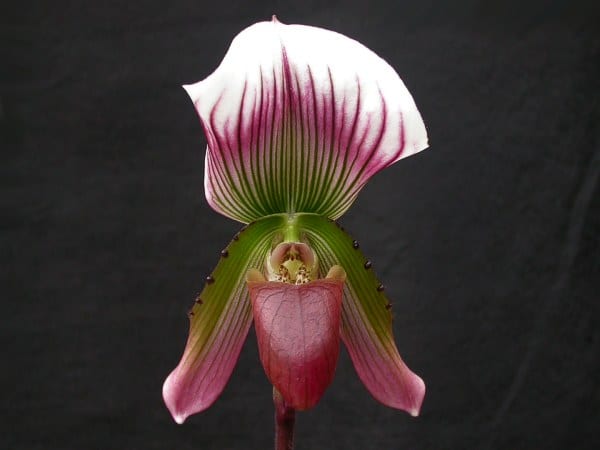
 © Dalton Holland Baptista / CC BY-SA 3.0
Callous Paphiopedilum
Paphiopedilum callosum is a slipper orchid native to the region stretching from Indochina to the northern Malay Peninsula. Its mottled leaves, patterned in light and dark green, stay attractive year-round, and from spring into early summer it sends up a flower stem covered in fine purple hairs, topped with a single bloom measuring roughly 8 to 11 cm across. The rounded pouch and the broad, upward-fanning dorsal sepal give it a quieter, more sculptural presence than many showier orchids. It calls for some intermediate-level know-how to grow well, but as a perennial that can be propagated by division, it's a plant you can keep growing and multiplying for years. Every Paphiopedilum species is listed in CITES Appendix I, which makes it an Internationally Endangered Species under Japan's Act on Conservation of Endangered Species (種の保存法). Transferring a plant within Japan, whether by sale or gift, requires a registration certificate under that Act, and this applies to plants propagated in Japan too. When buying, always confirm that the plant comes with its registration certificate.
View Callous Paphiopedilum encyclopedia →0% commission on your first sales!Register by September 30, 2026 and your first 2 plants are commission-free!
Grower Wanted!
List your plants on GrowerDirect and sell directly to customers nationwide!
6 Transparency Commitments from GrowerDirect
Growers disclose the following information for Orchids listings, guaranteeing transparency on variety, origin, light requirements, and growing difficulty.
- Variety Disclosed
- Real Photos
- Color Specification
- Origin Disclosed
- Light Requirements
- Difficulty Level Disclosed
Browse all 142 varieties
Light Requirements
Growing Difficulty
No listings match your filters
Adjust your filters, or get notified when new listings arrive.
Getting alerts is free with a member account. When new listings match your saved search, we'll notify you by email and in-app.
Browse other categories
Callous Paphiopedilum key facts
- Growing Difficulty
- Intermediate
- Lifespan
- Perennial that can be kept for many years by division (little data on lifespan)
- Size
- Leaves 10-20 cm; flower stem 12-25 cm; flowers 8-11 cm across
- Watering
- Dilute liquid fertilizer year round
- Light & Placement
- It likes quite deep shade; keep it out of direct sun in bright to moderate shade.
- Watering
- Water evenly all year and keep humidity high.
- Temperature & Overwintering
- Mean temperatures in its habitat are about 19-24 °C. Keep it indoors somewhere warm in winter.
- Soil & Repotting
- In the wild it roots in deep leaf litter. Pot it in a mix that holds moisture yet stays airy, and repot after flowering.
- Fertilizer
- Feed dilute liquid fertilizer evenly year round.
- Pests & Cautions
- As an Appendix I species, always check the registration certificate under the Act on Conservation of Endangered Species when acquiring a plant.
About Callous Paphiopedilum
Paphiopedilum callosum is an intermediate-level slipper orchid from Indochina, prized for mottled leaves and a single 8-11cm bloom on a purple-haired stem. A perennial you can propagate by division over time.
7 things to know before growing Callous Paphiopedilum
1Bright Shade, Not Direct Sun
Paphiopedilum callosum dislikes strong direct sun and prefers soft, filtered light, similar to what passes through a sheer curtain. If you keep it outdoors, choose a spot with dappled shade, such as under a bench, rather than full sun. Leaf scorch can also disturb the mottled leaf pattern, so it's worth being careful about placement.
2Water Before It Dries Out
Water thoroughly once the surface of the potting mix starts to dry, letting water run out through the drainage holes. The plant likes humidity but dislikes sitting in constantly soggy mix, which can lead to root rot, so aim for a balance between the two. Growth slows in winter, so you can space out watering a bit more during that season.
3Choose a Moisture-Retentive, Airy Mix
In the wild, this terrestrial orchid grows along forest streams, rooting into thick layers of leaf litter. Pot it in a mix that holds moisture while still letting air reach the roots, and keep humidity high. Because the mix breaks down over time, plan on refreshing it through periodic repotting.
4Repotting Schedule
Repot as the mix breaks down and the plant grows. The best time is after flowering has finished. Once a plant has filled out, repotting is also a good opportunity to divide it and increase your stock.
5Adjust Care by Season
From spring into early summer, the plant sends up a flower stem covered in fine purple hairs and comes into bloom. Strong direct sun and stagnant humidity in summer, along with cold and dryness in winter, can both weaken the plant, so adjusting its position and airflow with the seasons is key to growing it successfully long term.
6Divide to Keep It Going
As a perennial, Paphiopedilum callosum can be divided once it forms a substantial clump, letting you keep cultivating it across generations over a long period. Divide only once the plant is well established, and make sure each division retains several growths.
7What to Look for in a Plant
When choosing a plant, look for mottled leaves free of significant damage or yellowing, with a firm base where the leaves meet. As an Appendix I species, it must come with a registration certificate under Japan's Act on Conservation of Endangered Species (種の保存法), so always confirm the certificate when acquiring one.
Frequently asked questions about Callous Paphiopedilum
- Q.Is this orchid suitable for beginners?
- A.Paphiopedilum callosum is generally considered an intermediate-level orchid, requiring a bit more attention than some easier houseplants. If you get the hang of watering and placement, it's entirely possible to grow it successfully while building experience. Start by following the basic care guidelines carefully.
- Q.How large does the plant get?
- A.The leaves reach roughly 10 to 20 cm in length, and the flower stem grows to about 12 to 25 cm. A single bloom, around 8 to 11 cm across, opens at the tip of the stem. Since it stays fairly compact in a pot, it's an easy size to manage indoors.
- Q.When and how often does it bloom?
- A.It blooms from spring into early summer, producing a single flower at the tip of a stem covered in fine purple hairs. How often it flowers depends on how well-established the plant is, so building up a healthy, mature plant supports more consistent yearly blooming.
- Q.Does the mottled leaf pattern always look the same?
- A.The leaves show a mottled pattern of light and dark green, but its appearance can shift depending on lighting conditions and the plant's overall condition. Leaf scorch from strong direct sun can disrupt the pattern, so it's worth being mindful of where you place the plant.
- Q.Is it better to grow it indoors or outdoors?
- A.It can be grown either indoors or outdoors, as long as you can keep it out of direct sun. Outdoors, a shaded spot such as under a bench works well; indoors, a bright spot behind a sheer curtain is a good choice. Adjusting for cold and dryness as the seasons change is also important.
Handy Growing Tools for Callous Paphiopedilum
Learn more about Callous Paphiopedilum in the encyclopedia
View Callous Paphiopedilum encyclopedia entry →
Care difficulty, size, origin and light needs — all basics covered.
More in this category
Can't find the plant you're looking for?
Post your wishes for free and growers with matching plants will contact you with introductions.