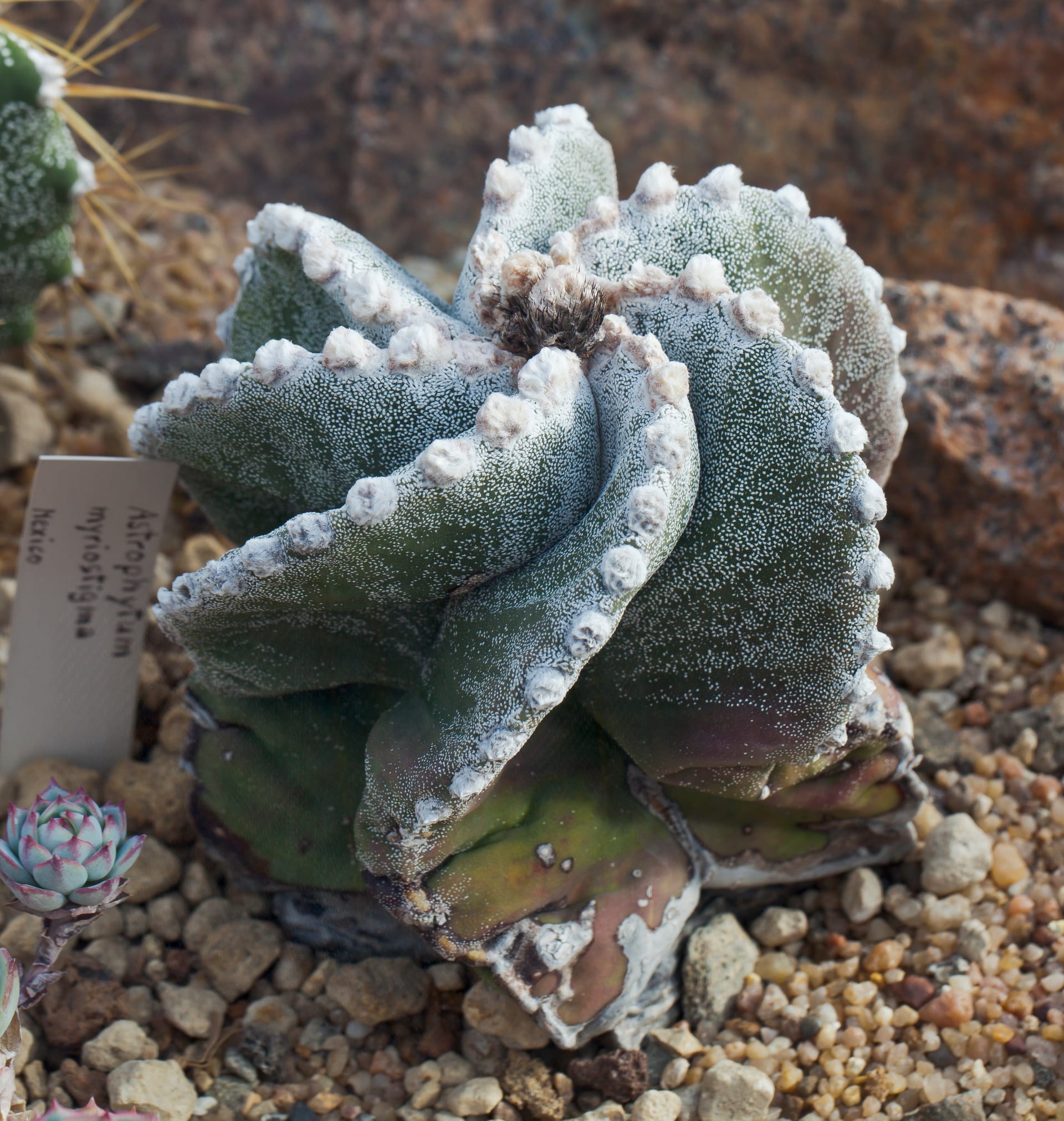
 © Diego Delso / CC BY-SA 3.0
Bishop's cap
Bishop's cap (Astrophytum myriostigma, called Ranpogyoku in Japan) is a spineless cactus that forms a star when seen from above. It usually has five ribs, and its skin is scattered with tiny white flecks, which are woolly scales, giving it a clean, speckled look. Forms with different rib counts and speckling, such as the three-ribbed and four-ribbed types, add to the fun of choosing one. It is sturdy, rated beginner-friendly, and a popular entry-level star cactus. It stays single-headed and, over the years, grows into a column, reaching 70 cm to 1 m tall and 10 to 20 cm across as a mature plant.
View Bishop's cap encyclopedia →0% commission on your first sales!Register by September 30, 2026 and your first 2 plants are commission-free!
Grower Wanted!
List your plants on GrowerDirect and sell directly to customers nationwide!
6 Transparency Commitments from GrowerDirect
Grower disclose this information for Succulents & Cacti. We guarantee transparency in variety, origin, light requirements, and difficulty level.
- Variety Disclosed
- Real Photos
- Color Details
- Origin Disclosed
- Light Requirements
- Difficulty Level
Browse all 131 varieties
Light Requirements
Difficulty Level
No listings match your filters
Adjust your filters, or get notified when new listings arrive.
Getting alerts is free with a member account. When new listings match your saved search, we'll notify you by email and in-app.
Browse other categories
Verified growers (preview)
Are you growing succulents & cacti?
Register as a grower and connect with buyers directly.
Apply as a growerBishop's cap key facts
- Growing Difficulty
- Beginner-friendly
- Lifespan
- Perennial; stays solitary and becomes columnar over many years
- Size
- 70 cm–1 m tall, 10–20 cm across (mature)
- Watering
- Light feeder; slow-release organic fertiliser mixed in at repotting
- Light & Placement
- From spring to autumn keep it outdoors under cover or in a cold frame; in winter in a greenhouse or sunny room. Long periods in low light make it stretch.
- Watering
- A summer grower. Water thoroughly when the mix dries; in winter just moisten it about twice a month.
- Temperature & Overwintering
- A Japanese reference gives 3°C as the minimum survival temperature. Watch for sunburn when moving it outdoors after winter or during sunny breaks in the rainy season.
- Soil & Repotting
- Use a free-draining cactus mix and repot every 2–3 years, adding a little slow-release organic fertiliser.
- Propagation
- Raised from seed; it rarely produces offsets.
- Pests & Cautions
- Scale insects are uncommon, but plants left unrepotted for years can become infested and lose condition.
About Bishop's cap
Bishop's cap is a spineless, star-shaped cactus with white-flecked skin. Learn its traits and the basics of light, watering and repotting for beginners.
7 things to know before growing Bishop's cap
1A bright, airy spot
Bishop's cap loves sun, and it stays compact and firm when grown outdoors in full sun or on a bright windowsill. Too little light makes it stretch and lose its shape, so give it plenty of brightness. If you move it from a winter indoor spot straight into strong direct sun, the skin can scorch, so acclimate it gradually.
2Water only when dry
Water thoroughly until it drains from the bottom, but only after the soil has dried out completely. Too much moisture invites root rot, so don't top up while the soil is still damp. Pour water at the base rather than over the plant, which helps keep the white flecks clean.
3Fast-draining soil
A commercial cactus and succulent mix is easy to use, and blending in akadama or pumice for extra drainage is a common approach. Soils rich in organic matter hold moisture longer, so go light on them. A pot with a drainage hole, such as unglazed terracotta, suits it well.
4Repot in spring
When the roots fill the pot, repot into a slightly larger one in spring, at the start of the growing season. Roots are disturbed at repotting, so hold off watering for a few days afterward. Because it grows into a single column, a heavy, stable pot helps prevent tipping as it gets taller.
5Seasonal care
Bishop's cap is a summer grower, with its growing season from spring to autumn. During that time give it plenty of sun and water thoroughly whenever the soil dries. Keep it outdoors out of the rain in an airy spot, or in a simple greenhouse, from spring to autumn; in winter move it to a greenhouse or a sunny room and water only about twice a month, just enough to lightly moisten the soil. Watch for sunburn when moving it outdoors after winter and during sunny breaks in the rainy season.
6How to choose a plant
Look for a firm body with white flecks evenly spread, and no dents, soft spots or brown, discolored wounds. Check that the growing point at the top is undamaged. Rib count and speckling vary by form, including the three-ribbed and four-ribbed types, so you can choose by preference.
7Protect the white flecks
The white flecks are woolly scales that can rub off or be marked by water spots. It has no spines, so it is easy to handle, but move it by the pot and avoid touching the plant itself too often. Damaged spots stand out, so careful handling is the key to keeping it looking clean.
Frequently asked questions about Bishop's cap
- Q.Is Bishop's cap easy for beginners?
- A.Yes. It is rated beginner-friendly and is known as a sturdy, entry-level star cactus. Give it sun and good airflow and avoid overwatering, and the basic care is not difficult.
- Q.How big does it get?
- A.It stays single-headed and, over the years, grows into a column. A mature plant reaches 70 cm to 1 m tall and 10 to 20 cm across. Growth takes years, so you can simply move up in pot size gradually as the plant grows.
- Q.How do the three- and four-ribbed types differ?
- A.They are forms whose rib count and white speckling differ from the usual five-ribbed plant, which gives you more variety to choose from. Whichever you pick, start with the same basics: plenty of sun, well-drained soil, and letting the soil dry between waterings.
- Q.Can I grow it on an indoor windowsill?
- A.Yes, as long as the spot is bright, such as a sunny window. Low light makes it stretch and lose its shape, so putting it outdoors on good days is ideal if you can. In winter, keep it away from frost and cold drafts.
- Q.How often should I water it?
- A.There is no fixed schedule. As a summer grower, water thoroughly whenever the soil dries during the spring-to-autumn growing season, and in winter water only about twice a month, just enough to lightly moisten the soil. It is best to pour at the base rather than over the plant.
Handy Growing Tools for Bishop's cap
Learn more about Bishop's cap in the encyclopedia
View Bishop's cap encyclopedia entry →
Care difficulty, size, origin and light needs — all basics covered.
More in this category
Can't find the plant you're looking for?
Post your wishes for free and growers with matching plants will contact you with introductions.