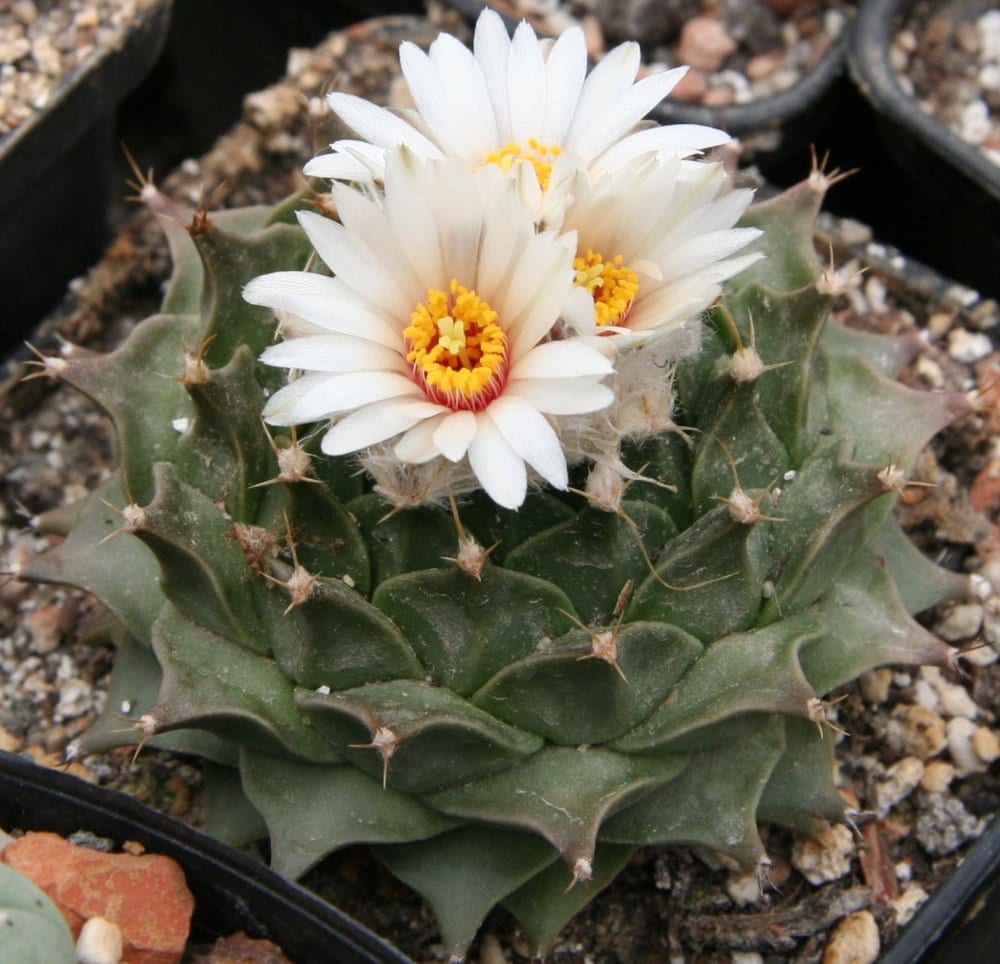
 © Michael Wolf / CC BY 2.5
Artichoke cactus
Teikan, the artichoke cactus, grows triangular, leaf-like tubercles in a tight spiral, giving it the look of an artichoke or an upside-down pine cone. It is the only species in its genus, with a woolly crown and white flowers in summer. Mature plants reach 15 cm or more across and grow flat, close to ground level rather than tall. It is a long-lived perennial, but its difficulty is rated for experienced growers, and it takes seven to eight years to bloom. It suits people who enjoy patiently raising a slow-growing plant. It is listed in CITES Appendix I and is an Internationally Endangered Species under Japan's Act on Conservation of Endangered Species (種の保存法), so transferring a plant within Japan requires a registration certificate under that Act, including for plants propagated in Japan. In principle, plants without a certificate cannot be sold, transferred, or displayed or advertised for sale, so always confirm the certificate when buying.
View Artichoke cactus encyclopedia →0% commission on your first sales!Register by September 30, 2026 and your first 2 plants are commission-free!
Grower Wanted!
List your plants on GrowerDirect and sell directly to customers nationwide!
6 Transparency Commitments from GrowerDirect
Grower disclose this information for Succulents & Cacti. We guarantee transparency in variety, origin, light requirements, and difficulty level.
- Variety Disclosed
- Real Photos
- Color Details
- Origin Disclosed
- Light Requirements
- Difficulty Level
Browse all 133 varieties
Light Requirements
Difficulty Level
No listings match your filters
Adjust your filters, or get notified when new listings arrive.
Getting alerts is free with a member account. When new listings match your saved search, we'll notify you by email and in-app.
Browse other categories
Verified growers (preview)
Are you growing succulents & cacti?
Register as a grower and connect with buyers directly.
Apply as a growerArtichoke cactus key facts
- Growing Difficulty
- Advanced
- Lifespan
- Long-lived perennial (little published data on lifespan); takes 7-8 years to flower
- Size
- 15 cm or more across, growing flat and level with the ground
- Watering
- Very little fertiliser
- Light & Placement
- It needs good sun to stay compact and flat. Keep it well ventilated at all times, including the rest period, somewhere that does not trap humidity.
- Watering
- Cacti are grown much like summer-growing succulents. Water sparingly and infrequently from March to October; too much water makes the stem elongate and lose its natural shape. Keep it completely dry in winter or whenever night temperatures stay below 10°C.
- Temperature & Overwintering
- Kept dry it reportedly survives brief cold to about -4°C, but winter it dry and frost-free. Humid air during dormancy is harmful.
- Soil & Repotting
- Use a very free-draining mineral mix with little organic matter, in a pot deep enough for the thick taproot.
- Propagation
- It is propagated almost only from seed. Seedlings are tiny and slow, reaching only 3-5 mm in their first year or two and taking 7-8 years to reach flowering size; grafting onto columnar stock is often used to speed growth.
- Pests & Cautions
- It is a CITES Appendix I species. Transfers within Japan require a registration certificate under the Act on Conservation of Endangered Species (including plants propagated in Japan), so always confirm the certificate accompanies the plant when buying or receiving one.
About Artichoke cactus
Teikan, the artichoke cactus, is the only species in its genus, with spiralling triangular tubercles. It grows 15 cm or more across and flowers after seven to eight years.
7 things to know before growing Artichoke cactus
1Advanced care, and a registration certificate is required
Teikan is rated for experienced growers. It grows slowly and can suffer if it is watered carelessly. It is listed in CITES Appendix I and is an Internationally Endangered Species under Japan's Act on Conservation of Endangered Species (種の保存法), so any transfer within Japan requires a registration certificate, including for plants propagated in Japan. In principle, plants without a certificate cannot be sold, transferred, or displayed or advertised for sale. Always confirm the certificate when buying.
2Where to place it
Give it bright light and good airflow. Keep it out of the rain, for example under eaves or on a bright windowsill, and shade or move it if intense midsummer sun starts to damage the plant. Because it stays low to the ground, set it on a shelf or stand rather than the floor so air can circulate around it.
3Water only when dry
Water only after the soil has dried out completely. During the warm growing season, give small amounts; cut back as temperatures fall and keep it fairly dry in winter. Pour water at the base rather than over the crown so the woolly top does not stay wet.
4Soil and pot
Use a fast-draining mineral mix with plenty of pumice or similar inorganic grit and little organic matter. It develops a thick root, so choose a pot deep enough to hold it. Go easy on fertilizer.
5Repot with care
Because growth is slow, frequent repotting is unnecessary. Repot only when the roots are crowded or the soil has broken down, and do it in the warm growing season. Work quickly to avoid damaging the thick root, and wait a few days before watering afterwards.
6Seasonal care
In summer, heat and humidity can make the plant stuffy, so keep air moving and shade it on days of harsh sun. In winter, protect it from frost and cold rain and keep it fairly dry in a bright spot indoors. When you resume watering in spring, start with small amounts and watch how it responds.
7Choosing a plant
Look for a firm plant with neat, spiralling tubercles and a healthy woolly crown. Check for discoloration, soft spots, damage, and any wobble at the base, and make sure the plant comes with its registration certificate. Since it takes seven to eight years to bloom, ask the seller about the plant's size and age if flowers matter to you.
Frequently asked questions about Artichoke cactus
- Q.Can a beginner grow it?
- A.Its difficulty is rated for experienced growers. Growth is slow and watering needs care, so it is best to get comfortable with other cacti first.
- Q.When does it flower?
- A.It produces white flowers in summer, but it takes seven to eight years to reach flowering. Young plants will not bloom right away, so be patient.
- Q.How large does it grow?
- A.It reaches 15 cm or more in diameter but stays flat, growing close to ground level rather than tall. When choosing a pot, think about the depth the root needs and the width of the plant rather than height.
- Q.How long does it live?
- A.It is a long-lived perennial, but there is little documentation on its lifespan, so a specific number of years cannot be given. With appropriate care, it can be a long-term companion.
- Q.How should I treat the woolly crown?
- A.The wool is a natural feature of the plant and does not need to be removed. Water trapped in it can dry slowly and lead to damage, so water at the base of the plant instead.
Handy Growing Tools for Artichoke cactus
Learn more about Artichoke cactus in the encyclopedia
View Artichoke cactus encyclopedia entry →
Care difficulty, size, origin and light needs — all basics covered.
More in this category
Can't find the plant you're looking for?
Post your wishes for free and growers with matching plants will contact you with introductions.