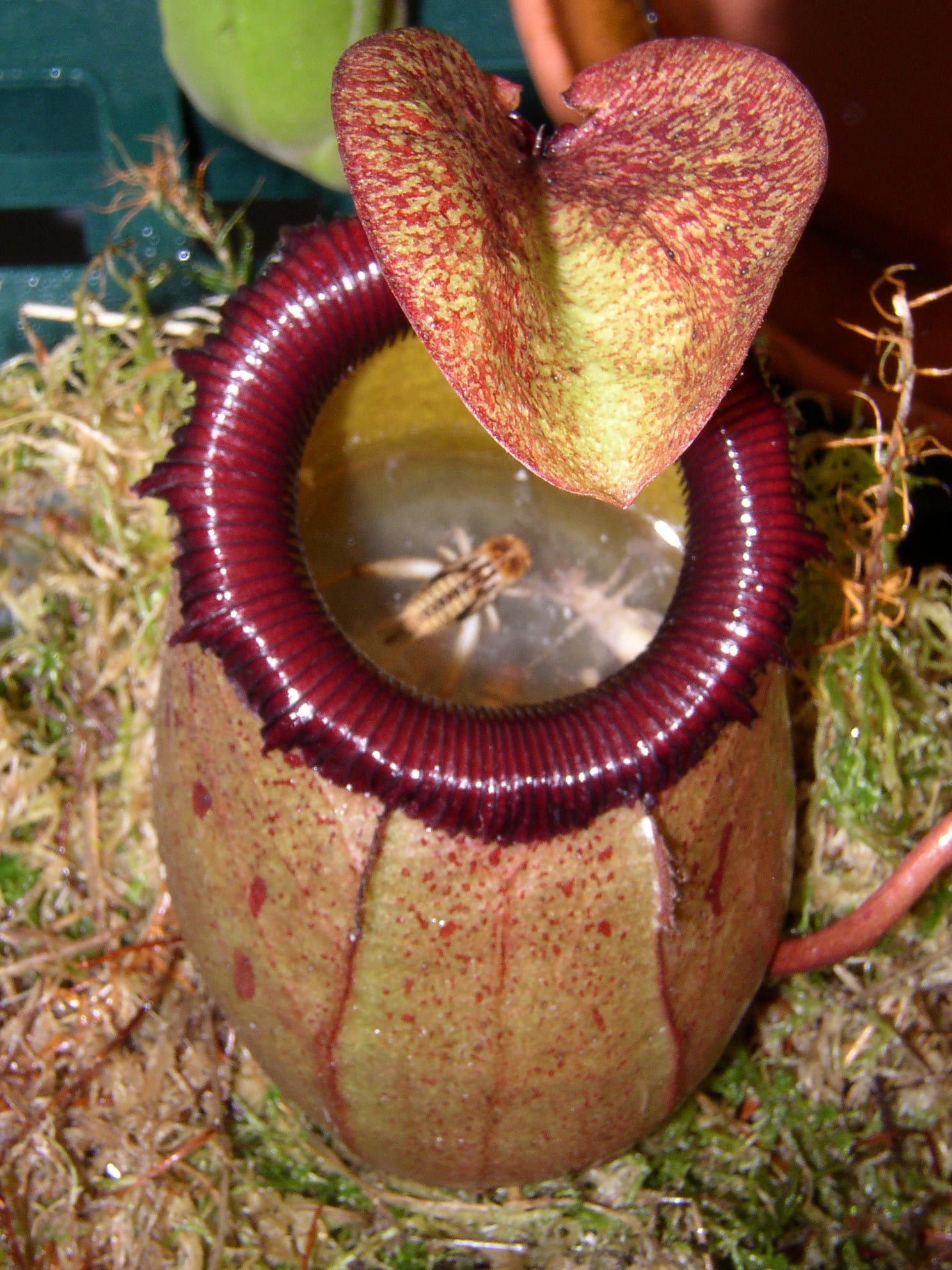
 © en:User:NepGrower / Public domain
Nepenthes sibuyanensis
Nepenthes sibuyanensis is a highland pitcher plant found only in the mountains of Sibuyan Island in the Philippines. Its pitchers ripen from yellow to red in an egg-shaped form, with the largest reaching up to 26 cm in height, and are crowned by a broad, near-black deep red peristome that gives the plant its striking look. A perennial with a weakly climbing habit, its stems can eventually reach around 1.5 meters. Restricted to Sibuyan Island's limited highland habitat, it is listed as Vulnerable on the IUCN Red List. Because it demands the specific conditions highland Nepenthes need, it is generally considered a plant for experienced growers.
View Nepenthes sibuyanensis encyclopedia →0% commission on your first sales!Register by September 30, 2026 and your first 2 plants are commission-free!
Grower Wanted!
List your plants on GrowerDirect and sell directly to customers nationwide!
6 Transparency Commitments from GrowerDirect
Every Grower listing discloses variety, origin, light requirements, and difficulty level for Carnivorous Plants. Complete transparency, guaranteed.
- Variety Disclosed
- Real Photos
- Color Information
- Origin Disclosed
- Light Requirements
- Difficulty Level
Browse all 145 varieties
Light Requirements
Difficulty Level
No listings match your filters
Adjust your filters, or get notified when new listings arrive.
Getting alerts is free with a member account. When new listings match your saved search, we'll notify you by email and in-app.
Browse other categories
Are you growing carnivorous plants?
Register as a grower and connect with buyers directly.
Apply as a growerNepenthes sibuyanensis key facts
- Growing Difficulty
- Advanced
- Lifespan
- Perennial (weak climber)
- Size
- Pitchers up to 26 cm tall and 15 cm wide; stems about 1.5 m
- Watering
- Very dilute fertilizer at most (catches insects)
- Temperature & Overwintering
- A highland species that needs cool nights to thrive long term; warm Japanese summer nights are the main challenge.
- Light & Placement
- Likes bright light, but wild pitchers sit among grass and moss out of direct sun; grow it in bright part shade, not harsh sun.
- Watering
- Use rain water or water low in dissolved minerals and water before the mix dries out. Do not leave the pot standing in water; a free-draining mix keeps the roots healthy.
- Soil & Repotting
- Plant in a free-draining, airy mix; pure sphagnum or orchid mix with sphagnum or perlite are common choices.
- Fertilizer
- If using chemical fertilizer, use it at very low strength; an occasional insect dropped into a pitcher is enough.
- Pests & Cautions
- Vulnerable on the IUCN list and confined to one island; buy only seed-grown or tissue-cultured plants.
About Nepenthes sibuyanensis
A highland pitcher plant endemic to Sibuyan Island, Philippines. Its egg-shaped pitchers reach up to 26 cm, with a broad, near-black deep red peristome — a perennial vine best suited to experienced growers.
7 things to know before growing Nepenthes sibuyanensis
1Bright, Indirect Light
Give it bright light rather than harsh direct sun, such as through a sheer curtain. Good airflow helps prevent the stress that comes with stagnant, humid air.
2Keep the Medium Consistently Moist
Water thoroughly before the growing medium dries out completely. It is sensitive to drying out, so keep a close eye on moisture during the growing season.
3Use a Well-Draining Mix
A mix of sphagnum moss and perlite balances drainage with moisture retention well. Choosing a low-nutrient medium also helps protect its delicate roots.
4Repot With Care for the Roots
Nepenthes have fine, delicate roots that are easily damaged during repotting. Avoid repotting during slow-growth periods and work quickly during the warmer months instead.
5Cool Nights Matter Through Summer
As a highland species, it struggles through prolonged summer heat and humidity. Providing good airflow, some shade, and cooler nighttime temperatures helps it get through the season.
6Choose a Plant With Healthy Pitchers
Look for a plant that is actively producing pitchers, since that is a good sign of overall condition. Peristome coloring and leaf firmness are also useful indicators of health.
7Keep Humidity on the Higher Side
Highland Nepenthes tend to form pitchers better in humid conditions. Misting or using a humidifier helps keep the air around the plant moist. Don't leave water standing in the saucer, though, so the roots don't stay soggy.
Frequently asked questions about Nepenthes sibuyanensis
- Q.Is this a good plant for beginners?
- A.Nepenthes sibuyanensis is considered one of the more demanding highland Nepenthes and is best suited to experienced growers. It is a good idea to build up experience with temperature and humidity control before taking it on.
- Q.How large does it grow?
- A.Its pitchers can reach up to about 26 cm in height and 15 cm in width. The stem has a climbing habit and can eventually reach around 1.5 meters.
- Q.How should I care for it in winter?
- A.As a highland species, it does best in cool conditions while avoiding sudden temperature drops. Pay attention to light levels too, since daylight hours shorten during this season.
- Q.Why isn't it forming pitchers well?
- A.Low humidity or insufficient light are the most common causes. Keeping humidity on the higher side and providing bright conditions tends to encourage better pitcher formation.
- Q.What does its climbing habit mean?
- A.It means the stem elongates and leans on nearby structures as it grows. Using a support or growing it as a hanging plant makes it easier to manage its shape.
Handy Growing Tools for Nepenthes sibuyanensis
Learn more about Nepenthes sibuyanensis in the encyclopedia
View Nepenthes sibuyanensis encyclopedia entry →
Care difficulty, size, origin and light needs — all basics covered.
More in this category
Can't find the plant you're looking for?
Post your wishes for free and growers with matching plants will contact you with introductions.