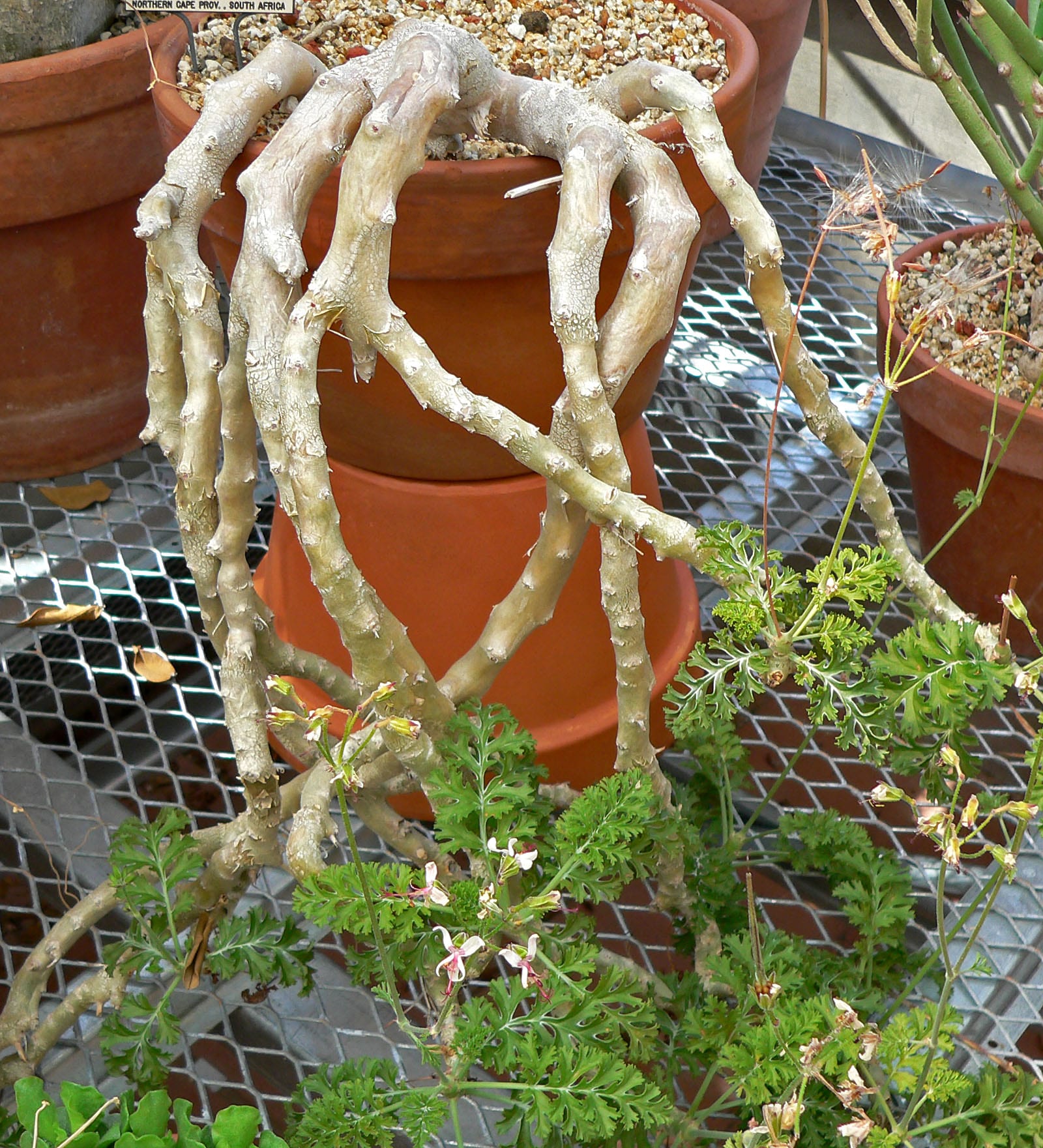
 © Stan Shebs / CC BY-SA 3.0
Pelargonium carnosum
Pelargonium carnosum may not match the image of a typical bright-flowered pelargonium — its appeal lies elsewhere. Known in Japanese as "Kareno-aoi," it forms thick, gnarled, grey-green succulent stems topped with soft, finely divided, fern-like leaves, giving it the sculptural character prized among caudiciform plants. Native to southern Africa, it follows a winter-growing cycle: active during the cooler months and dormant, leafless, through summer. A slow-growing, long-lived perennial, it rewards patient growers as its form develops character over the years — a plant best suited to those with some succulent-growing experience.
View Pelargonium carnosum encyclopedia →0% commission on your first sales!Register by September 30, 2026 and your first 2 plants are commission-free!
Grower Wanted!
List your plants on GrowerDirect and sell directly to customers nationwide!
6 Transparency Commitments from GrowerDirect
Our Grower disclose all key information for Caudex Plants listings, ensuring complete transparency on variety, origin, light needs, and difficulty.
- Variety Disclosed
- Real Plant Photos
- Color Details
- Origin Disclosed
- Light Requirements
- Difficulty Level
Browse all 146 varieties
Light Requirements
Difficulty Level
No listings match your filters
Adjust your filters, or get notified when new listings arrive.
Getting alerts is free with a member account. When new listings match your saved search, we'll notify you by email and in-app.
Browse other categories
Verified growers (preview)
Are you growing caudex plants?
Register as a grower and connect with buyers directly.
Apply as a growerPelargonium carnosum key facts
- Growing Difficulty
- Advanced
- Lifespan
- Long-lived perennial (little published data)
- Size
- About 60 cm tall (up to 1.2 m)
- Watering
- Once per growing season, a diluted low-nitrogen succulent fertiliser
- Dormancy Care
- A winter grower that drops its leaves and rests in summer. Water in spring (February to April) and autumn (August to November), and keep it dry in midsummer and midwinter.
- Light & Placement
- In the wild it grows among rocks and in the shade of other plants, so in summer give it light shade or morning sun in a cool, well-ventilated spot.
- Watering
- Water only when temperatures are at least 14°C. Overwatering spoils its shape and the lush growth becomes prone to fungal disease.
- Temperature & Overwintering
- Protect from frost and keep it dry at a minimum of 8°C.
- Soil & Repotting
- Use a mix with almost no organic matter. It dislikes frequent repotting and can stay in the same pot for years.
- Fertilizer
- Feed only once in the growing season with a low-nitrogen succulent fertiliser at reduced strength.
About Pelargonium carnosum
Pelargonium carnosum is a winter-growing caudiciform succulent from southern Africa, prized for its thick grey-green stems and finely divided soft leaves. It sheds its leaves and goes dormant in summer.
7 things to know before growing Pelargonium carnosum
1Light & Placement
During the autumn-to-spring growing season, give it strong light with good air circulation outdoors or by a bright window. During its leafless summer dormancy, keep it out of direct sun in a spot that won't stay damp.
2Water Sparingly in Spring and Autumn
It is a winter grower that grows from autumn to spring and drops its leaves in summer, but watering is done in spring (February to April) and autumn (August to November), keeping it dry in midsummer and midwinter. Water only when minimum temperatures are at least 14°C. Too much water ruins its naturally compact shape and makes lush foliage prone to disease, so err on the sparing side.
3Low-Organic Soil
Use a free-draining mix with almost no organic matter. Limit feeding to one application during the growing season of a low-nitrogen succulent fertilizer, diluted weaker than the label rate.
4Keep Repotting to a Minimum
Pelargonium carnosum dislikes being repotted, so keep it in the same pot for as long as possible. Choosing a free-draining mix and pot from the start makes this easier.
5Summer Leaf Drop Is Normal
As temperatures rise in summer, the plant sheds its leaves and rests as a bare stem. This can look alarming, but it's a normal part of its cycle — there's no need to water more or worry.
6Watch Cold Tolerance in Season
Despite being a winter grower, it's still sensitive to hard frost even during its active autumn-to-spring period. Bring it to a bright spot indoors when temperatures drop sharply.
7Choosing a Healthy Plant
Look for a plant with a thick, firm, grey-green stem showing clear knotted texture. If you're looking during the growing season, well-developed leaves are another good sign of vigor.
Frequently asked questions about Pelargonium carnosum
- Q.All the leaves fell off in summer — is it dying?
- A.No, this is normal dormancy. Pelargonium carnosum is a winter-growing species that sheds its leaves and rests during the hot summer months. As long as the stem stays firm, there's no cause for concern.
- Q.Can it stay outdoors in winter?
- A.Even during its autumn-to-spring growing season, it's sensitive to hard frost. In regions or periods with sharp temperature drops, it's best moved to a bright spot indoors.
- Q.How large does it grow?
- A.It typically reaches about 60cm in height, with larger specimens growing to around 1.2m. Growth is slow, and the plant's character develops gradually over time.
- Q.Is it suitable for beginners?
- A.It's generally considered an advanced-level plant. Getting the winter-growing watering rhythm right takes some practice, so it suits growers who already have experience with succulents or caudiciform plants.
- Q.How often does it need repotting?
- A.It dislikes being repotted, so the basic approach is to keep it in the same pot for as long as possible.
Handy Growing Tools for Pelargonium carnosum
Learn more about Pelargonium carnosum in the encyclopedia
View Pelargonium carnosum encyclopedia entry →
Care difficulty, size, origin and light needs — all basics covered.
More in this category
Can't find the plant you're looking for?
Post your wishes for free and growers with matching plants will contact you with introductions.